
Why Most SME Projects Run Late (And How to Fix It)


Published: 15 June 2026 | Last reviewed: 15 June 2026
For many SMEs, projects rarely fail all at once. They drift. A six-week timeline quietly becomes three months through missed dependencies, unclear ownership, and constant small additions to scope. The reasons are rarely down to one big mistake. Instead, small inefficiencies stack up: vague task ownership, missed dependencies, scope creep, and timelines built more on hope than evidence.
For small and medium-sized businesses, late projects are not just an inconvenience. They tie up staff time, delay revenue, and erode client trust. The good news is that most causes of delay are predictable, and predictable problems can be planned for.
This article looks at the most common reasons SME projects run late, and the practical steps that help keep them on track.
Why Are SME Projects Late So Often?
Larger organisations often have dedicated project management offices, formal governance, and spare capacity to absorb delays. SMEs rarely have that luxury. A single missed deadline can ripple through the whole business, delaying invoicing, straining supplier relationships, or pushing back the next project in the queue.
Understanding why SME projects run late starts with looking honestly at how projects are actually planned, scheduled, and managed day to day, rather than how they are supposed to be managed on paper.
The Most Common Causes of Project Delays
1. Unclear Scope from the Start
Many projects begin with a verbal agreement or a brief email rather than a clear, written scope. Without an agreed definition of what success looks like, it becomes easy for tasks to be added along the way, a pattern often called scope creep.
Each small addition might seem reasonable on its own, but together they can add weeks to a timeline that was never adjusted to account for the extra work.
2. Poor Visibility of Task Dependencies
Most projects are not simple linear lists of tasks. Many tasks depend on others finishing first, such as a design needing sign-off before development can begin, or a supplier delivering materials before installation can start.
A simple website redesign, for example, might depend on client approval of wireframes before development starts. If feedback arrives a week late, developers either sit idle or the entire delivery date shifts. Without dependency mapping, a delay in one task can have a knock-on effect that is not visible until it is too late to plan around it. This is one of the main reasons a single missed deadline can derail an entire schedule.
3. Overoptimistic Timelines
It is common for timelines to be based on best-case scenarios, with no allowance for sickness, holidays, slow client feedback, or simply tasks taking longer than expected. When every task is scheduled back-to-back with no buffer, even a small delay pushes the whole project off course.
4. Lack of a Single Source of Truth
When project information is spread across emails, spreadsheets, sticky notes, and people's memories, it becomes difficult for anyone to see the full picture. Project tracking suffers, and updates do not reliably reach everyone who needs them.
5. No Clear Ownership of Tasks
If a task does not have a named owner with a clear deadline, it tends to fall to the bottom of everyone's list and gets duplicated or quietly dropped. Shared responsibility without individual accountability is one of the quietest, but most common, causes of project drift.
6. Limited Visibility for Decision-Makers
Managers and business owners often only find out a project is running late once the deadline has already passed. Without regular, structured updates, there is no early warning system to flag delivery risk while there is still time to act.
Practical Steps to Keep SME Projects on Track
Map Out Dependencies Before You Start
Before committing to a deadline, take the time to identify which tasks rely on others. A simple dependency map, or a Gantt chart with dependency lines, makes it far easier to spot where a delay in one area will affect the rest of the project.
Build in Realistic Buffers
Add buffer time in proportion to uncertainty: more for tasks with many unknowns, less for routine, well-understood work. This is especially important for tasks that depend on external parties, such as suppliers, contractors, or client approvals.
Use a Critical Path to Focus Attention
Critical path analysis identifies the sequence of tasks that determines the shortest possible project duration. Any delay to a task on the critical path delays the whole project, while delays to other tasks may not matter as much. Identifying this path helps teams focus their attention and resource planning where it counts most.
Keep One Central Project Record
Whether it is a shared planning tool or a single spreadsheet, having one place where tasks, deadlines, owners, and statuses are recorded reduces the risk of things falling through the cracks. Everyone should be able to check the same single source of truth rather than relying on separate notes.
Assign Clear Ownership for Every Task
Every task should have one named person responsible for it, even if multiple people are involved in completing it. Clear ownership makes it obvious who to ask for an update, and makes it far less likely that a task is quietly forgotten.
Review Progress Regularly, Not Just at Deadlines
Short, regular check-ins, whether weekly or fortnightly, give the team a chance to flag problems early. A risk register can help capture potential issues before they become actual delays, giving the team time to respond before delays escalate.
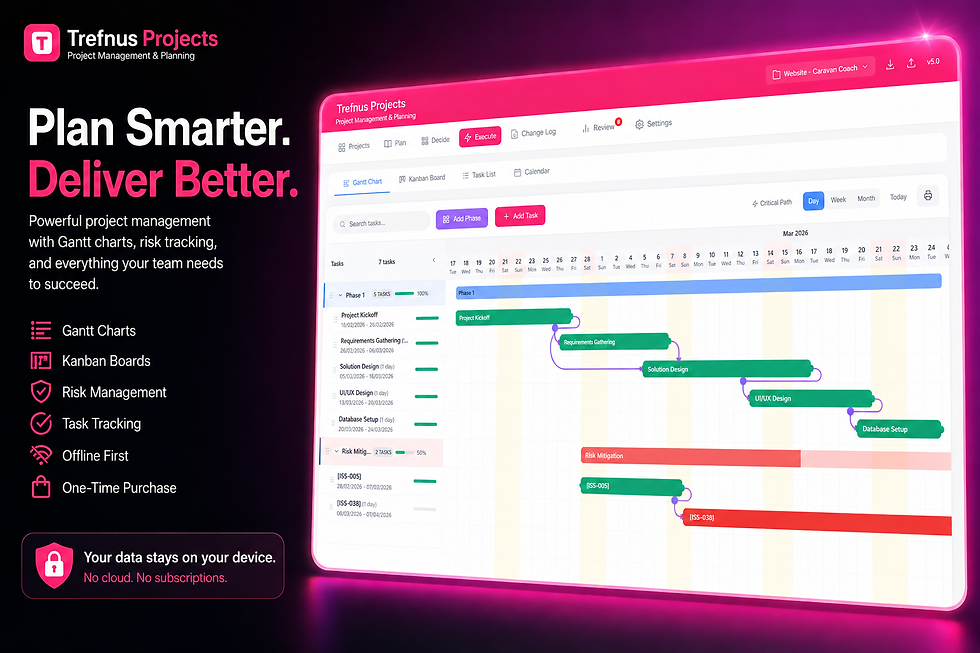
Bring Structure to Your Projects with Trefnus Projects Trefnus Projects is an offline-first project planning software tool built for SMEs. It brings Gantt charts, dependency mapping, critical path highlighting, Kanban boards, and a risk register together in one place, so you can see exactly where a project stands and what needs attention next. Because it works offline and stores data locally, there is no monthly subscription and no reliance on an internet connection to keep your projects moving. Explore Trefnus at: |

Signs a Project Is About to Run Late
Even with good intentions, projects can start slipping quietly.
Watch out for these early warning signs:
Tasks repeatedly waiting on approvals from clients, suppliers, or colleagues
Deadlines moving without any corresponding change in scope
Team members unclear on who owns a task or what 'done' looks like
Project updates spread across multiple tools, chats, and inboxes
If two or more of these sound familiar, it is worth reviewing the project's dependencies, ownership, and schedule before the delay becomes harder to recover from.
Benefits of Tackling Delays Early
Addressing the root causes of late projects brings benefits beyond simply hitting deadlines:
More accurate quoting and pricing for future projects, based on realistic timelines
Improved client relationships, with fewer awkward conversations about missed dates
Better use of staff time, with less firefighting and rework
Clearer visibility for managers, supporting better decisions about resourcing and priorities
Reduced stress for teams, who can plan their workload with more confidence
Frequently Asked Questions
Why do small business projects often take longer than planned?
Small business projects often take longer than planned because timelines are frequently built on best-case assumptions, with little allowance for delays from suppliers, client feedback, staff availability, or unexpected issues. Without mapped dependencies or a critical path, a single delay can quietly push back the whole schedule before anyone notices.
What is the most common cause of project delays in SMEs?
The most common cause of project delays in SMEs is unclear scope combined with poor visibility of task dependencies. When the definition of done is vague, extra work creeps in unnoticed, and when dependencies are not mapped, a delay in one task can have knock-on effects that are not visible until the deadline has already passed.
How can a small business avoid project delays without hiring a project manager?
A small business can reduce project delays by mapping dependencies before starting, assigning clear ownership for every task, building realistic buffers into the schedule, and using a simple project planning tool to keep everything in one place. These steps create much of the structure a project manager would provide, without needing a dedicated role.
What is a critical path and why does it matter for SMEs?
A critical path is the sequence of tasks that determines the shortest possible time a project can take, where any delay to one of these tasks delays the whole project. For SMEs, identifying the critical path helps teams focus their limited time and attention on the tasks that genuinely affect the deadline, rather than spreading effort evenly across everything.
How often should an SME review project progress to avoid delays?
Most SMEs benefit from reviewing project progress weekly or fortnightly, depending on the length and complexity of the project. Regular, short check-ins make it far easier to spot emerging risks early, when there is still time to adjust the plan, rather than discovering a problem only once a deadline has passed.
Final Thoughts
Most SME projects run late for reasons that are well understood and largely avoidable: unclear scope, hidden dependencies, unrealistic timelines, scattered information, and unclear ownership. None of these require a large team or a big budget to fix. They require a clear plan, a shared record everyone can see, and a habit of reviewing progress regularly.
Putting even a few of these practices in place can make a noticeable difference to how often projects land on time. For SMEs looking for a straightforward way to bring dependencies, timelines, and ownership together in one place, a dedicated project planning tool such as Trefnus Projects can provide that structure without adding complexity or ongoing subscription costs.
Further Reading and Official Guidance
Project Management Institute, PMI Knowledge Library
Association for Project Management, APM Resource Hub
UK Government, Project Delivery Functional Standard
The information in this article is intended for general guidance only and does not constitute professional legal, financial, or regulatory advice. Always consult a qualified professional for advice specific to your circumstances.


