
Best Project Management Methods for Small Teams


Published: 12 June 2026 | Last reviewed: 12 June 2026
In a small business, project management often happens across spreadsheets, group chats, sticky notes and someone's memory, all at the same time. It works, mostly, until it doesn't. A supplier order gets forgotten, two people duplicate the same piece of work, or a deadline quietly slips until a client asks where things have got to.
The right project management methods for small teams can prevent most of these problems without adding hours of admin to anyone's week. Unlike the formal frameworks built for large programme offices, methods suited to small teams need to be quick to learn, easy to maintain day to day, and flexible enough to fit around everyone's existing workload.
This guide walks through the most widely used project management methods, explains where each one works best for a small business, and looks at how a simple project management tool can help put any of them into practice without unnecessary complexity.
In simple terms, project management methods are structured ways of planning, sequencing and tracking work so that tasks get done in the right order, on time, and without anything important being missed. Some methods focus on visualising workflow, others on managing deadlines and dependencies, and most small teams end up borrowing elements from more than one.
What Makes Project Management Different for Small Teams
Before comparing specific methods, it helps to understand why approaches designed for large organisations often do not translate well to smaller businesses.
Limited Time for Process and Admin
In a large organisation, a project manager's role is often to manage the project and little else. In a small business, the person running a project is usually also doing the work within it, alongside their day job. Any method that demands daily status meetings, detailed reporting, or extensive documentation will struggle to stick, however well it works on paper.
Everyone Wears Several Hats
Roles in small teams tend to be fluid. The person who scopes a project might also be the one delivering it, chasing suppliers, and updating the client. This makes clear ownership of tasks important, even when that ownership is informal, so that nothing falls between people who each assumed someone else was handling it.
Visibility Matters More Than Documentation
Large projects often generate substantial documentation, including charters, detailed risk logs and weekly status reports. Small teams generally need something simpler: a shared, current view of what is happening, what is overdue, and what is coming next. A project plan that nobody looks at is often worse than no plan at all, since it gives a false sense that things are under control.
Project Management Methods for Small Teams Explained
With those constraints in mind, here are the project management methods most commonly used by small teams, along with where each tends to work best.
Kanban: Visualising the Flow of Work
Kanban boards organise tasks into columns representing stages of work, typically something like To Do, In Progress and Done. Each task is represented by a card that moves across the board as work progresses.
Kanban suits small teams because it gives an at-a-glance view of who is doing what, without the need for detailed scheduling. It works particularly well for ongoing operational work that does not have a fixed end date, such as handling support requests, producing content, or working through a backlog of maintenance tasks.
Where it falls short: Kanban does not naturally show deadlines or dependencies between tasks, so it is less useful for projects with a hard delivery date and a sequence of tasks that depend on one another.
Agile and Scrum-lite Approaches
Agile methods break work into short cycles, often called sprints, typically lasting one to four weeks, with a review at the end of each cycle. Scrum is the best-known Agile framework, originally developed for software teams, with formal roles such as Scrum Master and Product Owner and daily stand-up meetings.
Full Scrum is usually too heavy for a small team. A Scrum-lite approach, a short weekly planning session, a brief midweek check-in, and an end-of-cycle review, keeps the main benefits of Agile (regular reprioritisation and manageable chunks of work) without the ceremony of dedicated roles. This works best for projects where requirements may evolve as work progresses, such as product development or marketing campaigns.
For example, a small marketing team running a quarterly campaign might plan the overall theme and assets up front, then work in two-week cycles, reviewing what performed well at the end of each cycle and adjusting the next batch of content accordingly, rather than fixing every detail months in advance.
Critical Path Method and Gantt Charts
For projects with a fixed deadline and several dependent tasks, such as an office move, a product launch, or an event, the critical path method (CPM) identifies the sequence of tasks that determines the minimum time needed to complete the project. Any delay to a task on the critical path delays the whole project, while tasks that are not on the critical path have some spare time, often called float.
Gantt charts are the most common way to visualise this. Each task is shown as a bar along a timeline, with lines connecting tasks that depend on one another. This approach suits small teams because it makes clear which tasks genuinely cannot slip and which have room for manoeuvre, which is useful when a project is being juggled alongside day-to-day work.
Where it falls short: a Gantt chart can become time-consuming to maintain if it is updated manually. It works best with a tool that recalculates dependencies and the critical path automatically as dates change.
Waterfall for Simple, Linear Projects
Waterfall plans a project as a sequence of distinct phases, each completed before the next begins, for example design, then build, then test, then launch.
This works well for projects that genuinely are linear, with little need to revisit earlier phases, such as a website build, a compliance audit, or a straightforward refurbishment. It is poorly suited to projects where requirements are likely to change, or where work needs to happen in parallel across the team.
For example, a Waterfall approach to a compliance audit might run through fixed phases such as gathering documentation, conducting site checks, drafting findings, and signing off corrective actions, with each phase starting only once the previous one is complete. This sequential structure suits an audit well, since later phases genuinely depend on the output of earlier ones.
Hybrid Approaches
In practice, most small teams end up using a hybrid of these methods. A Gantt chart or simple timeline covers the overall plan and key deadlines, while a Kanban board handles the day-to-day execution of tasks within each phase. Sticking rigidly to a single named methodology matters far less than having a shared, current view of the work that everyone actually uses.
A typical setup might look like this: the project lead maintains a Gantt chart showing the major milestones and deadlines, for example when a new product needs to be ready for a trade show, and updates it only when those milestones move. Each milestone then has its own Kanban board, where team members move their individual tasks through To Do, In Progress and Done on a daily basis. The project lead checks the boards during a short weekly review to confirm the milestones are still on track, rather than chasing individual task updates day to day.
Comparing Project Management Methods for Small Teams
The table below summarises where each method tends to add the most value.
Method | Best Suited To | Typical Project Length | Structure Needed | Example Use Case |
Kanban | Ongoing operational work with no fixed end date | Continuous | Low | Managing support requests or content production |
Agile / Scrum-lite | Work where requirements may evolve | Weeks to months, in short cycles | Medium | Product development, marketing campaigns |
Critical path / Gantt | Fixed deadlines with dependent tasks | Weeks to months | Medium to high | Office move, product launch, event planning |
Waterfall | Linear projects with distinct sequential phases | Weeks to months | Medium | Website build, compliance audit |
Hybrid | Most small business projects in practice | Varies | Tailored | Gantt overview combined with a Kanban board |
Choosing and Implementing the Right Method for Your Team
Match the Method to the Project, Not the Other Way Around
Many businesses pick a single methodology and try to apply it to every type of work. It is usually more effective to start with the characteristics of the project itself. A project with a fixed deadline and dependent tasks suits a critical path or Gantt chart approach. Ongoing work without a clear end date suits Kanban. Work where requirements are likely to change benefits from an Agile-lite approach. Most businesses end up using more than one method across different projects, and that is entirely normal.
Start Simple and Add Structure Only When Needed
A simple task list with clear owners and due dates, reviewed weekly, is enough to run most small projects. Treat this as the starting point rather than a placeholder. Additional structure, such as a formal risk register, a detailed work breakdown, or a full Gantt chart with dependencies, is worth introducing once a specific project genuinely calls for it, for example because it involves several dependent workstreams or a hard external deadline, rather than being set up by default for every piece of work.
Get the Whole Team's Buy-in
A project management method only works if everyone actually uses it. Even informal ownership of tasks needs to be agreed and understood, ideally in a short kickoff conversation rather than imposed without discussion. A method that one person maintains in isolation, while everyone else continues to work from email and memory, will not deliver the visibility it promises.
Review and Adapt
Revisit the chosen method periodically. An approach that worked well for a five-person team juggling two projects may need adjusting once the business has grown to fifteen people running five projects at once. The aim is not to follow a methodology for its own sake, but to keep the team aligned, the work visible, and deadlines realistic.
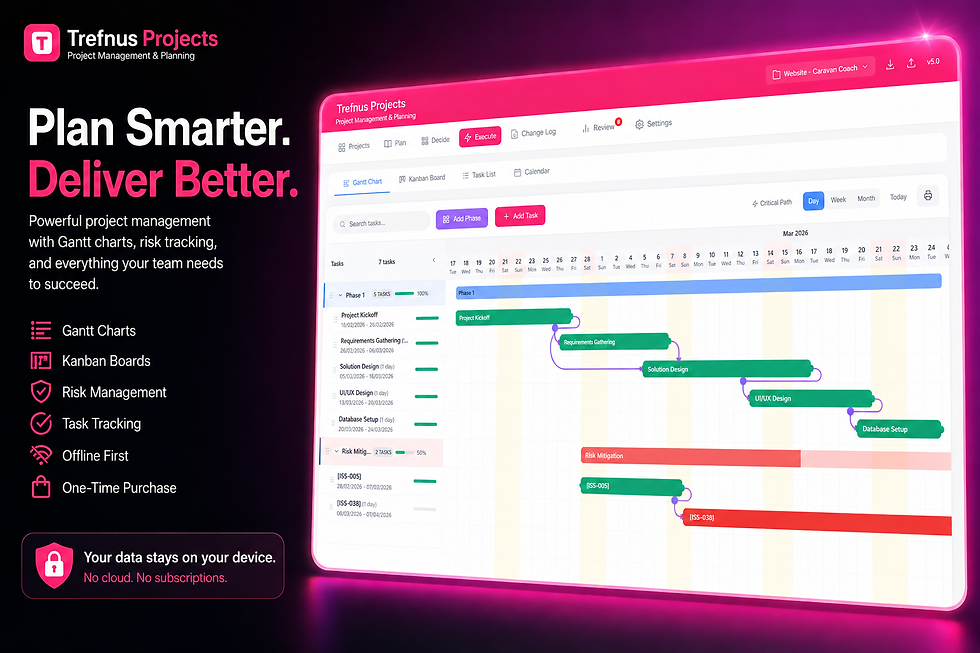
One Workspace for Planning and Execution Whichever method, or combination of methods, your team settles on, having a single place to capture the plan, track progress and keep everyone updated removes much of the friction. Trefnus Projects combines Gantt charts with critical path highlighting, Kanban boards, task lists and risk registers in one workspace, so small teams are not piecing together spreadsheets, sticky notes and separate apps to manage a single project. Explore Trefnus Projects at: |

Common Pitfalls When Adopting a Project Management Method
Choosing the Tool Before the Method
It is tempting to buy a piece of software first and then work out how to use it. This often leads to a tool that does not match how the team actually works, and to features going unused. Deciding how the team wants to plan and track work first, then choosing a tool that supports that approach, tends to produce a better fit.
Over-Complicating the Process
Adding every available field, status, tag and approval step to a project plan can make it feel thorough, but it also makes it slower to update. If updating the plan takes longer than doing the work it describes, the plan will quickly fall out of date.
Inconsistent Use Across the Team
A project plan is only useful if it reflects reality. If some team members update their tasks daily and others only when chased, the plan stops being a reliable source of information and people revert to asking each other directly, which defeats the purpose of having a shared view in the first place.
No Single Source of Truth
When project information is split across email threads, chat messages, spreadsheets and a project tool, it becomes difficult to know which version is current. Consolidating plans, tasks and decisions into one place, even an imperfect one, is usually better than maintaining several partially updated records.
Frequently Asked Questions
What is the best project management method for a small team?
There is no single best method for every small team. The right choice depends on the type of work involved. For ongoing operational work without a fixed deadline, such as handling support requests, Kanban tends to work well. For projects with a fixed deadline and tasks that depend on one another, such as a product launch or office relocation, a critical path or Gantt chart approach is usually more suitable. Many small teams use a hybrid, combining a Gantt chart for the overall timeline with a Kanban board for day-to-day task management.
Is a Kanban board or a Gantt chart better for a small business?
Kanban boards and Gantt charts solve different problems, so the better choice depends on the project. Kanban boards are best for visualising the flow of ongoing work through stages such as To Do, In Progress and Done, and they work well when tasks are roughly similar in size and there is no strict deadline. Gantt charts are best when a project has a fixed end date and tasks that depend on each other in sequence, because they show the timeline and highlight which tasks are on the critical path. Many small teams use both, a Gantt chart for the overall plan and a Kanban board for executing the tasks within it.
Do small teams really need project management software, or will a spreadsheet do?
A spreadsheet can work for very small or short projects, particularly when only one or two people are involved. However, spreadsheets struggle once a project has dependencies between tasks, multiple people updating information at the same time, or a need to see overall status at a glance. A lightweight project management tool that supports Gantt charts, Kanban boards and task tracking in one place generally becomes worthwhile once a project involves more than a handful of people or runs for more than a few weeks.
How long does it take to set up a project management system for a small team?
A basic Kanban board or task list can be set up within an hour for most small teams, since it mainly involves agreeing on the stages or categories that reflect how work actually flows. A fuller project plan using the critical path method, including identifying tasks, durations and dependencies, typically takes longer to set up, often half a day for a moderately complex project, but this investment usually pays back quickly by avoiding missed dependencies and last-minute surprises.
Can a small team use Agile project management without becoming a software company?
Yes. The core principles behind Agile, working in short cycles, reviewing progress regularly, and keeping a prioritised list of upcoming work, apply to many types of work beyond software development, including marketing, operations and product development. A small team does not need to adopt formal Scrum roles or terminology to benefit from these principles. A simplified version, sometimes called Scrum-lite, with a short weekly planning session and a brief end-of-cycle review, captures most of the benefit without the additional structure.
How often should a small team review its project plan?
For active projects, a weekly review is usually sufficient to keep a plan useful without becoming a burden. This is typically a short session to update task status, flag anything that has slipped or is at risk, and confirm priorities for the coming week. Projects that are approaching a critical deadline, or that involve several interdependent tasks running close together, may benefit from a brief check-in more frequently, such as twice a week, during that period.
Further Reading and Official Guidance
The following resources provide further background on project management approaches and good practice for small businesses.
Conclusion
Choosing between project management methods for small teams does not need to be complicated. Kanban suits ongoing work without a fixed deadline, Agile-lite approaches suit projects where requirements may change, and the critical path method with a Gantt chart suits projects with a hard deadline and dependent tasks. Most small businesses benefit from a hybrid, combining a clear overall timeline with a simple board for tracking day-to-day progress.
What matters most is that the chosen approach is light enough to maintain alongside everyone's existing workload, and that the whole team actually uses it. A tool that brings planning, tracking and reporting together in one place, such as Trefnus Projects, can make that consistency far easier to achieve, helping small teams deliver projects on time without adding unnecessary administration to their week.
Disclaimer
The information in this article is intended for general guidance only and does not constitute professional legal, financial, or regulatory advice. Always consult a qualified professional for advice specific to your circumstances.


