
Project Dependencies Explained: A Guide for SMEs


Published: 12 June 2026 | Last reviewed: 12 June 2026
Anyone who has watched a project schedule slip by weeks because one delayed task held up everything else has experienced the effects of project dependencies first-hand. A dependency is simply a relationship between two tasks, where the timing of one affects the timing of another. Once you understand how dependencies work, you can sequence tasks logically, anticipate knock-on delays before they happen, and plan resources with far more confidence.
For small and medium-sized businesses, where project teams are often stretched thin and there is little slack in the schedule, getting dependencies right can be the difference between a project that runs smoothly and one that overruns badly. This guide explains the main types of project dependencies, why they matter, and how to identify and manage them using straightforward tools such as a Gantt chart.
In simple terms, a project dependency is a relationship between two tasks where one task relies on another starting or finishing first. For example, if a supplier delivers materials three days late, the installation work that depends on those materials will also shift by three days, along with every task further down the schedule that relies on installation being finished.
What Are Project Dependencies?
In project management, a dependency describes how one task relates to another in terms of sequence and timing. The earlier task is usually called the predecessor, and the later task the successor. If the successor cannot begin until the predecessor is complete, the two tasks are dependent on one another.
Dependencies exist in almost every project, whether it is a small office refurbishment, the launch of a new product, or an internal process change. Foundations must be laid before walls go up, designs must be approved before production starts, and content must be written before it can be reviewed. Recognising these relationships early allows a project manager to build a realistic schedule rather than a wish list of dates.
The Four Types of Task Dependency
Most project management methodologies recognise four core types of logical dependency. Understanding each one helps when building a schedule that reflects how work genuinely needs to happen.
Finish-to-Start (FS): The most common type. The successor task cannot start until the predecessor finishes. For example, a shop fit-out cannot begin until the lease has been signed.
Start-to-Start (SS): The successor cannot start until the predecessor has started, though they can run in parallel. For example, testing might begin shortly after development starts, rather than waiting for it to finish entirely.
Finish-to-Finish (FF): The successor cannot finish until the predecessor finishes. For example, quality checks cannot be completed until production is complete, even if checking has been ongoing throughout.
Start-to-Finish (SF): The least common type. The successor cannot finish until the predecessor starts. This is occasionally seen in shift handovers, where the outgoing shift cannot finish until the incoming shift has started.
Examples of Project Dependencies in Everyday Projects
Dependencies show up in almost every type of SME project, often without anyone consciously labelling them as such.
A builder cannot start fitting work until planning permission or building control sign-off has been received.
A marketing team cannot publish a campaign until product photography and copy have been approved.
A recruitment process cannot proceed to a job offer until references have been received and checked.
An equipment installation cannot begin until delivery has been confirmed and the site has been prepared.
Why Project Dependencies Matter for Small Businesses
Project dependencies are not just an academic concept. For SMEs running lean teams, getting them wrong has very real consequences.
Resource conflicts: If two dependent tasks both need the same person or piece of equipment, an unrecognised dependency can leave a team member double booked or idle.
Knock-on delays: A short delay to one task can ripple through the entire schedule if its successors were not planned with the dependency in mind.
Client expectations: Many SMEs work to fixed deadlines set by clients or contracts. Understanding dependencies makes it possible to explain, with evidence, why a deadline may move if an earlier task slips.
Better prioritisation: When the team can see which tasks are holding up others, it becomes easier to decide where limited time and budget should be focused first.
Internal Dependencies vs External Dependencies
Dependencies generally fall into two broad categories, and the distinction matters because the level of control a business has over each differs significantly.
Internal Dependencies
Internal dependencies sit within the project team's control. They typically involve sequencing of work between team members or departments, such as a design needing sign-off before development starts, or a draft article needing to be written before it can be edited.
External Dependencies
External dependencies rely on people, organisations or events outside the project team's direct control. Common examples for SMEs include waiting for a supplier delivery, planning permission or building control approval, a client decision, or a third-party contractor completing their work.
External dependencies deserve extra attention when planning, because they often carry the greatest risk of delay and the least flexibility. Building in contingency time around known external dependencies, and following them up proactively rather than waiting passively, is one of the simplest ways to protect a project schedule.
How to Identify Dependencies in Your Project
Dependencies are easiest to manage when they are identified at the planning stage, rather than discovered halfway through a project when it is too late to plan around them. A few practical steps help bring them to the surface.
Break the project down: Start with a work breakdown structure that splits the project into manageable tasks. Dependencies are far easier to spot once work has been broken down to a useful level of detail.
Ask the right question for each task: For every task, ask what needs to happen before it can start, and what cannot happen until it finishes. This simple habit surfaces most logical dependencies.
Involve the people doing the work: Team members often know about practical dependencies that are not obvious from a high-level plan, particularly around shared resources or specialist equipment.
Review with stakeholders: External dependencies, such as approvals or supplier deadlines, are best confirmed directly with the relevant party rather than assumed.
Mapping Dependencies on a Gantt Chart
A Gantt chart is one of the most effective tools for visualising project dependencies, because it shows tasks as bars along a timeline with lines connecting related tasks. This makes the downstream impact of a delay immediately visible, rather than something that has to be worked out manually.
Returning to the earlier example, if the supplier delivery slips by three days, a Gantt chart with linked dependencies will automatically push back the installation task and any tasks that follow it, while leaving unrelated tasks unaffected. This also makes it easier to see whether the delay falls on the critical path, and whether it creates a clash with resources booked for other work during those days.
As projects grow more complex, manually tracking these effects becomes difficult. Visual planning tools help teams spot risks earlier and reduce the administrative burden of updating schedules by hand whenever a date changes.
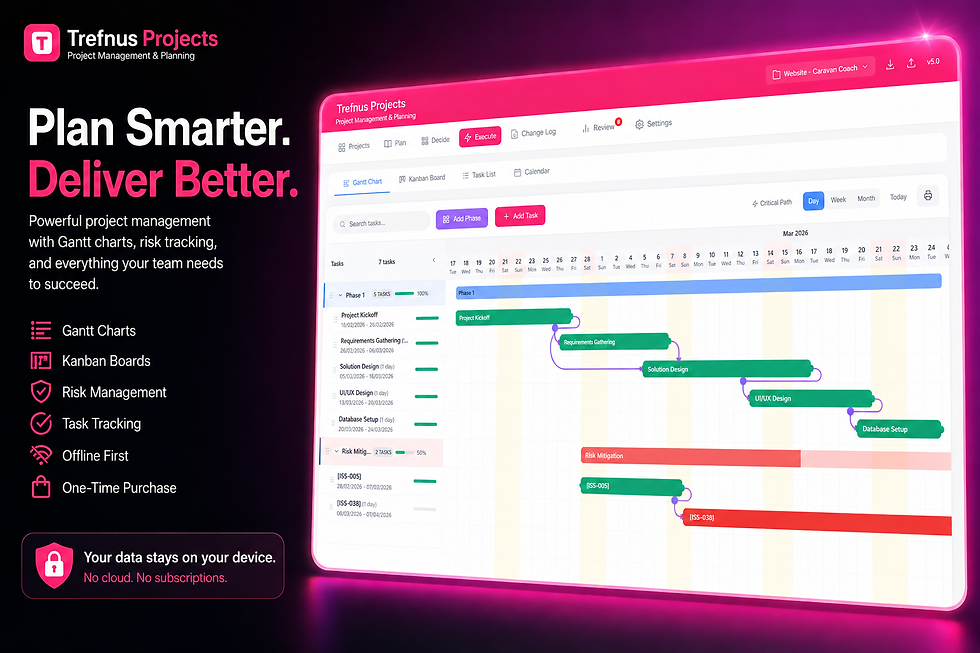
Map Dependencies Visually with Trefnus Projects Trefnus Projects includes a drag-and-drop Gantt chart with dependency lines and critical path highlighting, allowing project managers to plan, adjust and communicate schedules without managing multiple disconnected spreadsheets. Explore Trefnus at: |

When a predecessor task is moved or extended in a well-built Gantt chart, its successors shift automatically, keeping the dependency intact. This is particularly useful for SMEs managing several projects at once, as it removes the need to manually update every related task whenever a date changes.
For teams that prefer not to use complex software, even a simple spreadsheet-based Gantt chart can capture dependencies, although the manual effort required to keep it accurate increases as the project grows. Dedicated planning tools that update dependent tasks automatically reduce this administrative burden considerably.
Common Mistakes When Managing Project Dependencies
Over-constraining the schedule: Marking every task as dependent on the one before it, even when work could proceed in parallel, creates an artificially long schedule and hides genuine flexibility.
Overlooking external dependencies: Internal tasks are usually well planned, but dependencies on suppliers, clients or third parties are sometimes left informal, increasing the risk of unexpected delay.
Failing to update dependencies after changes: When a task date changes, related dependencies should be reviewed. Leaving outdated dependency links in place can give a false sense of how the schedule will be affected.
Confusing dependencies with constraints: A dependency is a logical relationship between two tasks. A constraint is a fixed date or condition imposed from outside, such as a contractual deadline. Treating a constraint as if it were a flexible dependency, or vice versa, can lead to unrealistic planning.
Project Dependencies and the Critical Path
Dependencies are the building blocks of the critical path, which is the longest sequence of dependent tasks that determines the minimum possible duration of a project. Any delay to a task on the critical path delays the entire project by the same amount, while delays to tasks off the critical path may have no overall effect at all, provided they stay within their available slack.
Understanding which dependencies sit on the critical path helps project managers focus their attention where it matters most. Rather than treating every delay as equally serious, the critical path makes it possible to distinguish between problems that genuinely threaten the deadline and those that do not.
Frequently Asked Questions
What is a dependency in project management?
A dependency in project management is a logical relationship between two tasks, where the start or finish of one task affects the start or finish of another. The earlier task is the predecessor and the later task is the successor. Dependencies determine the order in which work can realistically take place.
What are the four types of task dependency?
The four standard types of task dependency are finish-to-start, where a task cannot begin until the previous one ends; start-to-start, where a task cannot begin until another has begun; finish-to-finish, where a task cannot end until another ends; and start-to-finish, where a task cannot end until another begins. Finish-to-start is by far the most common in practice.
How do you manage dependencies in a small project?
Small projects can manage dependencies by breaking work into clear tasks, identifying what each task needs to happen before it can start, and mapping these relationships visually, typically using a Gantt chart. Reviewing dependencies whenever dates change, and keeping a close eye on external dependencies such as supplier deliveries or approvals, helps keep small projects on track without heavy administrative overhead.
What is the difference between a dependency and a constraint?
A dependency is a relationship between two tasks based on the logic of the work itself, such as needing to finish writing before editing can start. A constraint is an external limitation imposed on the schedule, such as a fixed deadline, a limited budget, or a date when a venue is available. Dependencies describe how tasks relate to each other, while constraints describe boundaries the whole project must work within.
Can a project have circular dependencies?
A circular dependency occurs when two or more tasks depend on each other in a loop, for example task A depends on task B, which in turn depends on task A. This makes scheduling impossible, since neither task can logically start first. Circular dependencies usually indicate that tasks have been defined too broadly and need to be broken down further, or that the dependency logic needs to be reconsidered.
How does project management software help with dependencies?
Project management software that supports dependency linking can automatically adjust the dates of successor tasks when a predecessor task changes, highlight the critical path, and flag scheduling conflicts. This removes much of the manual recalculation involved in keeping a schedule accurate, which is particularly valuable for SMEs managing multiple projects with limited administrative resource.
Further Reading and Official Guidance
Association for Project Management, Body of Knowledge: https://www.apm.org.uk/resources/find-a-resource/apm-body-of-knowledge/
Project Management Institute, PMBOK Guide overview: https://www.pmi.org/standards/pmbok
HSE guidance on planning and managing construction projects: https://www.hse.gov.uk/construction/cdm/2015/index.htm
Conclusion
Project dependencies are simply the logical relationships that determine the order in which work can happen. Understanding the four main types, finish-to-start, start-to-start, finish-to-finish and start-to-finish, and distinguishing internal dependencies from external ones, gives SME project managers a much clearer picture of how a schedule will actually behave.
Identifying dependencies early, mapping them visually and reviewing them whenever plans change helps avoid the cascading delays that can derail a project. Tools that map dependencies on a Gantt chart and highlight the critical path, such as Trefnus Projects, make this process considerably easier to manage day to day, particularly for businesses juggling several projects at once.
Disclaimer
The information in this article is intended for general guidance only and does not constitute professional legal, financial, or regulatory advice. Always consult a qualified professional for advice specific to your circumstances.


