
Project Governance for Small Businesses: A Practical Guide

Updated: Jun 21

Published: May 2026 | Last reviewed: May 2026
In Brief
Effective project governance for small businesses means defining decision-making authority, tracking risks, reporting progress consistently, and reviewing projects at key milestones. You do not need a complex framework. Clarity about roles and a handful of consistent habits will take most SME projects a long way.
Running a project without proper oversight is a little like setting off on a long journey without a map. You might reach your destination, but you are likely to waste time and money along the way.
Project governance for small businesses is the framework that keeps projects on track. It defines who makes decisions, how risks are handled, and how progress is reported. For small and medium-sized enterprises, this does not mean bureaucracy. A lightweight, well-structured approach can be the difference between a project that delivers real value and one that drifts quietly past its deadline.
This guide explains what project governance is, why it matters for smaller organisations, and how to build a practical framework without the overhead of a large corporate process.
What Is Project Governance?
Project governance is the structure of authority, accountability, and decision-making that surrounds a project. It is not the same as project management. Project management covers the day-to-day running of tasks and timelines. Governance sits above this and provides the oversight layer.
In practical terms, a governance framework answers questions such as:
Who has the authority to approve scope changes?
How are risks identified and escalated?
Who receives progress reports, and how often?
What happens when a project runs over budget?
How are decisions documented and communicated?
Without clear answers to these questions, projects become vulnerable to scope creep, unclear accountability, and unresolved blockers. Good governance creates the structure that prevents this.
Why Project Governance Matters for Small Businesses
Small businesses often assume governance is something only large organisations need. In reality, the smaller your team, the more important clear accountability becomes. With fewer people, every role carries more weight. The Project Management Institute's Pulse of the Profession research consistently identifies unclear objectives and weak stakeholder engagement among the leading causes of project failure, issues that a basic governance framework directly addresses.
Common problems that arise without governance include:
Projects that expand beyond their original scope without formal approval
Decisions being made by the wrong person, or not made at all
Stakeholders who disengage because they are not kept informed
Budget overruns that are only noticed once the damage is done
A governance framework does not add unnecessary process. It provides clarity. People know what they are responsible for, who they report to, and how decisions are made. That clarity saves time across the entire project lifecycle.
Key Components of a Project Governance Framework
An effective framework for a small business does not need to replicate enterprise-level complexity. The following components form the core of a workable structure.
1. Clear Roles and Responsibilities
Every project needs explicitly defined roles. In a small business, one person may hold more than one role, but the roles themselves should still be named and documented.
Project Sponsor: Owns the business case and has ultimate accountability for the project's success.
Project Manager: Responsible for day-to-day delivery, including planning, resources, and reporting.
Steering Group or Senior Responsible Owner: Provides strategic oversight and makes decisions outside the project manager's authority.
Team Members: Deliver specific tasks and flag risks and issues to the project manager.
EXAMPLE: Roles in a Five-Person Business Owner/Director: Project Sponsor Operations Manager: Project Manager Two delivery staff: Team Members External accountant: Consulted at budget reviews only
Even with this small a team, writing these roles down avoids confusion about who approves spending or resolves blockers. |
2. A Project Brief
The project brief is the foundational governance document. It sets out the objectives, scope, budget, timeline, key stakeholders, and success criteria. Agreeing this before work begins ensures everyone is working to the same understanding.
It should be reviewed and updated when significant changes occur, rather than filed away after the kick-off meeting.
3. Decision-Making Authority
One of the most common causes of project delays is decisions that nobody feels authorised to make. A governance framework should define a clear decision-making hierarchy with agreed thresholds.
EXAMPLE: Approval Thresholds for a £10,000 Web Redesign Project Project Manager can approve: scope adjustments and budget variances up to £500 Project Sponsor sign-off required: variances between £500 and £2,000 Steering Group decision required: changes affecting timeline by more than two weeks or budget by more than 20%
Writing these thresholds down and sharing them at kick-off removes ambiguity and speeds up the decision-making process considerably. |
4. Risk and Issue Management
Risk management is a central governance function. A risk register should be maintained throughout the project, capturing potential problems, their likelihood, their potential impact, and the actions being taken to address them.
Each risk and issue should have a named owner. Regular reviews, even a brief check as part of an existing team meeting, ensure the register stays current and emerging risks are caught early.
EXAMPLE: A Simple Risk Register Entry Risk: Key supplier delays delivery of materials Likelihood: Medium | Impact: High Owner: Operations Manager Mitigation: Identify a secondary supplier; place provisional order by Week 3 Status: Open |
5. Progress Reporting
Effective governance depends on visibility. Regular, structured progress reports give stakeholders the information they need to make informed decisions. Consistency matters more than format.
A useful weekly or fortnightly status update covers:
Work completed since the last report
Work planned for the next period
Any risks or issues requiring attention
Budget status against the agreed plan
Any decisions or approvals needed
EXAMPLE: Simple Weekly Status Email Structure Subject: [Project Name] Weekly Update – w/e 30 May RAG Status: AMBER Completed this week: Wireframes signed off; hosting migrated Planned next week: Content upload begins; UAT scheduled Issues/risks: Design revisions requested – potential 3-day delay, under review Budget: £4,200 spent of £10,000 budget Decisions needed: Confirm revised go-live date by Friday |
6. Stage Gates and Milestone Reviews
Stage gates are formal review points built into the project lifecycle. At each gate, the sponsor or steering group confirms whether the project should proceed to the next phase.
For a typical small business project, stage gates might sit at the end of planning, at the midpoint of delivery, and at closure. In many cases, a structured thirty-minute review meeting is sufficient. The value is in the habit, not the duration.
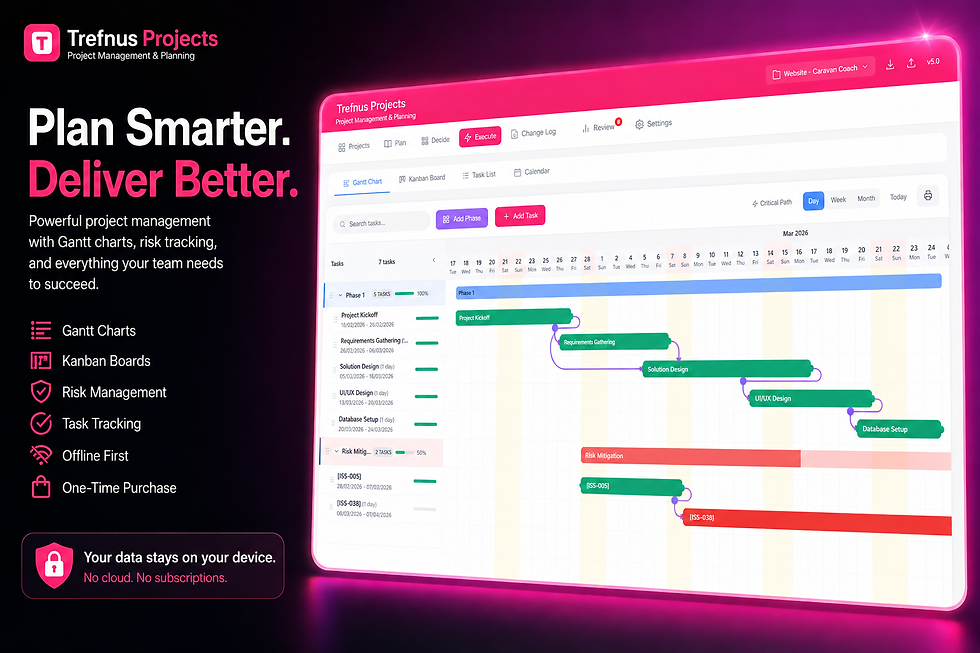
TOOL SPOTLIGHT Governance-Ready Project Management for Small Businesses For small businesses that want governance features without enterprise complexity, tools such as Trefnus Projects combine planning, risk management, and progress reporting in a single offline-capable workspace. It includes a Risk Register, Decision Matrix, Gantt chart, Kanban board, and Brief View, giving project managers the oversight layer a governance framework requires without the administrative overhead of maintaining separate documents. See how Trefnus Projects helps small businesses manage governance, risks, reporting, and delivery in one workspace. |

How to Set Up Project Governance Without Overcomplicating It
The most common mistake small businesses make is trying to implement too much at once. Start simply, build consistent habits, and add structure as projects grow in complexity.
Step 1: Define Your Governance Structure
Write down who holds each governance role before the project starts. Share it with the team at kick-off. If one person holds multiple roles, be explicit about where each hat is worn.
Step 2: Agree and Document the Project Brief
Before work begins, agree scope, budget, timeline, and objectives. Get sign-off from the project sponsor. Treat the brief as a live document, not a one-off exercise.
Step 3: Build a Risk Register from Day One
Hold a brief risk identification session during planning. Log everything you can think of, assign owners, and set a reminder to review the register regularly.
Step 4: Establish a Reporting Rhythm
Set a regular cadence for progress updates and stick to it. A predictable rhythm builds stakeholder confidence and surfaces problems early.
Step 5: Use the Right Tools
A spreadsheet can work for a very simple project. As complexity grows, a dedicated project management tool reduces the overhead of maintaining separate planning documents, risk registers, and status reports, making governance far easier to sustain in practice.
Common Project Governance Mistakes to Avoid
Skipping the project brief: Starting work before scope and objectives are agreed is one of the fastest routes to scope creep.
Governance in name only: Creating a structure but not following it. If the steering group never meets and the risk register is never updated, the framework offers no real protection.
Over-engineering the process: Lengthy approval chains and excessive documentation slow projects down. Keep governance proportionate to the size and risk of the project.
Treating governance as a one-off task: Governance needs to be active throughout the lifecycle, not just at the start.
Failing to involve stakeholders: Governance works best when the people affected by the project are kept informed and consulted at appropriate points.
Project Governance Frameworks Worth Knowing
Several established frameworks offer useful principles for small businesses. You do not need to adopt any of them in full. Most SMEs benefit most from borrowing lightweight principles rather than implementing a framework wholesale.
PRINCE2: A structured methodology widely used in the UK, with defined roles, stage gates, and clear decision-making processes. The most practical starting point for most small businesses is to adopt the governance principles and the stage-gate concept, without implementing every process element.
PMI PMBOK Guide: Outlines best practices including stakeholder management, risk processes, and change control. Useful as a reference rather than a rigid rulebook.
BS 6079: The British Standard for project management, applicable to organisations of all sizes. Worth reading for context, particularly if you work with public sector clients who may reference it.
Agile Governance: For businesses using iterative delivery, sprint reviews and retrospectives serve as lightweight governance touchpoints. Well suited to digital and creative projects where requirements evolve.
If you are starting from scratch, PRINCE2's core principles adapted to your scale is the most practical route. If your projects are shorter and more iterative, agile-style reviews will feel more natural. Either way, the key is consistency, not comprehensiveness.
Project Governance Checklist for Small Businesses
Use this checklist as a quick reference at the start of any project.
Small Business Project Governance Checklist | |
1 | Define the project sponsor, project manager, and steering group (where needed) |
2 | Agree and sign off the project brief before work begins |
3 | Set clear decision-making thresholds and document them |
4 | Open a risk register and assign owners to each risk |
5 | Establish a regular reporting cadence (weekly or fortnightly) |
6 | Schedule stage-gate reviews at key project milestones |
7 | Maintain a decisions log throughout the project lifecycle |
8 | Conduct a close-out review and capture lessons learned |
Frequently Asked Questions
What is project governance in a small business?
Project governance in a small business is the set of processes, roles, and decision-making rules that keep projects aligned with business objectives. It defines who approves decisions, how risks are managed, and how progress is reported, without the overhead of a large corporate structure.
Do small businesses need a formal project governance framework?
Yes, even a lightweight framework helps. Clear accountability, defined approval thresholds, and regular progress reviews make projects more predictable. The framework does not need to be complicated; it simply ensures projects are managed consistently and transparently.
What is the difference between project governance and project management?
Project management covers the day-to-day execution of tasks, timelines, and resources. Project governance sits above this and deals with oversight, accountability, and strategic alignment. Governance sets the rules; management follows them.
What roles are typically involved in project governance?
Common governance roles include a project sponsor (who owns the business case), a project manager (who runs delivery), and a steering group or senior responsible owner who makes key decisions. In small businesses, one person may hold more than one of these roles.
How often should a project governance review take place?
For most small business projects, a brief weekly or fortnightly status review is sufficient, with a more formal stage-gate review at key milestones such as the end of planning, the start of delivery, and at project closure.
Can project governance help with risk management?
Yes. A governance framework typically includes a risk register and a clear process for escalating issues. Identifying risks early and assigning ownership means problems are addressed before they derail the project or affect the budget.
Conclusion
Project governance for small businesses is about giving your projects the structure they need to succeed. Clear roles, documented decisions, active risk management, and consistent reporting make projects more predictable and more likely to deliver genuine value.
Start simply. Define roles before work begins, agree your project brief, open a risk register, and set a reporting rhythm. As your projects grow in scale and ambition, your governance framework can grow with them.
The right tools make this significantly easier. A project management workspace that brings together planning, risk registers, and progress tracking removes much of the administrative burden and keeps governance visible to everyone who needs it.
Explore how Trefnus Projects helps small businesses manage governance, risks, reporting, and delivery in one workspace.
Further Reading and Official Guidance
The following sources provide authoritative guidance on project governance and project management practice.
Source | Domain | Link |
Association for Project Management (APM) | ||
PRINCE2 Guidance (AXELOS) | ||
Cabinet Office: Project Delivery Guidance | ||
BSI: BS 6079 Project Management Standard | ||
Federation of Small Businesses | ||
PMI Pulse of the Profession Report |
Disclaimer
The information in this article is intended for general guidance only and does not constitute professional legal, financial, or regulatory advice. Always consult a qualified professional for advice specific to your circumstances.


