
What Is a Project Brief and How Do You Write One?


Every project begins with a question: what exactly are we trying to do? Without a clear answer, teams lose direction, budgets creep, and deadlines slip. That is where a project brief comes in.
A project brief is a short, structured document that defines the purpose, scope, and goals of a project before any work begins. It acts as the single source of truth for everyone involved, from the project manager to the client to the wider team.
In this guide, you will learn what a project brief is, why it matters, and how to write one that keeps your project on track from the very first day.
What Is a Project Brief?
A project brief is a concise overview document that captures the essential details of a project at the outset. It is typically one to three pages long and written before planning begins in earnest. Think of it as the foundation on which everything else is built.
Unlike a full project plan, which maps out tasks, timelines, and resources in detail, a project brief focuses on the bigger picture.
It answers four fundamental questions:
What problem are we solving?
What does success look like?
Who is responsible?
What are the constraints?
Once agreed by all stakeholders, the project brief becomes the reference point for every decision made during the project. It stops scope creep in its tracks and ensures no one is pulling in a different direction.
Why Is a Project Brief Important?
Many small and medium business owners skip the project brief, particularly when a project feels straightforward. This is one of the most common and costly mistakes in project management.
Here is why a project brief matters
1. It Aligns Stakeholders from the Start
Miscommunication is the leading cause of project failure. A project brief forces everyone, including clients, team members, and senior decision makers, to agree on the objectives before any work begins. If there is disagreement, it is far better to surface it at the brief stage than halfway through delivery.
2. It Defines Scope Clearly
Scope creep happens when new requirements are added without proper evaluation. A well-written project brief clearly states what is in scope and, just as importantly, what is out of scope. This gives you a firm foundation to push back on unplanned additions.
3. It Saves Time and Money
The cost of fixing a misunderstanding grows dramatically the later it is caught. Investing an hour in a thorough project brief can save days of rework later. According to the Project Management Institute, poor communication accounts for a significant proportion of project failures, many of which start with an unclear brief.
4. It Keeps the Team Focused
During a project, teams face constant decisions: which feature to prioritise, whether to include an extra deliverable, how to handle an unexpected challenge. A project brief gives the team a clear decision-making framework. If it does not serve the stated objectives, it probably does not belong in the project.
5. It Creates Accountability
When roles and responsibilities are written down and agreed upon, everyone knows what they are accountable for. There is no room for the classic response: "I did not know that was my job."
What Should a Project Brief Include?
A good project brief does not need to be long, but it does need to be complete. Here are the key sections every project brief should contain:
Project Title and Overview
Start with a clear, descriptive title and a two to three sentence summary of what the project is about. Someone unfamiliar with the work should be able to read this and understand the purpose immediately.
Background and Context
Explain why this project is being undertaken. What problem does it solve? What opportunity does it address? This section helps the team understand the reasoning behind the project, which is essential for good decision making throughout delivery.
Project Objectives
List specific, measurable objectives. Avoid vague language like "improve the website" or "increase sales." Instead, aim for statements like "increase online enquiries by 20% within three months of launch." Good objectives are SMART: Specific, Measurable, Achievable, Relevant, and Time-bound.
Scope
Define what is included in the project and what is explicitly excluded. This is one of the most valuable sections of a project brief. Be as specific as possible.
For example:
In scope: design and development of a five-page website, copywriting for all pages, integration with existing CRM.
Out of scope: ongoing website maintenance, social media content, paid advertising campaigns.
Deliverables
List the tangible outputs the project will produce. Deliverables are different from objectives: objectives describe the outcome you want, while deliverables are the specific items you will produce to achieve that outcome.
Timeline and Key Milestones
Provide an estimated start date, end date, and any critical milestones along the way. At the brief stage, this does not need to be a detailed Gantt chart. A simple list of key dates is sufficient to establish expectations.
If you want to move from a high-level timeline in your brief to a fully detailed schedule, tools like Gantt charts are invaluable. You can read more about how to use Gantt charts for project planning in our related guide.
Budget
State the approved or estimated budget for the project. If the budget is not yet confirmed, note the range or the approval process. Leaving budget out of the brief is a common mistake that leads to awkward conversations later.
Stakeholders and Roles
Identify who is involved and what their role is.
This typically includes:
Project sponsor: the person with overall accountability and authority
Project manager: responsible for day-to-day delivery
Core team members: those doing the work
Key stakeholders: those with an interest in the outcome
Constraints and Assumptions
Note any constraints that could affect the project, such as budget limits, regulatory requirements, technology restrictions, or resource availability. Also list any assumptions you are making, because if those assumptions turn out to be wrong, the project plan may need to change.
Risks
Briefly identify any known risks and how they might be managed. A full risk register can come later, but flagging the most significant risks at the brief stage helps stakeholders make an informed decision about whether to proceed. Our guide to project risk management covers this topic in more depth.
How to Write a Project Brief: A Step-by-Step Guide
Writing an effective project brief does not have to be complicated. Follow these steps to create one that works:
Start with a conversation, not a document. Before you open a template, talk to the key stakeholders. Understand their expectations, concerns, and constraints. The brief should reflect a shared understanding, not one person's interpretation.
Use plain language. Avoid jargon. The project brief should be readable by everyone involved, including non-technical stakeholders and clients. If someone needs a glossary to understand it, rewrite it.
Be specific about scope. Vagueness is the enemy of a good brief. The more specific you are about what is and is not included, the less room there is for misunderstanding.
Get it signed off. A project brief is only useful if everyone agrees to it. Circulate it to all key stakeholders and obtain written approval before work begins. This creates a clear audit trail if disputes arise later.
Keep it concise. One to three pages is ideal for most projects. If your brief is longer than that, consider whether you are including information that belongs in the project plan rather than the brief.
Revisit it as needed. A project brief is not set in stone. If the scope or objectives change significantly, update the brief and re-obtain approval. Keeping the document current ensures it remains a useful reference throughout the project.
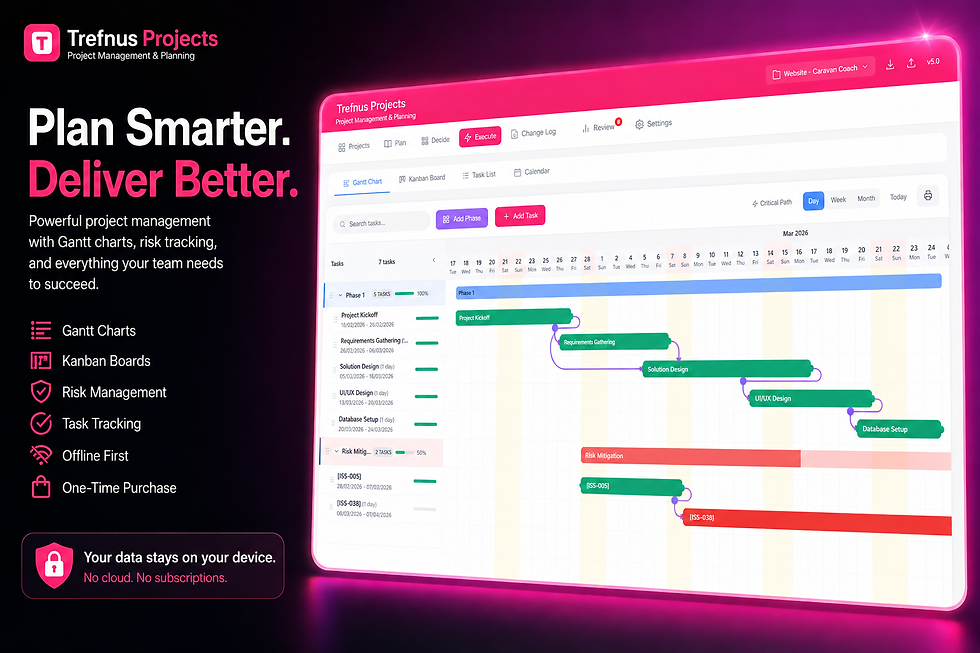
Try Trefnus Projects Trefnus Projects includes a built-in Brief View that gives you an executive summary of your project at a glance, alongside Gantt charts, risk registers, a decision matrix, and a full Kanban board. It is an offline-first PWA that works on any device, with no subscription required. Explore Trefnus Projects at: |

Common Mistakes to Avoid
Even experienced project managers make mistakes with project briefs. Here are the most common ones to watch out for:
Writing it alone. A project brief written by one person without consultation is little more than a wishlist. Involve the key stakeholders from the start.
Being too vague about objectives. If your objectives cannot be measured, you will never know whether the project succeeded.
Ignoring risk. Pretending risks do not exist does not make them go away. A brief that acknowledges risk builds more trust than one that presents an unrealistically rosy picture.
Skipping the sign-off. Without formal approval, stakeholders can claim they never agreed to the scope or budget. Always get written sign-off.
Never revisiting it. Projects change. If the brief becomes out of date and nobody updates it, it stops being useful and may actually mislead the team.
Project Brief vs Project Plan: What Is the Difference?
It is worth clarifying the distinction between a project brief and a project plan, as the two are often confused.
A project brief is written at the very start of the process, before detailed planning begins. It is short, strategic, and focused on the what and why.
A project plan is developed once the brief is approved. It is far more detailed and covers the how: specific tasks, timelines, resource allocation, dependencies, risk management strategies, and budget breakdowns. Tools such as Gantt charts, work packages, and the critical path method are all elements of a detailed project plan.
Think of the brief as the brief and the plan as the blueprint. You need the brief before you can build the blueprint.
Conclusion
A project brief is one of the simplest and most powerful tools available to any project manager or business owner. It takes relatively little time to produce but saves a disproportionate amount of time, money, and frustration over the course of a project.
By defining your objectives clearly, agreeing scope upfront, identifying key risks, and getting stakeholder sign-off before work begins, you give your project the best possible chance of success.
Once your brief is approved, the next step is to build it out into a detailed project plan. That means breaking down your scope into work packages, scheduling tasks on a Gantt chart, mapping dependencies using the critical path method, and setting up a risk register to manage uncertainty as it arises.
If you are looking for a tool that supports all of those steps in one place, Trefnus Projects is worth exploring. Its Brief View gives you a clean executive summary of your project, while the full suite of planning, execution, and reporting tools helps you take the project from idea to completion. Visit trefnus.com/projects to find out more.
Disclaimer
The information in this article is intended for general guidance only and does not constitute professional legal, financial, or regulatory advice. Always consult a qualified professional for advice specific to your circumstances.


