
Project Risk Management: A Practical Guide for Businesses


Every project carries uncertainty. Whether you are launching a new product, renovating a property, or rolling out a new IT system, things rarely go entirely to plan. Project risk management is the discipline of identifying those uncertainties early, assessing their potential impact, and putting plans in place to reduce the damage if things go wrong.
For small and medium businesses in particular, a single unmanaged risk can derail an entire project. A delayed supplier, an absent key team member, or a budget overrun can cascade quickly when resources are tight. The good news is that effective project risk management does not require expensive consultants or complex software. It requires a clear process, consistent habits, and the right tools.
This guide walks you through the essentials: what project risk management is, why it matters, how to build a risk register, and how to respond when things go wrong.
What Is Project Risk Management?
Project risk management is the process of identifying, analysing, and responding to risks throughout the life of a project. A risk is any uncertain event that, if it occurs, could have a positive or negative effect on your project objectives.
It is important to note that risks are not the same as issues. A risk is something that might happen. An issue is something that has already happened. Good risk management aims to prevent risks from becoming issues in the first place.
The core activities in project risk management include:
Risk identification: spotting what could go wrong (or unexpectedly right)
Risk analysis: assessing the likelihood and potential impact of each risk
Risk response planning: deciding how to handle each risk
Risk monitoring: tracking risks throughout the project and updating your register
Why Project Risk Management Matters for Small Businesses
Many small business owners skip formal risk management because it feels like extra admin. In reality, failing to manage risk is one of the most common reasons projects overrun on time and budget.
Consider a small construction company taking on a kitchen refurbishment project. Without a risk register, the project manager might not have considered that a key subcontractor could be unavailable, that building materials have long lead times, or that the client might request changes mid-project. Each of these risks is manageable with advance planning but can become costly if they come as a surprise.
Effective project risk management helps businesses:
Avoid unpleasant surprises that disrupt timelines and budgets
Improve stakeholder confidence by demonstrating structured thinking
Make better decisions when resources are limited
Learn from past projects and apply those lessons to future ones
Spot opportunities, not just threats, in uncertain situations
The Risk Management Process: Step by Step
Step 1: Identify Your Risks
Start by brainstorming everything that could affect your project. Involve your team in this process. People working closest to the detail often spot risks that senior managers overlook.
Common risk categories to consider include:
Resource risks: key staff leaving, skills gaps, or equipment availability
Schedule risks: task dependencies, critical path delays, or unrealistic deadlines
Financial risks: cost overruns, currency fluctuations, or late payments
Technical risks: system failures, integration issues, or changing requirements
External risks: supplier problems, regulatory changes, or weather disruption
Step 2: Analyse Each Risk
Once you have a list of risks, assess each one using two dimensions: likelihood (how probable is it?) and impact (how serious would it be?).
A simple scoring method assigns a value from 1 to 4 for each dimension, then multiplies them to give a risk score. A risk with a likelihood score of 4 and an impact score of 4 scores 16, placing it firmly in the high-priority zone. A risk scoring 2 or below can typically be monitored without immediate action.
This approach, often called a risk matrix, gives you a clear and visual way to prioritise where to focus your energy.
Step 3: Build a Risk Register
A risk register is a living document that captures all identified risks, their scores, the person responsible for monitoring them, and the planned response. It is the backbone of your project risk management process.
Here is an example of what a simple risk register might look like for a small business project:
Risk | Likelihood | Impact | Score | Response |
Key supplier delays | Medium | High | 12 | Dual-source early |
Scope creep | High | High | 16 | Change control log |
Staff absence | Medium | Medium | 9 | Cross-train team |
Budget overrun | Low | High | 8 | Monthly cost review |
Technology failure | Low | Medium | 4 | Backup systems in place |
Keep your risk register updated throughout the project. New risks will emerge, and existing ones will change in likelihood or impact as the project progresses.
Step 4: Plan Your Risk Responses
For each significant risk, decide in advance how you will respond.
The four standard response strategies are:
Avoid: change the project plan to eliminate the risk entirely
Mitigate: take action to reduce the likelihood or impact of the risk
Transfer: shift the financial impact to a third party, such as through insurance
Accept: acknowledge the risk and decide to deal with it if it occurs
Document your chosen response in the risk register alongside the name of the team member who owns the risk. Ownership is critical. A risk without a named owner is a risk that no one is watching.
Step 5: Monitor and Review Risks Regularly
Risk management is not a one-off exercise at the start of a project. It requires ongoing attention. Include a risk review as a standing agenda item in your project meetings. Ask the team whether any new risks have appeared, whether existing risks have changed, and whether any planned responses have been effective.
As your project moves through its phases, some risks will diminish while others will grow. Keeping your register current means you are always working with an accurate picture.
Common Mistakes in Project Risk Management
Even businesses that recognise the value of risk management often fall into the same traps. Here are the most frequent mistakes to avoid.
Treating the risk register as a one-time document. It needs to be reviewed and updated regularly, not filed away after the kick-off meeting.
Failing to assign ownership. Every risk needs a named person responsible for monitoring it and triggering the response plan if needed.
Only thinking about threats. Risks can also be positive. An unexpectedly fast delivery from a supplier is a positive risk worth planning for.
Focusing only on obvious risks. Involve the whole team. Technical staff, delivery partners, and client contacts often spot risks that project managers miss.
Confusing risks with issues. Once a risk materialises, it becomes an issue and needs to be managed as such, through your issues log rather than your risk register.
How Trefnus Projects Supports Risk Management
Managing project risk effectively depends on having a clear view of your project at all times. When tasks, dependencies, and timelines are visible in one place, risk becomes much easier to spot and respond to.
Trefnus Projects is a project management app built for small and medium businesses that need professional-grade planning without the complexity of enterprise software. It brings together the tools that make risk management practical.
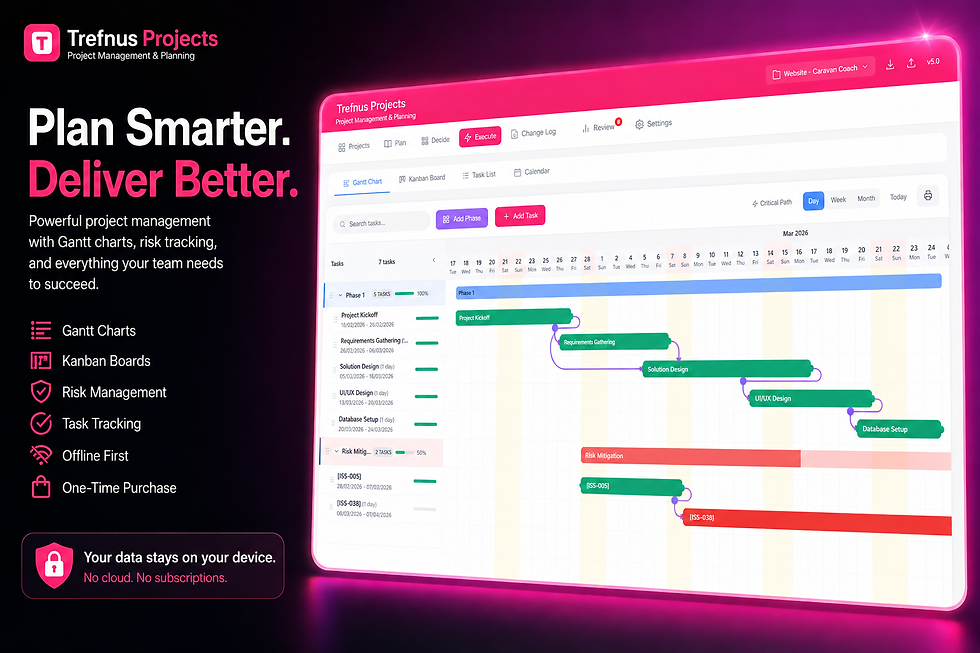
Trefnus Projects: Built for Real-World Project Challenges Gantt chart with drag-and-drop scheduling, so you can see how a delay in one task ripples across the whole project. Dependency lines and critical path highlighting, making it easy to spot which tasks carry the highest schedule risk. A built-in Risk Register under the DECIDE module, letting you log, score, and track risks without leaving your planning workspace. Offline-capable as a Progressive Web App, so your project data stays accessible even without an internet connection. Kanban board and task list views to monitor execution and flag blocked tasks before they become issues. Explore Trefnus Projects at: |

Rather than maintaining separate spreadsheets for your Gantt chart, your task list, and your risk register, Trefnus Projects keeps everything in one workspace. That means less time switching between tools and more time managing your project.
If you are running multiple projects or managing a team, the reporting dashboard gives you an at-a-glance view of project health, workload distribution, and completion rates. That visibility is exactly what you need to catch emerging risks before they escalate.
Risk Management Terminology: Quick Reference
If you are new to project risk management, the terminology can feel overwhelming. Here is a quick reference to the most important terms.
Term | Definition |
Risk | An uncertain event that could affect project objectives |
Issue | A risk that has already materialised and requires immediate action |
Risk Register | A live document that records all identified risks, scores, owners, and responses |
Likelihood | The probability that a risk will occur, usually scored on a scale |
Impact | The effect on the project if the risk occurs, usually scored on a scale |
Risk Score | Likelihood multiplied by impact, used to prioritise risks |
Risk Owner | The team member responsible for monitoring a specific risk |
Risk Appetite | How much uncertainty an organisation is willing to accept |
Residual Risk | The level of risk remaining after a response has been applied |
Critical Path | The sequence of tasks that determines the minimum project duration |
Conclusion
Project risk management is not about predicting the future. It is about being prepared for uncertainty and having a plan ready when things change. For small and medium businesses, this is particularly valuable because there is usually little slack in the budget or timeline to absorb unexpected problems.
By following a consistent process, building a risk register, assigning ownership, and reviewing risks throughout the project, you can significantly reduce the number of surprises that derail your plans.
Good project planning tools make this process easier. When your Gantt chart, task list, risk register, and team reporting all live in one place, you spend less time chasing information and more time managing your project with confidence.
Disclaimer
The information in this article is intended for general guidance only and does not constitute professional legal, financial, or regulatory advice. Always consult a qualified professional for advice specific to your circumstances.


