
Project Cost Analysis: A Practical Guide for Business Owners


Every project costs money. The question is whether you know exactly how much it will cost before you commit, and whether you can keep spending under control once work is under way. Project cost analysis answers both questions. It is the process of identifying, estimating, and monitoring every cost associated with a project, from initial planning through to final delivery.
For small and medium business owners, getting this right is critical. Overspending on projects can erode margins, strain cash flow, and damage client relationships. A structured approach to project cost analysis helps you make better decisions, set realistic budgets, and avoid the surprises that derail so many projects.
This guide walks you through the key concepts, the types of costs you need to consider, and a practical step-by-step process you can apply to any project.
What Is Project Cost Analysis?
Project cost analysis is the systematic process of breaking a project down into its component parts and assigning a realistic financial value to each one. It goes beyond a rough budget estimate. A proper analysis accounts for every category of expenditure, builds in realistic contingency provisions, and provides a framework for tracking actual spend against forecast throughout the project.
It is closely related to cost estimation, but the two are not identical. Cost estimation is the initial forecast, often carried out before a project is fully defined. Cost analysis is broader: it includes ongoing monitoring, variance reporting, and the evaluation of whether the costs being incurred are delivering proportionate value.
Done well, project cost analysis gives you three things: a reliable baseline budget, an early warning system for overspend, and the data you need to improve future project estimates.
Types of Project Costs You Need to Understand
Before you can carry out a meaningful project cost analysis, you need to understand the different categories of cost involved. Failing to account for all of them is one of the most common reasons projects run over budget.
Cost Type | Description |
Direct Costs | Costs that can be directly attributed to a project, such as labour, materials, and equipment hire. |
Indirect Costs | Overheads and shared costs not tied to a single project, such as office rent, utilities, and management time. |
Fixed Costs | Costs that remain constant regardless of project size or output, such as software licences or consultant day rates. |
Variable Costs | Costs that fluctuate with project scope or volume, such as raw materials, subcontractor fees, or usage-based tools. |
Sunk Costs | Costs already incurred that cannot be recovered. Relevant when deciding whether to continue or abandon a project. |
Opportunity Costs | The value of the next best alternative foregone by committing resources to a particular project. |
Understanding these distinctions matters because they affect how you estimate, where you apply contingency, and which costs you can realistically control or reduce.
How to Carry Out a Project Cost Analysis: A Step-by-Step Process
A rigorous project cost analysis does not need to be complex, but it does need to be thorough. Follow these six steps to build a cost analysis that you can rely on.
Step | Action | What to Do |
1 | Define the scope | Clarify exactly what the project covers. Without a clear scope, costs will be incomplete from the start. |
2 | List all cost items | Break the project into tasks or work packages and assign a cost to each. Include both direct and indirect costs. |
3 | Estimate quantities | Where costs are variable, estimate realistic quantities based on historical data, supplier quotes, or industry benchmarks. |
4 | Add a contingency | Build in a contingency buffer, typically 10 to 20 per cent, to cover unforeseen costs or scope changes. |
5 | Compare against budget | Set your baseline budget and use the analysis to identify gaps, risks, or opportunities to reduce spend. |
6 | Monitor and update | Cost analysis is not a one-off exercise. Track actuals against estimates throughout the project lifecycle. |
Cost Estimation Techniques
There is no single correct way to estimate project costs. The right technique depends on how much information you have available and how much precision you need.
Analogous Estimating
This approach uses data from previous, similar projects as a reference point. It is quick to produce but relies on the assumption that past projects are a reliable guide to the current one. Best suited to early-stage estimates where detailed data is not yet available.
Parametric Estimating
Parametric estimating uses statistical relationships between project variables to calculate costs. For example, if you know that a certain type of construction costs a fixed amount per square metre, you can apply that rate to your project's dimensions. This method is more accurate than analogous estimating when the underlying data is reliable.
Bottom-Up Estimating
This is the most detailed and time-consuming approach. You break the project down into its smallest components, estimate the cost of each one individually, and then aggregate those figures into a total. It is the most accurate method but requires a well-defined project scope before you begin.
Three-Point Estimating
Rather than producing a single cost figure, three-point estimating generates three: an optimistic estimate, a pessimistic estimate, and a most likely estimate. These are combined using a weighted formula to produce a more realistic overall figure. This technique is particularly useful for projects with a high degree of uncertainty.
Project Budgeting vs. Cost Analysis: Understanding the Difference
Project budgeting and project cost analysis are closely connected but serve different purposes. A budget is the approved financial baseline for a project: the amount you are authorised to spend. Cost analysis is the process that supports and informs that budget, both at the outset and throughout delivery.
Think of the budget as the destination and cost analysis as the navigation. The analysis tells you where you are, how fast you are spending, and whether you are on track to arrive within the allocated amount. Without it, you are driving blind.
Effective project budget management requires regular cost analysis as a standard practice, not a one-off exercise carried out before work begins.
Common Mistakes in Project Cost Analysis
Even experienced project managers make errors in cost analysis. Being aware of the most common pitfalls can help you avoid them.
Underestimating indirect costs. Direct costs are usually easier to identify. Indirect costs, particularly management time and shared overhead, are frequently overlooked or underestimated.
Failing to update the analysis. A cost analysis produced at the start of a project and then ignored quickly becomes meaningless. Actuals need to be tracked against estimates on a regular basis.
Ignoring scope changes. When the project scope changes, the cost analysis must change with it. Scope creep is one of the most significant contributors to budget overruns.
No contingency provision. Projects rarely proceed exactly as planned. A budget with no contingency buffer has no capacity to absorb the unexpected.
Optimism bias. There is a well-documented tendency to underestimate costs and overestimate efficiency, particularly in early-stage planning. Using historical data and structured estimation techniques helps to counter this.
Managing Project Costs with the Right Tools
The mechanics of cost analysis, identifying costs, estimating figures, and monitoring actuals, are straightforward in principle. The challenge lies in keeping all of that information organised, up to date, and visible to the right people throughout the project lifecycle.
Spreadsheets can handle early-stage estimates, but they become difficult to maintain as projects grow in complexity. They also lack the connection between tasks, timelines, and costs that is essential for meaningful tracking.
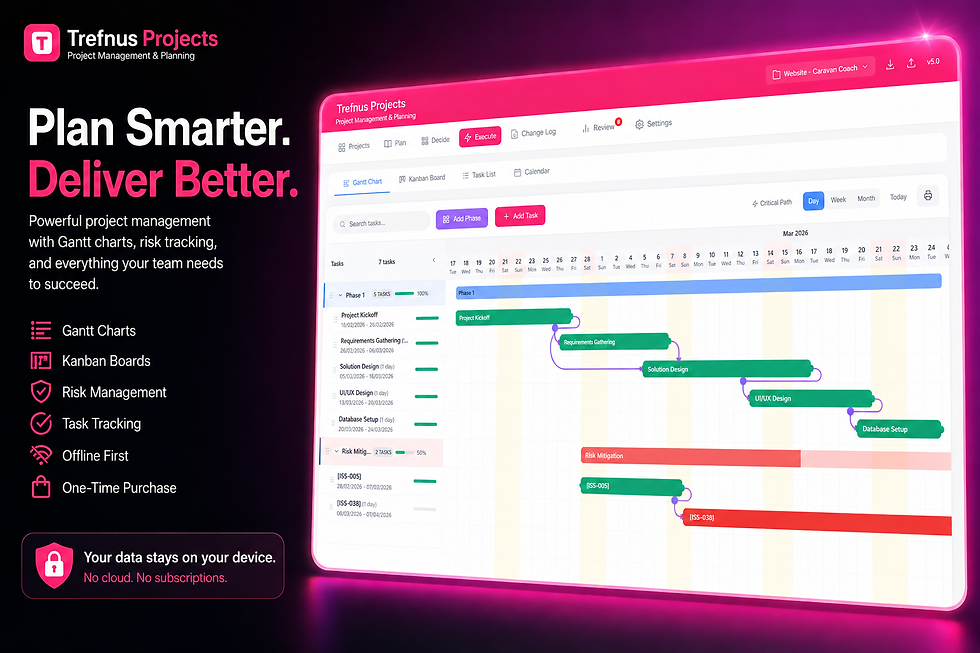
Trefnus Projects Trefnus Projects is an offline-capable project management app that brings your tasks, timelines, and costs into one place. Each task can carry its own budget and cost data, giving you a clear picture of where money is being spent at every level of the project. The built-in Gantt chart with dependency tracking and critical path highlighting makes it straightforward to see which tasks are driving your timeline and your costs. When plans change, you can update tasks and durations quickly using drag-and-drop, and the analysis updates with them. The app works entirely offline, so your project data stays on your own device with no subscription required for daily use. For teams managing multiple projects and looking to bring more discipline to project budget management, it is a practical starting point. Explore Trefnus Projects at: |

Cost Analysis and Decision Making
One of the most valuable applications of project cost analysis is in decision making. When you are evaluating whether to proceed with a project, comparing alternative approaches, or deciding whether to continue after a setback, cost data is central to making a sound judgement.
This is where cost analysis intersects with cost-benefit analysis: the process of weighing the total expected costs of a project against its anticipated benefits. A project may be technically feasible but financially unjustifiable once all costs are properly accounted for. Equally, a project that appears expensive in isolation may look very different when the long-term benefits are factored in.
Building a habit of thorough cost analysis across your projects creates a body of historical data that makes future estimates more reliable and future decisions better informed.
Conclusion
Project cost analysis is not a bureaucratic exercise. It is one of the most practical tools available to any business owner or project manager who wants to deliver work on budget and make confident, data-backed decisions.
The key is consistency. Define your costs clearly, use a structured estimation approach, build in contingency from the start, and track actuals throughout. Whether you are managing a small internal project or a complex multi-team delivery, these principles apply equally.
As your projects grow in scale, having the right tools in place makes the process considerably easier. A clear view of tasks, timelines, and costs in one place reduces the risk of things slipping through the net and gives you the visibility you need to stay in control.
Disclaimer
The information in this article is intended for general guidance only and does not constitute professional legal, financial, or regulatory advice. Always consult a qualified professional for advice specific to your circumstances.


