
How to Estimate Project Timelines Accurately


Published: 11 June 2026 | Last reviewed: 11 June 2026
Missed deadlines are one of the most common causes of project failure, and they almost always trace back to the same root problem: poor timeline estimation. According to PMI's Pulse of the Profession, 48% of projects miss their original deadline, with inaccurate estimates cited as a leading factor. For small and medium-sized businesses, the consequences are especially acute: overrun projects drain budgets, damage client relationships, and demoralise teams.
The good news is that accurate project schedule estimation is a learnable skill. With the right frameworks and a few disciplined habits, you can build schedules that are credible, defensible, and achievable. This guide covers the most effective estimation techniques, the common traps to avoid, and how modern tools can help.
Why Project Timeline Estimation Goes Wrong
Before diving into technique, it is worth understanding why estimates so often miss the mark.
Optimism bias
People consistently underestimate how long tasks will take, particularly when estimating their own work. Psychologists call this the planning fallacy: we plan for best-case conditions rather than realistic ones. When a team member says a task will take three days, they are usually imagining an uninterrupted run of focused work, which rarely reflects reality.
Scope not fully defined
Estimates made before the scope is clear are little more than guesses. Ambiguous requirements lead to hidden tasks surfacing mid-project, which blows timelines apart.
Dependencies overlooked
Many tasks cannot start until others are finished. When those dependencies are not mapped, teams assume work can run in parallel when it cannot, and the schedule collapses the moment one task slips.
No buffer for uncertainty
Even well-planned projects encounter unexpected problems. Without contingency built into the schedule, any deviation sends the project over deadline.
How to Estimate Project Timelines: Core Techniques
There is no single correct method for estimating project timelines. Experienced project managers typically combine several techniques, cross-checking their estimates to arrive at a more credible figure.
1. Work breakdown structure (WBS)
The work breakdown structure is the foundation of any sound estimate. The principle is simple: decompose the project into its smallest constituent tasks. Rather than estimating how long it takes to redesign a company website, you estimate how long it takes to write the homepage copy, design the navigation, code the contact form, and so on.
Breaking work down to this level of granularity forces clarity and surfaces tasks that might otherwise be forgotten.
Start from the project deliverables, not the activities.
Break each deliverable into discrete tasks that can be assigned to a single person.
Stop breaking down when tasks are small enough to estimate confidently, typically one to five days of effort.
To make this concrete, suppose an SME is redesigning its company website. A partial WBS for the project might look like this:
Example: website redesign project Discovery and briefing: 3 days Wireframes and design: 5 days Copywriting: 4 days Development: 10 days Testing and amends: 3 days Total (sequential): 25 working days |
This immediately reveals something important: development cannot begin until designs are approved. If design runs a day over, it pushes development, testing, and the launch date. That single dependency determines the critical path for the whole project.
2. Analogous estimating
Analogous estimating draws on data from similar past projects. If your team delivered a comparable website in six weeks last year, that is a useful baseline, adjusted for differences in scope or complexity. This technique works well in the early stages when detailed planning is not yet possible, provided you are honest about how similar the reference projects actually are.
3. Three-point estimating (PERT)
Three-point estimating, rooted in the Programme Evaluation and Review Technique (PERT), addresses optimism bias directly by requiring three figures for each task:
Optimistic (O): Duration if everything goes smoothly.
Pessimistic (P): Duration if significant problems arise.
Most likely (M): Your best realistic guess.
These are combined using a weighted formula: (O + 4M + P) divided by 6. This produces an expected duration that accounts for uncertainty without arbitrarily padding every task. It is particularly useful for complex or unfamiliar work where the range of possible outcomes is wide.
4. Bottom-up estimating
Once your WBS is in place, bottom-up estimating builds the overall project duration by aggregating individual task estimates. Each task is estimated separately, dependencies are mapped, and the durations are rolled up to produce a total. This is the most time-intensive method, but also the most accurate for projects with clear scopes and experienced teams.
5. Critical path method
The critical path method (CPM) identifies the longest sequence of dependent tasks through a project, which determines the minimum possible project duration. Any task on the critical path cannot be delayed without pushing back the end date. Tasks not on the critical path have float, meaning limited delay can be absorbed without consequence.
In the website example above, the critical path runs through design, development, and testing. Delays in copywriting, assuming it runs in parallel, have no direct effect on the launch date. Knowing this tells you where to focus your attention.
Key takeaway Accurate estimates come from structured decomposition, not intuition. A work breakdown structure and mapped dependencies are more valuable than experience alone. |
This is where modern project planning software becomes especially valuable. Building and maintaining these structures manually in a spreadsheet becomes error-prone as projects grow in complexity.
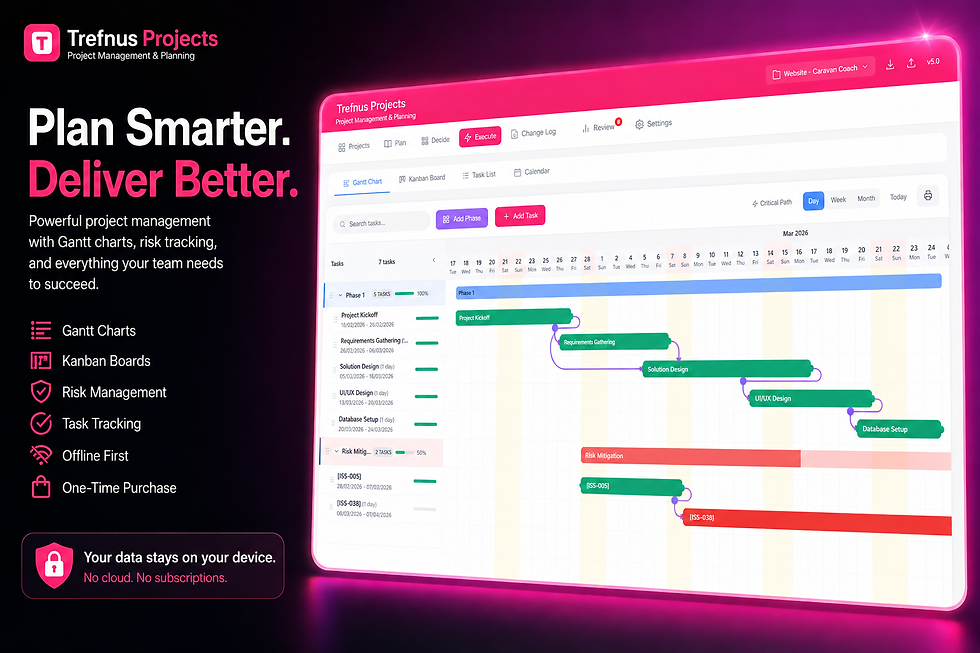
Plan smarter with Trefnus Projects Trefnus Projects includes a full Gantt chart with critical path highlighting, drag-and-drop scheduling, and dependency mapping, giving you everything you need to build and manage accurate project timelines. Available as an offline-capable PWA, it works wherever you do. Explore Trefnus at: |

Building a Credible Project Schedule
Choosing your estimation technique is only part of the job. Translating those estimates into a practical schedule requires a few additional steps.
Map task dependencies
Once you have individual task estimates, identify which tasks depend on others before they can begin. These dependencies shape the sequence of work and determine what can run in parallel. A task that appears straightforward in isolation may sit behind three others that each take a week. Document them explicitly.
Account for resource availability
Your team members are rarely available full time on a single project. An estimate of five days of effort is not the same as five calendar days if the person assigned is only available for three hours a day. When building your schedule, check real availability for each resource, including planned leave and concurrent projects.
Build in contingency
Good project schedules include contingency time to absorb unforeseen problems without immediately blowing the deadline. A common rule of thumb is to add ten to fifteen per cent to your total schedule estimate, adjusted for the risk profile of the project.
Contingency is not the same as padding every task. Padding inflates individual estimates and obscures where the real time is being spent. Hold contingency as a named reserve at the project level, deployed deliberately when genuine issues arise.
Use milestones to structure the timeline
Breaking the schedule into milestones creates natural checkpoints for assessing progress. A milestone marks the completion of a significant deliverable or phase, giving the team clear intermediate goals and giving stakeholders visibility. A project that is on track at every milestone has a very good chance of finishing on time.
Common Mistakes to Avoid When Estimating Timelines
Even project managers who know the right techniques can fall into habits that undermine their estimates.
Not involving the people doing the work: Estimates made without input from the people carrying out the tasks are almost always inaccurate. The person closest to the work has the best understanding of what it involves.
Confusing effort with duration: Effort is the total work hours required. Duration is how long it takes in calendar time. A task requiring 16 hours of effort from someone who is 50% allocated takes four calendar days, not two.
Ignoring lessons from past projects: Teams that do not compare estimates against actuals are condemned to repeat the same errors. Even a brief retrospective after each project generates useful data for future planning.
Treating the initial estimate as fixed: Scope changes and new information emerge during execution. Your schedule should be a living document, updated as circumstances change.
How Project Management Tools Support Better Estimates
Manual scheduling in spreadsheets can work for simple projects, but it becomes difficult to maintain as complexity grows. Dependencies, resource constraints, and progress tracking all benefit from dedicated software.
Effective tools let you visualise your schedule as a Gantt chart, showing task durations, dependencies, and milestones in a single view.
Features to look for include:
Gantt chart with dependency linking and critical path display.
Milestone tracking with progress indicators.
Resource assignment with availability awareness.
Drag-and-drop rescheduling to model changes quickly.
Risk register integration to flag timeline risks as they emerge.
Trefnus Projects is a project management application built for SMEs, offering Gantt chart scheduling, critical path highlighting, dependency mapping, a built-in risk register, and milestone tracking, all in an offline-capable progressive web app. Learn more at trefnus.com/projects.
Frequently Asked Questions
What is the most accurate method for estimating project timelines?
The most accurate method for most projects is bottom-up estimating combined with three-point (PERT) estimates for uncertain tasks. Start by breaking the project into its smallest individual tasks using a work breakdown structure, then estimate each task using optimistic, pessimistic, and most-likely durations. Roll up the individual estimates to produce an overall schedule. This approach is more time-intensive than analogous estimating, but it consistently produces more reliable results, particularly for complex projects where individual tasks vary significantly in duration and risk.
How much contingency should I add to a project timeline?
A common guideline is to add ten to fifteen per cent contingency to your total schedule estimate, though the right amount depends on the risk profile of the project. High-risk projects with significant unknowns or dependence on external parties may warrant twenty per cent or more. Hold contingency as a named reserve at the project level rather than inflating individual task estimates, so you can deploy it deliberately and track how much of the reserve has been consumed as the project progresses.
What is the critical path in project planning?
The critical path is the longest sequence of dependent tasks that runs from project start to project end, determining the shortest possible duration. Any delay to a task on the critical path directly delays the completion date. Tasks that are not on the critical path have float, meaning they can slip by a limited amount without affecting the end date. Identifying the critical path helps you focus risk management and resource attention where they matter most.
How do dependencies affect a project timeline?
Task dependencies define which tasks must be completed before others can begin. When dependencies are not mapped, teams assume work can run in parallel when it cannot, and even a short delay on an upstream task can cascade through the schedule. Mapping all dependencies before finalising the schedule is one of the most important steps in producing a credible timeline.
What is the difference between effort and duration in project scheduling?
Effort is the total work hours required to complete a task. Duration is how long it takes in calendar time, which depends on the assigned person's availability. A task requiring 20 hours of effort from someone who is 50% available takes five calendar days, not 2.5. Confusing effort with duration is one of the most common causes of schedule overruns, particularly where team members split their time across multiple projects.
Further Reading and Official Guidance
Conclusion
Accurate project timeline estimation is not about building in enough slack and hoping for the best. It is about applying structured techniques consistently: decomposing work to a meaningful level of detail, choosing estimation methods that suit the project, mapping dependencies before committing to a schedule, and treating contingency as a managed reserve rather than a fudge factor.
Consistently successful teams are not necessarily working on easier projects. They are usually better at planning realistically before execution begins, and at treating the schedule as a working document rather than a one-off exercise.
If you are looking for tools to support better project planning, Trefnus Projects provides Gantt chart scheduling, critical path analysis, milestone tracking, and risk register functionality in a single offline-capable application. Explore Trefnus Projects at trefnus.com/projects.
Disclaimer
The information in this article is intended for general guidance only and does not constitute professional legal, financial, or regulatory advice. Always consult a qualified professional for advice specific to your circumstances.


