
How to Run a Project Kickoff Meeting


Published: 30 May 2026 | Last reviewed: 30 May 2026
A project kickoff meeting is one of the most important events in any project's lifecycle. Done well, it aligns your team, sets clear expectations, and builds the momentum needed to get off to a strong start. Done poorly, it leaves people confused about their roles, unclear on objectives, and uncertain about what happens next.
According to the Project Management Institute, organisations that undervalue project management report an average of 67% more projects failing outright. A structured launch session will not guarantee success, but it dramatically reduces the misalignment and miscommunication that cause preventable failures. This guide covers how to prepare, run, and follow up on a kickoff so that your team has everything it needs from day one.
What Is a Project Kickoff Meeting?
A kickoff is a formal gathering that marks the official start of a project. It brings together the core team and key stakeholders to agree on goals, clarify roles, review the plan, and establish how the group will communicate and work together throughout delivery.
Kickoffs can be internal (your own team only) or external (including clients, partners, or suppliers). Both serve the same purpose: ensuring everyone starts from the same page before any work begins.
The kickoff is distinct from earlier scoping or planning meetings. By this point, the project brief should be defined, a budget agreed, and the team assembled. The launch session translates that preparation into shared understanding and collective commitment, what the APM describes as a core element of sound project governance.
Why a Structured Kickoff Matters
Many projects run into trouble not because of technical failure, but because of misaligned expectations. Team members may have different assumptions about timelines or deliverables. Stakeholders may hold priorities that were never openly discussed. A well-run initiation session surfaces these issues early, before they become costly.
The core benefits include:
Shared understanding of project goals and success criteria
Clear accountability for each workstream and deliverable
Early identification of risks and constraints
Agreed communication protocols and reporting rhythms
Increased team confidence and engagement from day one
Sample Kickoff Meeting Structure
The following agenda is suitable for a medium-complexity project with a team of four to twelve people. Adjust timings to reflect the scale and complexity of your own project.
Time | Agenda Item | Purpose |
0–5 mins | Welcome and introductions | Build rapport; confirm attendees' roles in the project |
5–15 mins | Project background and objectives | Explain why the project exists and what success looks like |
15–25 mins | Scope and key deliverables | Agree what is in and out of scope; surface any early concerns |
25–35 mins | Roles and responsibilities | Confirm ownership of each workstream; clarify decision-making authority |
35–50 mins | Timeline and milestones | Walk through the plan; flag dependencies and hard deadlines |
50–60 mins | Risks and open issues | Identify known risks; begin the risk register collectively |
60–70 mins | Communication and reporting plan | Agree update frequency, reporting format, and escalation path |
70–80 mins | Questions and next steps | Clear outstanding questions; confirm actions, owners, and deadlines |
Share the agenda with the invitation, at least 48 hours in advance. Attendees who arrive prepared ask better questions and reach decisions faster.
How to Prepare for a Project Kickoff Meeting
Preparation is what separates a productive session from a rambling one. The meeting itself should feel like the culmination of careful planning.
Complete the project brief first
Before anyone joins the kickoff, the project brief should be finished. This document should cover the objectives, scope, key deliverables, timeline, budget, and any known constraints or assumptions. Circulate it at least 48 hours in advance so attendees can come prepared with questions.
Confirm who needs to attend
Invite people who have a direct role in delivering the project or who need to be aligned on its direction. Avoid padding the attendee list: too many people slow discussion and dilute focus. Every person in the room should have a clear reason for being there. For cross-functional teams, make sure each workstream has at least one representative present.
Running the Project Kickoff Meeting
With preparation complete, the session itself should flow naturally. Here is how to manage each stage effectively.
Open with purpose, not process
Begin by welcoming attendees and framing the purpose of the meeting clearly. Avoid going straight into the agenda: open instead with a brief statement of why this project matters and what a successful outcome looks like. This orients the room before diving into detail.
Make introductions purposeful
Where team members do not already know each other, introductions matter. Rather than asking people to state their name and job title, prompt each person to briefly describe their role in the project and one thing they are hoping to get from the session. This makes the opening purposeful rather than procedural, which is particularly important for cross-functional or multi-organisation teams.
Walk through the brief together
Even if the brief was circulated in advance, cover the key elements together in the meeting. Pause at the objectives and ask if anyone has concerns or questions. Do the same at the scope section. Inviting challenge at this stage is far less costly than discovering disagreement once work has begun.
Clarify roles and responsibilities
Unclear ownership is one of the most common causes of project confusion. Confirm who is responsible for each workstream, who makes decisions, and who needs to be consulted or kept informed. A simple RACI framework (Responsible, Accountable, Consulted, Informed) is a useful reference for projects involving many stakeholders, and forms a core part of good stakeholder management.
Review the timeline and milestones
Walk through the high-level plan, including milestones and hard deadlines. Flag dependencies: tasks that cannot start until something else is complete. Ask the team whether the plan looks realistic and note any concerns for follow-up. Committing to an unachievable timeline in the initiation session only creates problems later.
Address risks openly
Every project carries risk. Bringing risks into the open at the start, rather than hoping they will not materialise, builds team confidence and sets a healthy norm for how uncertainty will be handled. Ask the team what they see as the biggest threats to successful delivery. Capture these as the beginning of your risk register.
Agree how the team will communicate
Establish the basics of how the team will stay connected: the frequency and format of progress updates, who owns the project log, how decisions will be recorded, and what the escalation path is if something goes wrong. Agreeing these norms at the start prevents important information from slipping through the gaps later.
End with clear next steps
Dedicate the final few minutes to confirmed actions. Who is doing what, and by when? Write these down in the meeting itself. Before closing, invite any outstanding questions, then confirm when notes will be circulated.
Signs a Kickoff Meeting Has Gone Well
It is not always easy to gauge a meeting's effectiveness in the moment. The following signals are a reliable indicator that the session achieved its purpose.
Every attendee can articulate the project objective without referring to notes
Ownership of each key workstream is confirmed and uncontested
At least one risk has been surfaced and logged
The team leaves knowing when the next progress check-in will happen
Questions raised in the meeting have been captured for follow-up rather than left open
The project brief was challenged, tested, or refined during the session rather than simply accepted
If one or more of these are missing, the gap is worth addressing in the follow-up notes or at the first check-in, before it becomes embedded in the project's working assumptions.
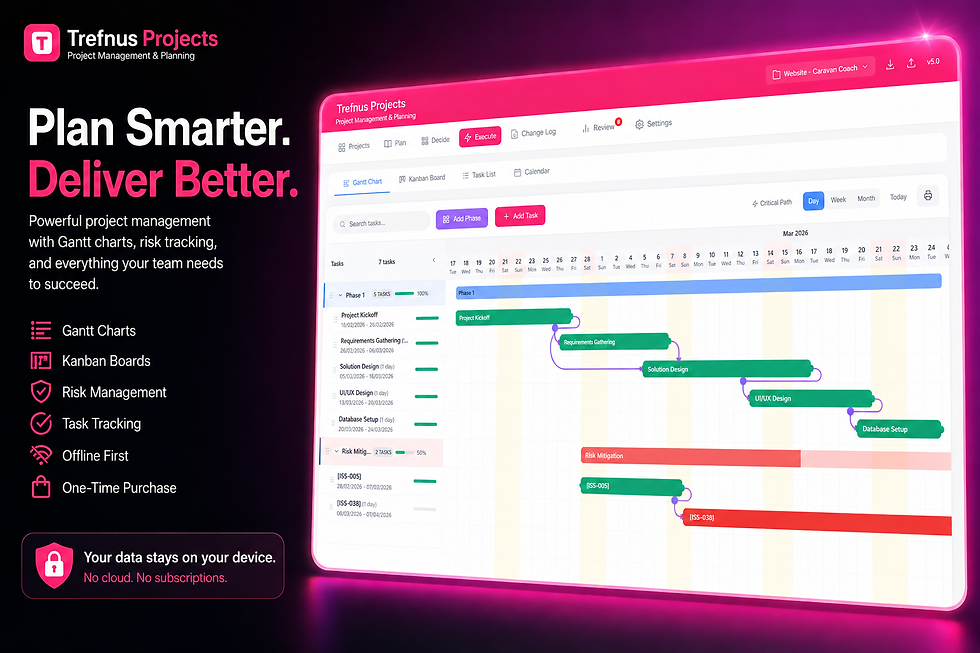
Plan your next project with Trefnus Projects Trefnus Projects is an offline-first project management app with Gantt charts, a Kanban board, risk register, decision matrix, and a built-in project brief view. It installs on any device with no subscription required. Find out more: |

In-Person vs Remote Kickoff Meetings
The principles of a good kickoff apply equally whether your team is in the same room or spread across different locations. However, remote sessions require extra attention on a few specific points.
Remote sessions
Use a video conferencing tool with screen sharing so you can walk through the brief and plan visually
Send all materials in advance; remote participants are less likely to ask for clarification mid-meeting
Build in deliberate time for questions, as remote attendees are less likely to interject naturally
Assign a dedicated note-taker so the meeting facilitator can focus on running the discussion
Keep the session to 90 minutes or less; remote meetings lose energy more quickly than in-person ones
In-person sessions
Use a whiteboard or shared screen for the timeline and risk discussions; visual anchors help groups think together
Arrange seating so that no one is physically peripheral to the group, particularly for cross-functional teams meeting for the first time
Allow slightly more time for informal relationship-building; it pays dividends in a project's later stages
For hybrid sessions, where some attendees are remote and some in the room, the remote participants' experience should be your primary concern. A hybrid kickoff that works well for the room but poorly for those dialling in leaves part of your team already behind.
Following Up After the Kickoff
The kickoff is not the end of the process: it is the beginning of execution. What happens in the 24 to 48 hours afterwards determines whether the energy generated translates into action.
Send meeting notes promptly
Circulate a written summary within 24 hours. This should cover key decisions made, actions agreed, owners assigned, and any open questions still to be resolved. A concise summary is far more useful than a lengthy transcript.
Set up your project management tools
Once the session is done, put the right tools in place. A good project management app lets you build out the task list, assign work, set deadlines, and track dependencies, without juggling spreadsheets.
Trefnus Projects includes a Gantt chart for timeline planning, a Kanban board for tracking task status, a risk register for monitoring identified risks, and a project brief view that keeps the team aligned on objectives. Explore it at .
Schedule the first progress check-in
Book the first progress check-in before the kickoff ends, or within 24 hours of it. A short weekly stand-up is sufficient for most projects. Regular check-ins catch drift early and keep everyone accountable without adding administrative burden.
Common Mistakes to Avoid
Running the session without a brief: without a documented project brief, the kickoff becomes a debate rather than a launch.
Inviting too many people: large groups make discussion unwieldy. Consider a separate stakeholder briefing for those who need to be informed but not actively involved.
Skipping introductions: relationship-building matters, particularly for cross-functional teams or projects with external stakeholders.
Failing to capture decisions and actions: if the session ends without a written record, key commitments will be forgotten or disputed.
Glossing over risks: not addressing risks in the kickoff does not make them go away. It simply means the team is less prepared when they materialise.
No agreed next steps: every kickoff should close with clarity on what happens next. Without confirmed actions and owners, momentum dissipates quickly.
Frequently Asked Questions
What should be included in a project kickoff meeting agenda?
A kickoff agenda should cover: welcome and introductions, project background and objectives, scope and key deliverables, roles and responsibilities, the timeline and milestones, known risks and constraints, communication and reporting arrangements, and agreed next steps. Circulate it to attendees at least 48 hours in advance.
How long should a project kickoff meeting be?
For most projects, 60 to 90 minutes is sufficient. Larger or more complex projects with many stakeholders may need up to two hours. Avoid scheduling more than two hours without a break, as longer sessions lose focus and engagement.
Who should attend a project kickoff meeting?
Include the project manager, core team members who will actively deliver the project, and key stakeholders who need to be aligned on direction. For external projects, this may include client representatives. Avoid inviting people with no active role, as large attendee lists make discussion harder to manage.
What is the difference between a kickoff meeting and a project planning meeting?
A project planning meeting happens during the preparation phase, before the project formally starts. It is used to develop the brief, agree scope, and build the initial plan. A kickoff comes afterwards: it is the moment the project officially launches, and its purpose is to align the assembled team on the plan already developed, confirm roles and commitments, and agree ways of working.
How do you run a remote project kickoff meeting?
Apply the same structure as an in-person session. Use video conferencing with screen sharing, send materials in advance, and build in deliberate discussion time. Assign a note-taker so the facilitator can focus on the group. Keep the session to 90 minutes or less and circulate notes within 24 hours.
Further Reading and Official Guidance
The following resources provide additional guidance on project management principles and best practice.
Conclusion
A project kickoff is one of the highest-leverage activities available to a project manager. When run well, it builds the shared understanding, team alignment, and mutual accountability that underpin successful delivery.
The keys are preparation, structure, and follow-through. Have your brief ready before the session. Run a clear agenda. End with agreed next steps and written notes everyone can refer back to. Then put the right tools in place so your team can track progress, manage risks, and stay aligned as the project moves forward.
If you are looking for a project management tool that brings these elements together in one place, take a look at .
Disclaimer: The information in this article is intended for general guidance only and does not constitute professional legal, financial, or regulatory advice. Always consult a qualified professional for advice specific to your circumstances.


