
Project Portfolio Management for SMEs: A Simple Guide

Updated: Jun 20

Published: 14 June 2026 | Last reviewed: 14 June 2026
Most small and medium-sized businesses do not run one project at a time. They run several, often with the same small team juggling client work, internal improvements, and the occasional fire drill. This is where project portfolio management for SMEs becomes useful. It is not about adopting complex enterprise software or hiring a dedicated portfolio office. It is about getting an honest, cross-project picture of everything happening across the business, so decisions about priorities, resources, and timelines are based on facts rather than guesswork.
In this article, we look at what project portfolio management means for a smaller organisation, why it matters, and how to introduce a practical approach to portfolio planning and project prioritisation.
What Is Project Portfolio Management?
Project portfolio management (PPM) is the practice of managing a group of projects together, rather than treating each one in isolation. Instead of asking ‘is this project on track?’, PPM asks a broader question: ‘given everything we are working on, are we focusing on the right things, with the right people, at the right time?
For larger organisations, PPM often involves formal governance boards, dedicated portfolio managers, and detailed scoring models. For SMEs, the principles are the same, but the execution is lighter. The goal is cross-project visibility and informed prioritisation.
Why Project Portfolio Management Matters for SMEs
Smaller businesses often run into the same set of problems when projects are managed individually, with no shared project register to refer to:
Team members are quietly overloaded because no one can see their full workload across projects
New work gets approved without checking whether the business has the capacity to deliver it
Important projects stall because urgent but lower-value work keeps jumping the queue
Budgets drift because spend is tracked per project, not across the business as a whole
Leadership cannot answer a simple question: ‘what are we actually working on right now, and why?’
A shared portfolio approach solves most of these problems. It requires a consistent way of recording, comparing, and reviewing projects together.
Signs Your SME Has Outgrown Ad Hoc Project Management
Many businesses operate without any portfolio oversight for years, and it works, until it doesn't.
The following signs usually indicate that a more structured approach to multi-project management is overdue:
Deadlines slipping because the same people appear on multiple projects at once
Teams unsure which piece of work takes priority on a given day
Projects starting faster than they finish, leaving a growing backlog of half-completed work
Leadership lacking a single view of everything currently in progress
Frequent context switching between projects, reducing focus and delivery quality
If two or more of these sound familiar, introducing a basic portfolio register and a regular review cycle is likely to pay for itself quickly.
A Typical SME Scenario
Consider a small marketing agency. At any one time, it might be running a website redesign for a client, an internal CRM migration, a recruitment campaign, and a handful of ongoing support retainers.
Viewed separately, each project appears manageable. But the same designer or developer is often quietly involved in all four. Without a consolidated view of who is committed to what, the business has no way of spotting this until deadlines start slipping.
When Does an SME Need Project Portfolio Management?
A useful trigger point is when a business is regularly running two or more projects at once, alongside day-to-day operational work, and decisions about what to prioritise start to feel reactive rather than planned.
At this stage, lightweight portfolio reviews help ensure projects still support current business priorities, rather than simply reflecting whichever client or department asked first. Basic capacity planning, knowing roughly how much time each person has available against what has already been committed, becomes equally important. Both can be achieved with a shared register and a regular review.
Building a Simple Project Portfolio Register
A practical portfolio register for an SME contains the same core information for every project, recorded consistently so projects can be compared side by side.
Core Information to Track per Project
Field | Why It Matters | Example | Update Frequency |
Project name and owner | Clarifies accountability | Website redesign, owner: Sarah | On creation |
Status (not started, active, on hold, complete) | Gives a quick health check across the portfolio | Active | Weekly |
Priority level | Helps decide what gets resources first | High | Monthly review |
Start and target end date | Highlights overlapping deadlines | 1 Mar to 30 Jun | On creation, reviewed monthly |
Estimated cost and budget | Supports business-wide budget visibility | £12,000 of £15,000 spent | Monthly |
Key dependencies or risks | Flags issues before they cause delays | Awaiting supplier quote | Weekly |
Many SMEs start with a single spreadsheet or shared board listing each project against these fields. The key is consistency: every project should be recorded and reviewed the same way.
Prioritising Projects Across the Portfolio
Once projects are recorded in a shared register, the next step is project prioritisation. A few approaches work well for SMEs:
Score Projects Against a Few Simple Criteria
Rather than relying on gut feel or who asked loudest, score each project against a handful of consistent criteria, such as expected business impact, urgency, cost, and resource requirements. A basic scoring exercise, done consistently, makes prioritisation far more objective.
Review the Portfolio on a Regular Cycle
A monthly portfolio review, even if it only takes thirty minutes, allows the business to ask: are these still the right projects? Has anything changed that affects priorities? Should anything be paused, accelerated, or stopped?
Be Honest About Capacity
One of the most common portfolio failures in SMEs is approving new projects without checking whether anyone has the time to deliver them. A rough resourcing summary, hours per person per week against current commitments, prevents over commitment.
Know When to Stop a Project
Effective portfolio management also means being willing to pause, defer, or stop initiatives that no longer justify the time or budget they require. A project that made sense six months ago may no longer align with current priorities, and continuing it by default, simply because it is already underway, is one of the most common ways SMEs lose capacity that could be better spent elsewhere.
As the number of projects grows, spreadsheets and shared documents often become harder to maintain consistently, particularly once dependencies, timelines, and resourcing all need to be visible together. At that point, teams often spend more time maintaining trackers than using them to make decisions. This is where dedicated portfolio tools can help.
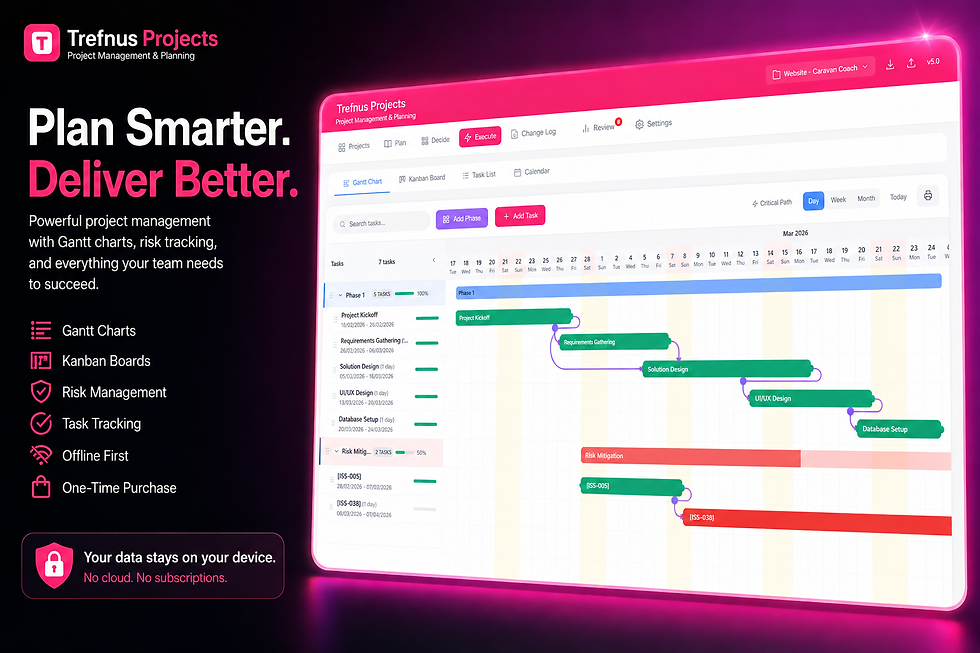
Manage Your Project Portfolio with Trefnus Projects Trefnus Projects brings Gantt charts, Kanban boards, risk registers, and dependency tracking together in one offline-first tool. It gives SMEs portfolio oversight across multiple projects, helping teams prioritise work and spot scheduling conflicts before they become problems. Explore Trefnus at: |

Balancing Resources Across Multiple Projects
Resource conflicts are one of the biggest sources of friction in SMEs running multiple projects.
A few practical steps help reduce this:
Maintain a consolidated record of who is working on what, updated weekly
Flag any team member assigned to more than two active projects for review
Build in buffer time for unplanned work, such as client queries or urgent fixes
Use dependency tracking to identify when one project's delay will affect another A tool that visualises dependencies and timelines across projects, such as a Gantt chart with critical path highlighting, makes resourcing conflicts visible well before they cause missed deadlines.
Common Project Portfolio Management Mistakes to Avoid
Treating every project as urgent: if everything is high priority, nothing is. Be willing to rank projects against each other.
Skipping regular reviews: a portfolio register that is never revisited becomes outdated within weeks.
Ignoring small projects: minor projects still consume time and budget, and should appear in the register even if briefly.
Overcomplicating the process: a simple system used consistently beats a sophisticated one that is abandoned after a month.
Frequently Asked Questions
What is the difference between project management and project portfolio management?
Project management focuses on delivering a single project successfully, covering tasks, timelines, and budgets for that piece of work. Project portfolio management looks across all projects at once, helping a business decide which projects to prioritise, how to allocate shared resources, and whether the overall mix of work aligns with business goals. In short, project management asks ‘how do we deliver this project well?’, while portfolio management asks ‘are we working on the right projects overall?’
Do small businesses really need project portfolio management?
Any business running more than one project at a time benefits from some form of portfolio management. Without it, teams often discover too late that they are overcommitted, that priorities have shifted without anyone noticing, or that two projects are competing for the same resources. A shared register of all active projects, reviewed regularly, delivers most of the benefit with minimal overhead.
How often should an SME review its project portfolio?
A monthly review is a practical starting point for most SMEs, giving enough time for meaningful progress between reviews while still catching priority changes, resourcing issues, or budget drift early. Businesses with fast-moving client work may benefit from a fortnightly or weekly check instead. The exact frequency matters less than consistency: a regular, predictable review cadence the team can rely on.
What tools can SMEs use for project portfolio management?
Many SMEs start with a shared spreadsheet listing active projects with status, priority, owner, and key dates. This works initially but becomes harder to maintain as the number of projects grows. Dedicated project management tools that support multiple projects, Gantt charts, Kanban boards, and dependency tracking offer a more scalable alternative, particularly when they provide a clear overview across projects rather than just within one. The right choice depends on the number of projects, team size, and how much detail needs to be tracked.
How do you prioritise projects when everything seems important?
Define a small number of consistent criteria, such as business impact, urgency, cost, and resources required, and score each project against them rather than relying on instinct or whoever asked most recently. This gives an objective basis for ranking projects and makes prioritisation decisions easier to explain to stakeholders. Reviewing these scores regularly, particularly when new projects are proposed, helps keep the portfolio realistic and well balanced.
Conclusion
Project portfolio management for SMEs is about helping businesses make better decisions about where limited time, budget, and people should be focused, rather than reacting to whichever project is loudest that week.
Start by bringing all current projects into a single register, agreeing a few consistent fields to track, and setting a regular review cadence. From there, tools that support multi-project management with shared timelines, dependency tracking, and clear status reporting can help the portfolio stay organised as the business grows. If you would like to see how this works in practice, explore Trefnus Projects to manage your portfolio in one place.
Further Reading and Official Guidance
The information in this article is intended for general guidance only and does not constitute professional legal, financial, or regulatory advice. Always consult a qualified professional for advice specific to your circumstances.


