
How to Do a SWOT Analysis for Small Businesses


Published: July 2026 | Last reviewed: July 2026
Most small business owners carry a rough sense of what is working and what is not. A SWOT analysis takes that instinct and turns it into something you can actually act on. It is a simple planning tool that asks four questions: what are you good at, where are you exposed, what could you take advantage of, and what could catch you out.
For a small or medium-sized business, a SWOT analysis for small businesses does not need to be a lengthy strategic exercise. For most small businesses, a useful SWOT analysis can be completed in one or two hours, producing a clear, one-page view of your position that can shape decisions on everything from pricing to staffing to which new customers to chase.
This guide walks through how to apply the SWOT framework properly, with a worked example and practical tips for turning your findings into action. The approach in this guide reflects common strategic planning practices used by SMEs, and draws on the same principles found in guidance from recognised UK business and project management organisations.
What Is a SWOT Analysis?
SWOT stands for Strengths, Weaknesses, Opportunities and Threats. Strengths and weaknesses are internal factors, things about your business that you have a degree of control over. Opportunities and threats are external factors, things happening in your market, industry or wider economy that you need to respond to rather than control.
The output is usually presented as a simple SWOT matrix: a four-box grid with one quadrant for each element, as shown below.
Strengths Internal factor | Weaknesses Internal factor |
Opportunities External factor | Threats External factor |
That format is popular because it forces a balanced view. Business owners often focus on either what is going well or what is going wrong. Working through all four quadrants creates a more balanced assessment.
A SWOT analysis is not a one-off document to file away. Many businesses build it into their annual planning cycle, or revisit it whenever they are considering a significant change, such as launching a new product, taking on premises, or entering a new market.
Why Small Businesses Benefit from a SWOT Analysis
Larger organisations often have dedicated strategy or research teams to track market conditions and competitor activity. Small businesses rarely have that luxury, which makes a structured review even more valuable; it is a way of stepping back from day-to-day operations to look at the bigger picture.
A well-run SWOT analysis for small businesses helps you to:
Identify genuine competitive advantages, rather than assuming you know what sets you apart
Spot weaknesses before they become urgent problems, such as an over-reliance on a single supplier or member of staff
Prioritise limited time and budget towards the opportunities most likely to pay off
Prepare for external threats, from new competitors to rising costs, rather than reacting to them after the fact
Create a shared reference point when discussing strategy with a business partner, investor or bank
How to Carry Out a SWOT Analysis for Your Small Business
The process itself is straightforward, but the quality of the result depends on how honestly and specifically each section is completed. The following steps offer a practical structure to follow.
Step 1: Set a Clear Objective
Decide what the SWOT analysis is for before you start. A general review of the whole business is useful, but a SWOT analysis focused on a specific decision, such as whether to open a second location or add an online shop, tends to produce sharper, more usable results.
Step 2: Involve the Right People
Where possible, involve more than one perspective. A sole trader may need to do this alone, but in a team of any size, input from staff who deal directly with customers, suppliers or day-to-day operations often surfaces issues the owner has not considered. Group input also reduces individual bias and uncovers issues that might otherwise be overlooked.
Step 3: Identify Your Strengths
List what your business does well and where it has a genuine edge. Useful prompts include: what do customers consistently praise, what do you do more efficiently or cheaply than competitors, and what skills, assets or relationships does the business hold that others do not?
Step 4: Identify Your Weaknesses
This step requires honesty rather than defensiveness. Consider where processes are inefficient, where costs are higher than they should be, where the business depends too heavily on one person, product or customer, and where competitors consistently outperform you.
Step 5: Identify Your Opportunities
Look outward at your market, industry and local area. Opportunities might include changes in customer behaviour, gaps left by a struggling competitor, new technology that could reduce costs, or funding and grant schemes aimed at small businesses.
Step 6: Identify Your Threats
Threats are external factors that could negatively affect the business if left unaddressed: new entrants to the market, rising supplier or energy costs, regulatory changes, or shifts in the economy that affect customer spending.
Step 7: Prioritise and Validate the Findings
A completed SWOT grid can easily run to twenty or thirty points across the four boxes. Not all of them carry equal weight. Go back through each quadrant and mark the two or three items in each that would have the biggest impact on the business if acted upon or left unaddressed. This shortlist is what should drive your next steps.
A Business SWOT Analysis Example: Local Plumbing Business
Generic statements rarely make a SWOT analysis memorable. A specific, business-relevant example is more useful, both as a worked illustration and as a SWOT analysis template you can adapt for your own business.
Imagine a local plumbing business with a handful of engineers. The owner has built up a strong local reputation over several years, but is now weighing up how to grow further. Applying the SWOT framework might produce something like this:
Strengths | Weaknesses |
• 150+ five-star Google reviews and strong word-of-mouth • Skilled, experienced team of engineers • Fast response times on emergency call-outs • Low overheads compared to national franchises | • Owner handles every quotation personally, limiting capacity • Limited marketing beyond word-of-mouth • No formal system for tracking parts stock • Cash flow tightness during quiet winter months |
Opportunities | Threats |
• Growing local demand for heat pump installations • Potential to offer maintenance contracts for recurring revenue • Government grants supporting low-carbon heating uptake • Partnerships with local builders and estate agents | • Larger national franchises entering the local area • Rising costs of parts, fuel and insurance • Changing regulations around gas and heating engineers • Economic uncertainty affecting customer spending |
From this grid, the priorities are fairly clear. The 150 five-star reviews are a genuine asset worth promoting more actively, the owner's role as a bottleneck on quotations needs a fix before the business can grow, and heat pump demand is a specific, time-limited opportunity worth acting on before national franchises establish a local presence.
Turning Your SWOT Analysis into an Action Plan
A SWOT analysis only creates value once it leads to decisions and action. Once you have prioritised the key points in each quadrant, the next step is to convert each one into a specific, measurable task with an owner and a deadline, rather than leaving it as a general intention.
Concrete targets make this much more useful. If a strength is an experienced sales team, the action might be to increase outbound prospecting by a set percentage over the next quarter. If a weakness is reliance on a single supplier, the action might be to identify two alternative suppliers within the next month. Converting each SWOT finding into a measurable task makes the exercise far more valuable than simply completing the grid.
For anything more complex than a handful of quick fixes, it helps to manage this as a proper project rather than a loose list of good intentions.
Once your SWOT analysis is complete, many businesses follow it up with:
A decision matrix, to weigh up competing opportunities and decide where to invest first
A formal risk register, to log and track any threats identified so they are reviewed rather than forgotten
A short project plan for the highest-priority actions, with owners and deadlines
A quarterly review, to revisit the SWOT analysis and check whether priorities have shifted
This is where a dedicated planning tool earns its keep. Turning a SWOT analysis into a Gantt chart or task board gives each action a clear owner, a deadline and a way to track progress, rather than leaving it as a static document that nobody revisits.
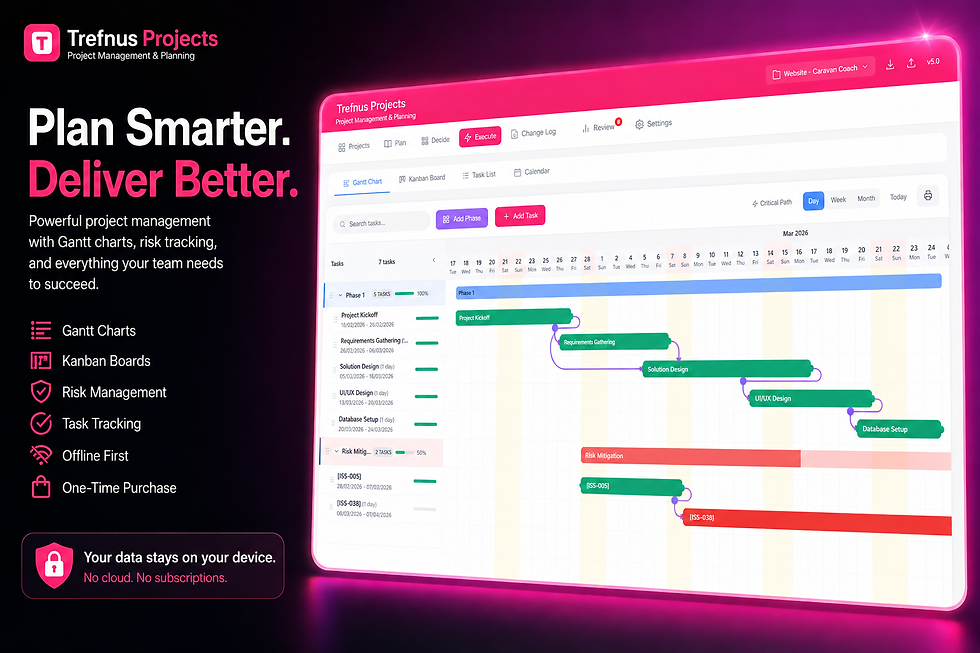
Trefnus Projects Once your SWOT analysis has identified priority actions, Trefnus Projects gives you the tools to plan and track them: Gantt charts for scheduling, a decision matrix for weighing up options, a risk register for logging threats, and a Kanban board for day-to-day execution. It works offline in the browser, so your planning data stays with you rather than depending on a constant internet connection. Explore Trefnus Projects: |

Common SWOT Analysis Mistakes to Avoid
Being too vague: Statements like "good customer service" or "strong competition" are not specific enough to act on. Push for detail: which customers, which competitors, and why.
Treating it as a one-off exercise: Markets and businesses change. A SWOT analysis from two years ago may no longer reflect reality.
Only involving one perspective: An owner's view of the business can differ significantly from that of staff or customers.
Confusing internal and external factors: Strengths and weaknesses are about your business; opportunities and threats are about the environment around it. Mixing them up weakens the analysis.
Stopping at the grid: A completed SWOT analysis that never leads to an action plan has limited value beyond the exercise of writing it.
Frequently Asked Questions
How often should a small business do a SWOT analysis?
Most small businesses benefit from revisiting their SWOT analysis at least once a year as part of routine business planning, and again whenever a significant change is being considered, such as a new product launch, a change in premises, or a notable shift in the market or competitive landscape.
Can I do a SWOT analysis on my own, or do I need a team?
A sole trader or very small business can complete a useful SWOT analysis alone, provided the process is approached honestly and with enough time set aside to think it through properly. That said, involving even one or two other people, whether staff, a business partner or a trusted adviser, tends to surface points a single perspective would miss, particularly around weaknesses and blind spots.
What is the difference between a SWOT analysis and a risk register?
A SWOT analysis is a broad strategic snapshot covering internal strengths and weaknesses alongside external opportunities and threats, typically used for planning and decision-making. A risk register is a more detailed, ongoing tool focused specifically on identifying, scoring and tracking individual risks, usually including the likelihood and impact of each one and who is responsible for managing it. Many businesses use a SWOT analysis to identify high-level threats, then feed the most significant ones into a formal risk register for closer tracking.
Should opportunities and threats only cover the external environment?
Yes. A common mistake is to list internal issues, such as a lack of skills or cash flow pressure, under opportunities or threats when they actually belong under strengths or weaknesses. Opportunities and threats should relate to factors outside the business, such as market trends, competitor activity, regulation, the economy or technology, that the business does not directly control.
How detailed should each quadrant of a SWOT analysis be?
There is no fixed rule, but three to six specific, well-evidenced points per quadrant is usually more useful than a long, generic list. The aim is to capture what genuinely matters to the business right now, not to exhaustively catalogue every possible factor. Prioritising a short list of the most significant points in each quadrant makes the analysis easier to act on.
What comes after a SWOT analysis?
Once the grid is complete, the priority is turning findings into action. Most businesses take the two or three most significant points from each quadrant and convert them into specific, measurable tasks with an owner and a deadline. For anything beyond quick fixes, this often means weighing up options with a decision matrix, logging threats in a formal risk register, building a short project plan for the highest-priority actions, and revisiting the whole analysis on a quarterly basis to keep it current.
Further Reading and Official Guidance
Disclaimer
The information in this article is intended for general guidance only and does not constitute professional legal, financial, or regulatory advice. Always consult a qualified professional for advice specific to your circumstances.


