
Decision Matrix Explained: How to Make Better Business Decisions


Published: 29 June 2026 | Last reviewed: 29 June 2026
Why Structured Decision-Making Matters
Businesses rarely struggle to find options. They struggle to compare them objectively. A decision matrix provides a structured framework for evaluating alternatives against weighted criteria, making decisions more transparent, easier to justify, and far less dependent on gut feeling alone.
In this guide, we explain what a decision matrix is, how to build one step by step, and when it is most useful for business owners and project managers.
What Is a Decision Matrix?
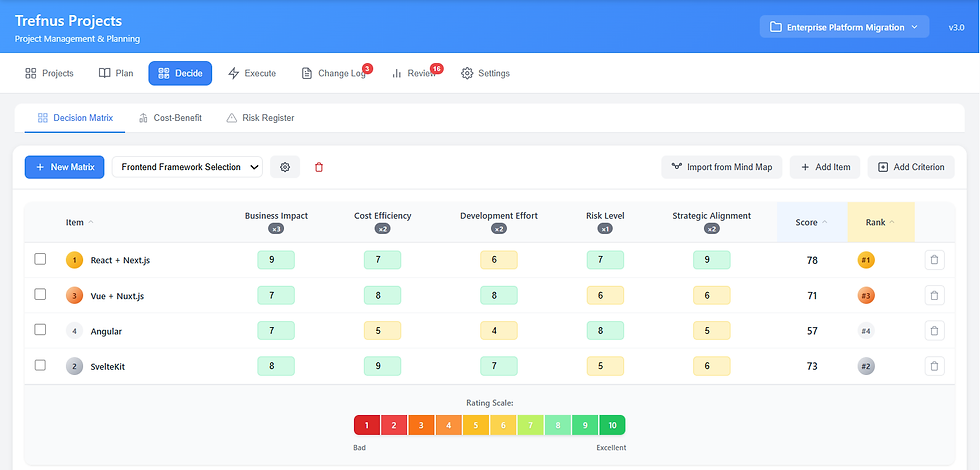
A decision matrix (also known as a weighted decision matrix, weighted scoring model, or multi-criteria decision analysis) is a table that lists your options as columns and your evaluation criteria as rows. Each criterion is given a weight that reflects its importance. You then score each option against each criterion, multiply the score by the weight, and total up the results.
The option with the highest weighted total is, objectively, the best fit for your stated priorities.
Multi-Criteria Decision Analysis (MCDA) has well-established academic foundations, having been developed and formalised in operations research and management science since the 1960s. The decision matrix is the practical, business-facing form of those principles: structured enough to be rigorous, simple enough for any team to use without specialist training.
It is worth noting that a prioritisation matrix is a related but distinct tool: it ranks a list of items (such as tasks or features) rather than comparing discrete options. Both rely on weighted scoring, but they answer different questions.
Decision matrices are widely used in project management, procurement, product development, and strategic planning.
They work particularly well when:
Several options appear broadly similar on the surface
Multiple stakeholders have different priorities
A decision needs to be documented and justified
Emotion or personal preference risks clouding judgement
How to Build a Decision Matrix: A Step-by-Step Guide
Step 1: Define the Decision
Start with a clear problem statement. For example: 'We need to select a project management tool for our team of twelve.' A well-defined question keeps your criteria focused and prevents scope creep in the analysis.
Step 2: List Your Options
Identify the options you are comparing. Aim for two to five realistic alternatives. Too many options make the matrix unwieldy; too few limit its value. For example: Option A (SaaS tool), Option B (spreadsheet), Option C (hybrid approach).
Step 3: Identify Your Criteria
List the factors that matter to your decision. Keep to five to eight criteria to maintain clarity.
Common criteria for a software selection might include:
Cost (initial and ongoing)
Ease of use
Integration with existing systems
Scalability
Risk of team adoption failure
Step 4: Assign Weights
Not all criteria are equally important. Assign a percentage weight to each one so that the weights total 100%. Using percentages that total 100% makes each criterion's influence immediately visible and ensures the weighted scores remain directly comparable across options. For example, cost might carry 30% if budget is the primary constraint, while scalability might carry only 15% for a small team unlikely to grow rapidly.
Involving your team in setting weights is valuable. It surfaces differing priorities early and builds buy-in for the final decision.
Step 5: Score Each Option
Score each option against each criterion, typically on a scale of 1 to 10 (where 1 is very poor and 10 is excellent). Be as objective as possible. If you have data, use it. If you are estimating, note your assumptions.
See the scoring guide below for reference:
Score | Meaning | Example |
1-3 | Poor fit or significant drawbacks | Very expensive; poor support |
4-6 | Acceptable but with limitations | Meets basic needs; limited scalability |
7-8 | Good fit with minor issues | Easy to use; mostly integrates well |
9-10 | Excellent fit; strong advantage | Seamlessly integrates; highly scalable |
Step 6: Calculate the Weighted Scores
For each option and criterion, multiply the raw score by the weight (expressed as a decimal). For example, if cost has a weight of 30% (0.30) and Option A scores 6, the weighted score is 1.8.
Total the weighted scores for each option. The highest total indicates the strongest overall fit.
Step 7: Review and Sense-Check
The decision matrix produces a recommendation, not a mandate.
Before committing, review the results:
Does the winning option feel right given what you know?
Are any criteria underweighted or missing?
Are the scores defensible if questioned by stakeholders?
If the numbers point strongly in one direction but your instinct pushes back, revisit your weights. The matrix may be correct, or it may reveal an assumption worth challenging.
A Worked Example: Selecting a Project Management Tool
The table below shows a completed decision matrix for a small business choosing between three approaches to project management.
Criteria | Weight (%) | Option A: Dedicated Tool | Option B: Spreadsheet | Option C: Hybrid |
Cost | 30% | 6 (1.8) | 9 (2.7) | 7 (2.1) |
Ease of Use | 25% | 8 (2.0) | 5 (1.25) | 7 (1.75) |
Integration | 20% | 9 (1.8) | 4 (0.8) | 7 (1.4) |
Scalability | 15% | 9 (1.35) | 3 (0.45) | 6 (0.9) |
Team Adoption Risk | 10% | 7 (0.7) | 6 (0.6) | 8 (0.8) |
Weighted Total | 100% | 7.65 | 5.80 | 6.95 |
In this example, Option A (the Dedicated tool) scores highest with a weighted total of 7.65, driven by strong performance on integration and scalability. Option B (the spreadsheet) performs well on cost but falls short on integration and scalability. Option C (the hybrid approach) offers a balanced middle ground but does not excel in any single category.
Although Option B scored highest on cost, the greater weighting given to integration and ease of use meant the dedicated solution delivered a higher overall value. This illustrates why weighting criteria is often more important than the raw scores themselves: a 9 on a low-weight criterion contributes far less than a 7 on a high-weight one.
The matrix gives the team a clear, shared basis for the decision, with every assumption visible and open to challenge.
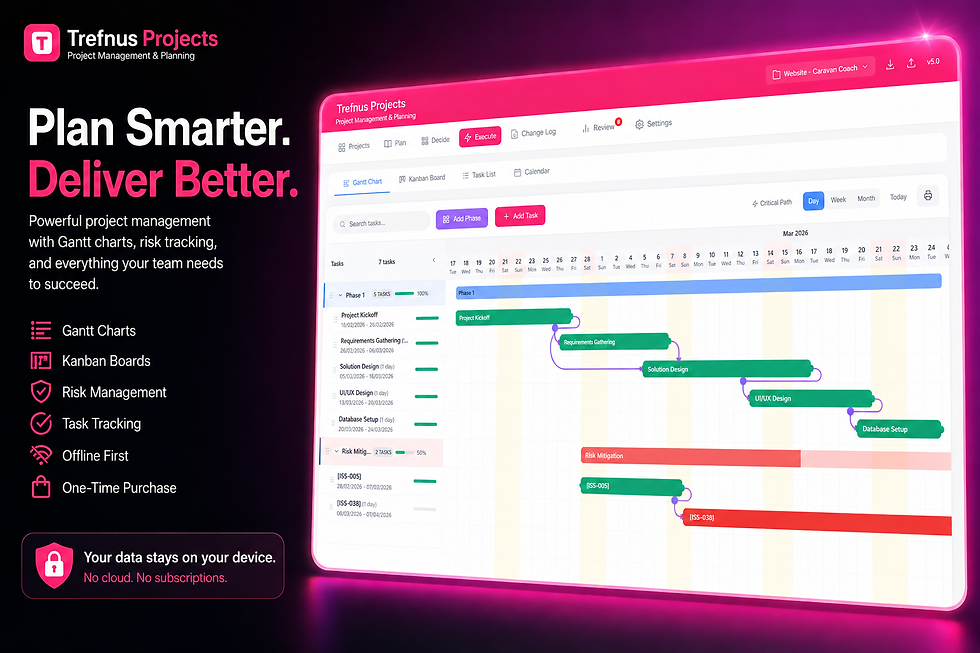
Make Smarter Decisions with Trefnus Projects Trefnus Projects includes a built-in Decision Matrix tool with weighted scoring, so your team can evaluate options consistently and document decisions in one place. Ideal for project managers and business owners who need structure without the spreadsheet headaches. Explore Trefnus Projects: |

Common Mistakes to Avoid
Ignoring Weights Altogether
A simple unweighted matrix treats every criterion as equally important. This is rarely true in practice. Always assign weights that reflect your actual priorities.
Scoring Retrospectively
If you already have a preferred option in mind, there is a temptation to score in a way that confirms it. Agree on your criteria and weights before you start scoring.
Too Many Criteria
More than eight or nine criteria dilutes the analysis and makes the matrix harder to explain to others. Focus on the factors that genuinely differentiate your options.
Treating the Matrix as Final
A decision matrix is a decision support tool, not a replacement for professional judgement. Use it alongside other evidence, stakeholder input, and contextual knowledge.
When Is a Decision Matrix Most Useful?
A decision matrix adds the most value in situations where the stakes are meaningful and the options are genuinely comparable.
Typical use cases include:
Software or tool selection
Supplier or contractor evaluation
Project prioritisation when resources are constrained
Choosing between strategic initiatives or product features
Hiring decisions where multiple candidates are closely matched
When a Decision Matrix Is Not the Right Tool
A decision matrix is not suited to every situation. Applying it where it does not fit adds complexity without adding value.
Avoid it in the following circumstances:
Urgent operational decisions: When speed is essential, the time required to build and score a matrix is a liability. A quick RACI or rapid team consensus is more appropriate.
Obvious yes/no choices: If one option is clearly superior on every meaningful criterion, the matrix will confirm the obvious. Use that time elsewhere.
Decisions with insufficient information: Scoring options you do not yet understand well enough produces false precision. Gather the information first.
Highly values-based or ethical decisions: Some decisions turn on principles that resist quantification. A matrix can inform them but should not drive them.
Recognising these limits is not a criticism of the tool. It is a sign of using it well.
Decision Matrix vs Other Decision-Making Frameworks
The decision matrix is one of several structured approaches to decision-making. Understanding where it fits alongside other tools helps you choose the right method for the situation.
Eisenhower Matrix: Best for prioritising tasks by urgency and importance. Useful for day-to-day time management rather than complex multi-option comparisons.
SWOT Analysis: Useful for exploring the strategic context of a single option rather than comparing alternatives.
Cost-Benefit Analysis: Focuses on financial return. Complements a decision matrix when cost is a key criterion but cannot capture qualitative factors on its own.
Risk Register: Helps you identify and manage risks associated with a chosen option once a decision has been made.
In practice, a decision matrix often works best as part of a broader toolkit, used alongside a risk register to evaluate options and then manage the risks of the preferred choice.
Frequently Asked Questions
What is a decision matrix used for?
A decision matrix is used to compare multiple options against a set of weighted criteria in order to identify the most suitable choice objectively. It is commonly used in project management, procurement, software selection, and strategic planning. By scoring and weighting each factor, it reduces the influence of personal bias and gives stakeholders a transparent basis for the final decision.
How do you weight criteria in a decision matrix?
Each criterion is assigned a percentage that reflects its relative importance, with all weights totalling 100%. The weighting process should involve the key decision-makers so that priorities are agreed before scoring begins. For example, if cost is the most critical factor, it might carry 30 to 40% of the total weight, while secondary considerations such as aesthetics or vendor reputation might carry 5 to 10% each.
What is the difference between a decision matrix and a weighted decision matrix?
A basic decision matrix scores each option against each criterion but does not account for the relative importance of those criteria. A weighted decision matrix adds a percentage weight to each criterion so that more important factors have a greater influence on the final score. In most business contexts, the weighted version gives a more accurate and defensible result.
Can a decision matrix be used for hiring decisions?
Yes. A decision matrix can be a useful tool in shortlisting and comparing candidates, particularly when several applicants are closely matched. Criteria might include relevant experience, technical skills, cultural fit, and interview performance. Weighting these factors in advance helps ensure that every candidate is assessed consistently and that the process is transparent. It should be used alongside structured interviews and other evaluation methods, not as the sole basis for a hiring decision.
How many options should a decision matrix include?
Between two and five options is generally the most practical range. Fewer than two makes the tool redundant; more than five can make the matrix unwieldy and difficult to communicate to stakeholders. If you have more than five options, consider a preliminary filter to narrow the field before applying the full matrix.
What are the limitations of a decision matrix?
A decision matrix is only as reliable as the criteria, weights, and scores that go into it. If weights are set to confirm a predetermined preference, or if scores are subjective and poorly calibrated, the output will be misleading. It also captures a snapshot in time: if priorities change, the matrix should be revisited. For very complex decisions, a decision matrix should be one input among several rather than the sole determinant.
Further Reading and Useful Resources
The following resources provide additional guidance on decision-making frameworks and project management best practice:
Mind Tools: Decision Matrix Analysis — A practical guide to building and using decision matrices in professional settings.
APM Body of Knowledge — The Association for Project Management's authoritative reference on project decision-making.
Trefnus Projects — Built-in decision matrix and risk register tools for small and medium-sized project teams.
CIPD: Evidence-Based Decision Making — Guidance on applying structured thinking to business and people management decisions.
Journal of Multi-Criteria Decision Analysis (Wiley) — The leading academic journal covering the theoretical and applied foundations of MCDA and weighted scoring models.
Conclusion
A decision matrix will not make difficult decisions disappear, but it will make them easier to navigate. By forcing you to define your priorities, score your options consistently, and document your reasoning, it transforms a subjective debate into a structured conversation.
For business owners and project managers dealing with competing priorities and limited resources, that clarity is genuinely valuable. Whether you are choosing software, selecting a supplier, or ranking a list of potential projects, a well-built decision matrix gives every stakeholder a shared language and a transparent basis for moving forward.
If you manage projects regularly, consider using a tool that integrates decision-making with your wider project workflow. Trefnus Projects includes a built-in Decision Matrix alongside risk registers, Gantt charts, and Kanban boards, so your decisions and your delivery plans live in the same place.
Disclaimer: The information in this article is intended for general guidance only and does not constitute professional legal, financial, or regulatory advice. Always consult a qualified professional for advice specific to your circumstances.


