How to Build a Preventive Maintenance Schedle


When equipment breaks down unexpectedly, the cost goes far beyond the repair bill. There is lost productivity, delayed orders, emergency contractor fees, and in some cases, safety risks for your team. For small and medium-sized businesses, these unplanned failures can be genuinely damaging.
A preventive maintenance schedule is one of the most effective ways to stay ahead of those problems. Rather than waiting for something to go wrong, you plan maintenance in advance, keep assets in good working order, and avoid the chaos of reactive repairs.
This guide walks you through how to build a preventive maintenance schedule from scratch, covering everything from identifying your assets to tracking completed work, and explains why having the right system in place makes the whole process far easier to manage.
What Is a Preventive Maintenance Schedule?
A preventive maintenance schedule is a planned programme of regular inspections, servicing, and upkeep tasks carried out on equipment, vehicles, buildings, or other assets before problems arise. It is sometimes referred to as planned preventive maintenance (PPM) or simply a PPM schedule.
Rather than responding to faults as they occur, preventive maintenance is proactive. Tasks are scheduled based on time intervals, usage levels, or manufacturer recommendations, ensuring that assets are kept in good condition throughout their working life.
A well-built schedule will include:
A complete list of assets that require maintenance
The specific tasks required for each asset
How frequently each task needs to be carried out
Who is responsible for completing each job
A way to record that work has been done
The result is a predictable, organised approach to maintenance, rather than a constant cycle of emergency repairs.
Why Preventive Maintenance Matters for Small Businesses
Larger businesses often have dedicated maintenance teams and significant capital reserves to absorb unexpected repair costs. Smaller businesses rarely have that cushion. For an SME, a single piece of failed equipment can halt operations entirely.
Here are the key reasons why building a preventive maintenance schedule should be a priority:
Reduced Downtime
Scheduled maintenance is carried out at a time that suits your business, not at the worst possible moment. By identifying wear and potential failures early, you dramatically reduce the risk of unexpected breakdowns.
Lower Repair Costs
Catching a problem early is almost always cheaper than dealing with it after a full failure. Regular servicing also extends the working life of assets, reducing how often they need to be replaced.
Compliance and Safety
Many industries have legal requirements around the inspection and maintenance of equipment, lifting gear, fire safety systems, and vehicles. A documented maintenance schedule provides evidence that you are meeting those obligations.
Better Planning and Budgeting
When you know what maintenance is coming up and when, it is far easier to plan labour, budget for parts, and coordinate with contractors. Reactive repairs are unpredictable and hard to budget for. Planned maintenance is not.
Improved Asset Performance
Well-maintained equipment simply performs better. It is more efficient, more reliable, and safer to use, which ultimately makes your entire operation run more smoothly.
How to Build a Preventive Maintenance Schedule: Step by Step
Building a preventive maintenance schedule does not have to be complicated. Follow these steps to create a system that works for your business.
Step 1: Create a Complete Asset Inventory
Before you can schedule maintenance, you need to know exactly what you are maintaining.
Walk through your site and compile a full list of every asset that requires upkeep, including:
Machinery and production equipment
Vehicles and plant
HVAC and electrical systems
Fire safety equipment and alarms
IT infrastructure and servers
Buildings, roofs, and drainage
For each asset, record key details such as make, model, serial number, age, and location. This becomes the foundation of your entire maintenance programme.
Step 2: Define the Maintenance Tasks for Each Asset
Once you have your asset list, work out what maintenance tasks each asset requires.
Good sources of information include:
Manufacturer manuals and service recommendations
Relevant industry standards or regulations
Previous service records or known failure points
Input from the people who operate the equipment day to day
Break tasks down into specific, actionable jobs rather than vague categories. For example, instead of 'service the compressor', list individual tasks such as 'check oil level', 'inspect belts for wear', and 'clean air filter'.
Step 3: Set Maintenance Frequencies
Not every task needs to happen at the same interval. Some checks are daily, others weekly, monthly, quarterly, or annual. Frequency should be based on manufacturer guidance, usage levels, and any applicable legal requirements.
Maintenance Type | Typical Frequency | Example Tasks |
Daily checks | Every working day | Fluid levels, tyre pressure, visual inspection |
Weekly servicing | Every 7 days | Equipment cleaning, belt tension, lubrication |
Monthly inspection | Every 30 days | Filter replacement, calibration checks |
Quarterly service | Every 3 months | Deep cleaning, wear part replacement, testing |
Annual overhaul | Once per year | Full strip-down, part replacement, compliance check |
For assets with high usage, you may also want to tie maintenance to machine hours or odometer readings rather than fixed calendar dates, which gives a more accurate picture of actual wear.
Step 4: Assign Responsibilities
Every task on your schedule needs a named owner, either a specific employee or a contracted service provider. Without clear ownership, jobs get missed and accountability disappears.
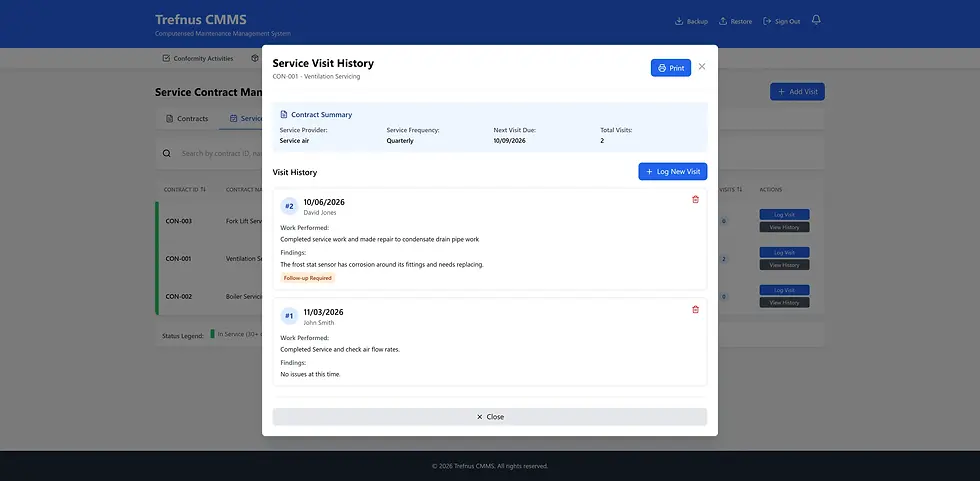
Where specialist knowledge or certification is required, make sure the task is assigned to someone qualified to carry it out. For contractors, record their contact details, qualifications, and any relevant contract renewal dates alongside the task.
Step 5: Record and Track Completed Work
A preventive maintenance schedule is only as good as the records that back it up.
For each completed task, you should record:
The date the work was carried out
Who completed it
Any faults found or parts replaced
The date of the next scheduled service
These records are essential for spotting recurring issues, proving compliance, and building an accurate picture of each asset's maintenance history over time.
Step 6: Review and Refine Regularly
Your maintenance schedule is not a static document. Review it at least once a year, or whenever you acquire new assets, lose old ones, or notice that a particular piece of equipment is failing more frequently than expected.
Use your service records to identify patterns. If the same fault keeps recurring on a particular asset, it may indicate that the maintenance frequency needs to increase, or that the asset is nearing end of life.
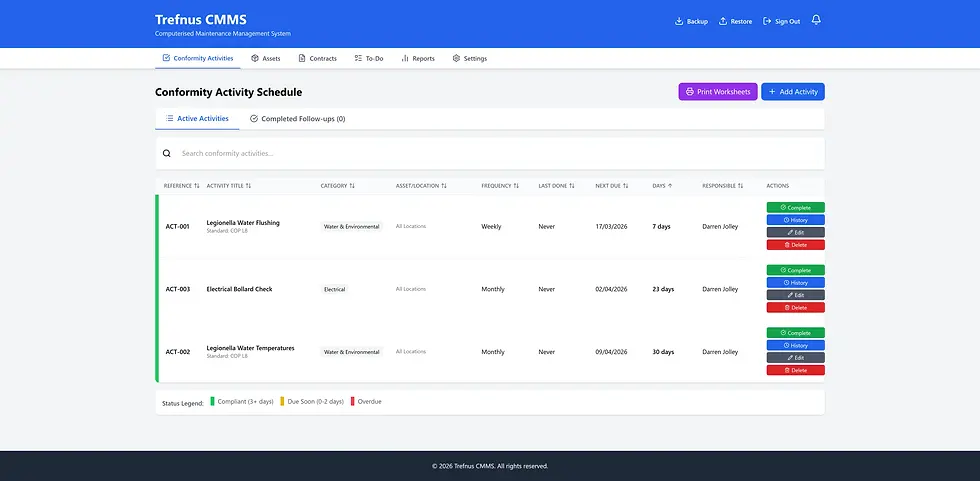
Manage Your Maintenance Schedule with Trefnus CMMS Trefnus CMMS is a browser-based maintenance management system built for small and medium-sized businesses. It allows you to log all your assets, schedule recurring maintenance activities, track completed jobs, manage contractor contracts, and record defects, all in one place.
The app works offline, requires no backend server, and can be installed on any device. Whether you are managing a single site or multiple locations, Trefnus CMMS gives you a clear, structured system for staying on top of your maintenance programme.
Explore Trefnus CMMS at: |

Common Mistakes to Avoid When Building a Preventive Maintenance Schedule
Even businesses that set out with the best intentions can fall into habits that undermine their maintenance programme. Here are the most common pitfalls and how to avoid them.
Common Mistake | Why It Happens | How to Avoid It |
No documented asset list | Maintenance handled reactively and informally | Start with a full asset inventory before scheduling anything |
Overly ambitious schedules | Copying generic templates without context | Match frequency to actual usage and manufacturer guidance |
No assigned ownership | Assuming someone will just do it | Name a specific person or role for each task |
Ignoring historical data | No record of past failures or service history | Log every job completed, including faults found |
Set and forget | Schedules created once and never updated | Review and update the schedule at least once a year |
Spreadsheets, Paper, or Dedicated Software: What Should You Use?
Many businesses start their preventive maintenance schedule on a spreadsheet or even a paper-based logbook. That is a perfectly reasonable starting point, and it is far better than nothing. However, as your asset list grows and the number of scheduled tasks increases, a manual system starts to show its limitations.
Here is a quick comparison:
Approach | Advantages | Limitations |
Paper logbooks | Simple, no cost, familiar | Easy to lose, no reminders, hard to search |
Spreadsheets | Low cost, flexible, portable | Manual updates, no automation, version control issues |
CMMS software | Automated scheduling, full asset history, reminders, reporting | Requires initial setup time |
Dedicated maintenance management software, often called a CMMS (Computerised Maintenance Management System), automates much of the administrative work involved in running a preventive maintenance programme. It can send reminders when tasks are due, store complete asset histories, manage contractor details, and generate reports, all without relying on someone manually updating a spreadsheet.
For businesses managing more than a handful of assets, or where compliance documentation is important, making the move to dedicated software tends to pay for itself quickly in time saved and breakdowns avoided.
Conclusion
Building a preventive maintenance schedule is one of the most practical steps a business owner can take to protect their assets, reduce costs, and avoid the disruption of unplanned breakdowns. The process is straightforward: know what you have, decide what each asset needs, set realistic intervals, assign responsibility, and keep records.
Start simple if you need to. Even a basic schedule is vastly better than no schedule at all. As your confidence grows, you can refine the frequency of tasks, improve your record-keeping, and eventually move to software that handles much of the administration for you.
If you are ready to move beyond spreadsheets, Trefnus CMMS offers a straightforward, offline-capable system designed for small and medium-sized businesses. It brings your asset list, maintenance schedule, contractor management, and defect tracking together in one place, making it easier to stay organised and in control.
Try Trefnus CMMS at: trefnus.com/cmms
Disclaimer
The information in this article is intended for general guidance only and does not constitute professional legal, financial, or regulatory advice. Always consult a qualified professional for advice specific to your circumstances.