
Contractor Management: A Practical Guide for SMEs


What Is Contractor Management and Why Does It Matter?
If your business relies on external contractors, whether for maintenance, specialist services, or ongoing site work, how well you manage those relationships has a direct impact on your operations, costs, and compliance.
Contractor management refers to the processes and systems businesses use to oversee contractors throughout the entire engagement lifecycle. This includes onboarding, scheduling, performance tracking, compliance verification, and contract administration.
For small and medium-sized businesses, poor contractor management is one of the most common and costly blind spots. Work gets missed, compliance documents lapse, and there is no clear record of what was done, when, or by whom. This guide covers what good contractor management looks like and how to put it into practice.
The Real Cost of Poor Contractor Management
The consequences of an unstructured approach to contractor management go beyond inconvenience. Here are the most common problems businesses face without a clear system in place.
Compliance Gaps
Contractors are legally required to hold relevant certifications, insurance, and qualifications for the work they carry out. Without a system to track expiry dates and renewal requirements, businesses can unknowingly allow unlicensed or uninsured contractors on site, exposing themselves to legal liability.
Missed Servicing and Maintenance
Equipment, facilities, and assets require regular attention. When contractor visits are arranged informally and tracked by memory or email threads, scheduled servicing gets delayed or forgotten entirely. This leads to equipment failures, increased repair costs, and potential health and safety issues.
No Audit Trail
When something goes wrong on site, the first question asked is often what work was done and when. If contractor visits are not properly recorded, it becomes difficult to identify the root cause, defend against claims, or meet reporting obligations.
Supplier Relationship Problems
Contractors who are poorly managed often become unreliable suppliers. Without clear agreements, defined response times, and consistent communication, quality tends to drift and disputes become more likely.
The Key Components of Effective Contractor Management
Good contractor management is not just about paperwork. It is about building structured, repeatable processes that give you visibility and control across every contractor engagement.
1. Contractor Onboarding
Before any work begins, a structured onboarding process ensures you have everything you need from a contractor.
This typically includes:
Proof of relevant qualifications and certifications
Public liability and employer's liability insurance
Health and safety policies and risk assessments
Signed contracts outlining scope, rates, and service level expectations
Emergency contact details and site access procedures
A well-designed onboarding checklist reduces the risk of compliance issues later and sets the tone for a professional working relationship from the outset.
2. Contract and SLA Management
Service Level Agreements (SLAs) define what a contractor is expected to deliver and under what conditions. Documenting these expectations clearly means both parties understand their obligations and there is a reference point if any dispute arises.
Key elements to include in contractor SLAs are response times for call-outs, frequency of scheduled visits, quality standards, reporting requirements, and payment terms.
3. Scheduling and Activity Tracking
Contractor visits should be planned in advance and recorded on completion. Whether a contractor is attending for a routine inspection, reactive repair, or major servicing, having a clear log of activities allows you to:
Confirm that work has been completed to standard
Track upcoming service intervals and avoid gaps
Provide evidence of maintenance for insurance and warranty purposes
Identify patterns in recurring defects or failures
4. Compliance Document Tracking
Certifications, insurance policies, and regulatory documents have expiry dates. A robust contractor management system should alert you when documentation is due for renewal, so you are never caught out by lapsed credentials.
This is particularly important in industries such as construction, food service, healthcare, hospitality, and facilities management, where regulatory requirements are strict and the consequences of non-compliance are serious.
5. Performance Monitoring
Tracking contractor performance over time helps you identify which suppliers consistently deliver good work and which are causing problems.
Key metrics to monitor include:
• Adherence to agreed response times
• Quality of completed work and frequency of rework
• Number of defects raised following contractor visits
• Cost versus budget for individual jobs
• Reliability and communication
Regular performance reviews give you the information you need to make better decisions when renewing contracts or selecting suppliers for new work.
Common Contractor Management Mistakes to Avoid
Relying on Email and Spreadsheets
Many businesses track contractor activity across a mix of email threads, spreadsheets, and paper records. While these tools have their place, they are not designed for contractor management. Information gets siloed, version control becomes a problem, and it is impossible to get a real-time picture of what is outstanding or overdue.
Below is a comparison of the most common approaches and how they stack up against a dedicated system.
Approach | Visibility | Compliance Risk | Scalability | Cost Efficiency |
Spreadsheets | Low | High | Poor | Low |
Email-based Tracking | Very Low | Very High | Very Poor | Low |
Paper Records | None | Critical | None | Very Low |
CMMS Software | High | Low | Excellent | High |
No Defined Escalation Process
When a contractor fails to show up, misses a deadline, or completes work to a poor standard, businesses without a clear process often resort to informal complaints or simply accept the situation. Having a defined escalation process, with documented steps and timeframes, protects your business and puts you in a much stronger position if the relationship needs to end.
Allowing Credentials to Lapse
Letting contractor certifications or insurance policies expire before being renewed is a compliance risk that many businesses only discover after the fact. A proactive system for tracking document expiry dates is not optional; it is a basic requirement of responsible contractor oversight.
Not Conducting Site Inductions
Even experienced contractors who have worked with your business before should complete a site induction when beginning a new project or returning after an extended absence. Site conditions, risks, and access procedures can change, and a brief induction process reduces the risk of accidents and misunderstandings.
Building a Contractor Management System That Works
You do not need an enterprise-level procurement department to manage contractors effectively. What you do need is a consistent process, supported by the right tools.
Start With a Contractor Register
A contractor register is a central record of all the contractors and suppliers your business uses. For each contractor, it should capture contact details, the type of work they carry out, their certification and insurance status, and a history of engagements.
This single source of truth is invaluable when you need to check a contractor's credentials quickly, find out when they last visited, or pull together documentation for an audit.
Use Scheduled Maintenance to Drive Contractor Visits
Rather than arranging contractor visits reactively, build a planned maintenance schedule that specifies when each piece of equipment or facility requires attention and which contractor is responsible. This proactive approach reduces emergency call-outs, extends asset life, and ensures nothing is overlooked.
Log Every Visit and Activity
Every contractor visit should be recorded, including the date, the work carried out, any issues identified, and confirmation of completion. This creates an audit trail that can be referenced for compliance purposes, warranty claims, or internal review.
Review Contracts Regularly
Contractor agreements should be reviewed at least annually. Check that SLAs still reflect your current requirements, that rates remain competitive, and that the scope of work accurately reflects what is actually being delivered. Contracts that are not reviewed tend to drift out of alignment with operational reality.
Key Contractor Management Terms
Familiarity with the following terminology will help you communicate clearly with contractors, legal advisers, and compliance teams.
Key Contractor Management Terms | |
Contractor Onboarding | The process of registering a new contractor, verifying credentials, and setting expectations before work begins. |
Service Level Agreement (SLA) | A formal agreement defining the scope, response times, and quality standards expected from a contractor. |
Compliance Documentation | Certificates, insurance documents, and qualifications that contractors must hold to work legally on your premises. |
Preventive Maintenance | Scheduled servicing carried out by contractors to prevent equipment failure rather than respond to it. |
Audit Trail | A chronological record of all contractor activity, used for accountability and regulatory compliance. |
Defect Management | The process of logging, tracking, and resolving faults identified during or after contractor work. |
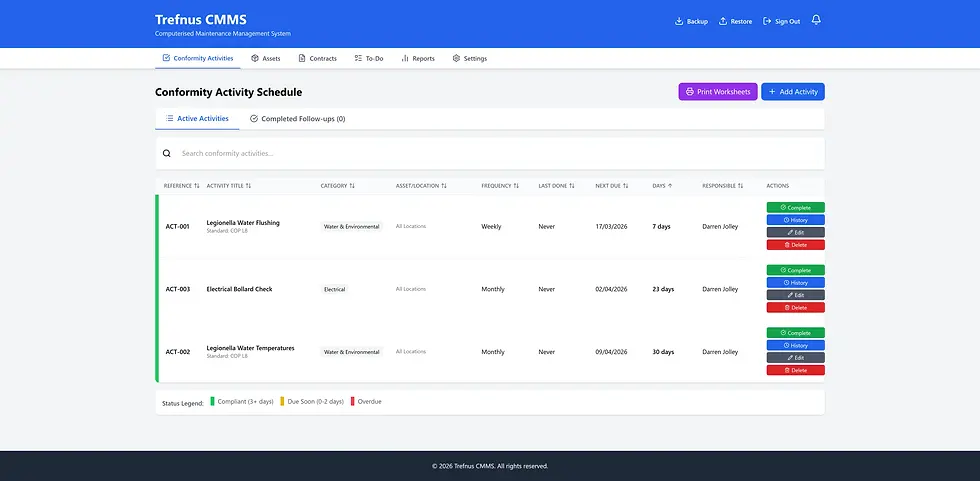
Trefnus CMMS Trefnus CMMS is designed to help small and medium businesses take control of contractor management. With dedicated modules for contract tracking, maintenance scheduling, activity management, and asset oversight, you can log contractor visits, set recurring service intervals, track defects, and keep a full audit trail, all without relying on spreadsheets or paper records. Find out more at |

Summary
Contractor management is one of those operational areas that businesses often underinvest in until something goes wrong. A missed service visit, a lapsed certification, or an undocumented repair can turn a minor issue into a significant liability.
The good news is that building a robust contractor management system does not require a large budget or a dedicated team. It requires clear processes, consistent documentation, and the right tools to keep everything in one place.
Start by auditing your current approach. Are all your contractor credentials up to date? Do you have a record of every visit and activity completed in the last twelve months? Is there a clear schedule for upcoming servicing? If the answer to any of these is no, it is worth taking action now rather than waiting for a problem to force your hand.
A dedicated maintenance management tool can make this significantly easier by giving you a single platform to manage contracts, schedule activities, log defects, and track compliance, all without the complexity of enterprise software.
Explore Trefnus CMMS at trefnus.com/cmms to see how it can support your contractor management processes.


