
What Is a Service Level Agreement and Why Does Your Business Need One?

Updated: Apr 9
Whether you provide services to clients or rely on third-party suppliers to keep your operations running, a service level agreement (SLA) is one of the most important documents you can put in place. An SLA defines exactly what is expected from each party, what happens when things go wrong, and how performance will be measured.
Yet many small and medium businesses either skip SLAs entirely or rely on vague verbal commitments that leave everyone exposed when disputes arise. This guide explains what a service level agreement is, what it should contain, and how to manage SLAs effectively so your business is protected.
What Is a Service Level Agreement?
A service level agreement is a formal contract between a service provider and a customer (or internal department) that sets out the standard of service to be delivered. It acts as a shared reference point, making clear what both parties have committed to and providing a framework for resolving any issues that arise.
SLAs are commonly used in:
IT and software services, such as uptime guarantees or helpdesk response times
Facilities management and maintenance contracts
Outsourced functions such as payroll, cleaning, or security
Internal departments, for example between an IT team and the rest of the business
The key principle of any service level agreement is that it creates accountability. Without one, both sides may have very different expectations about what the service involves, what constitutes a failure, and who is responsible for fixing it.
What Should a Service Level Agreement Include?
A well-written SLA does not need to be lengthy, but it does need to be precise. The following elements are typically included.
Service Description
This section defines the scope of the service being provided. It should be specific enough to avoid ambiguity. For example, rather than stating 'maintenance services', it should specify which assets are covered, what types of maintenance are included, and any exclusions.
Performance Metrics and Targets
SLAs are built around measurable targets, often referred to as service level objectives (SLOs).
Common examples include:
Response time: how quickly the provider will acknowledge an issue
Resolution time: how quickly the issue will be resolved
Uptime percentage: the proportion of time a system or service is available
Completion rate: the percentage of tasks completed within a defined period
These metrics should be realistic, measurable, and agreed upon by both parties before the contract is signed.
Responsibilities of Each Party
An SLA should be clear about what the customer or client is also expected to do. For example, the customer may need to report faults within a certain timeframe, provide access to premises, or supply certain information. Shared responsibility prevents disputes where one party claims the other caused the failure.
Monitoring and Reporting
Good SLAs include a reporting process so both sides can track performance over time. This might involve monthly reports, regular review meetings, or access to a shared dashboard. Regular monitoring ensures problems are identified early rather than building into larger disputes.
Consequences for Failing to Meet Targets
This section, sometimes called service credits or remedies, sets out what happens if the provider fails to meet the agreed targets. Remedies may include financial penalties, extended contract terms, or priority escalation. This is one of the most important parts of any SLA because it gives the agreement real teeth.
Review and Termination Terms
An SLA should specify how often it will be reviewed and what the process is for making changes. It should also include the conditions under which either party can end the agreement, including notice periods and acceptable grounds for termination.
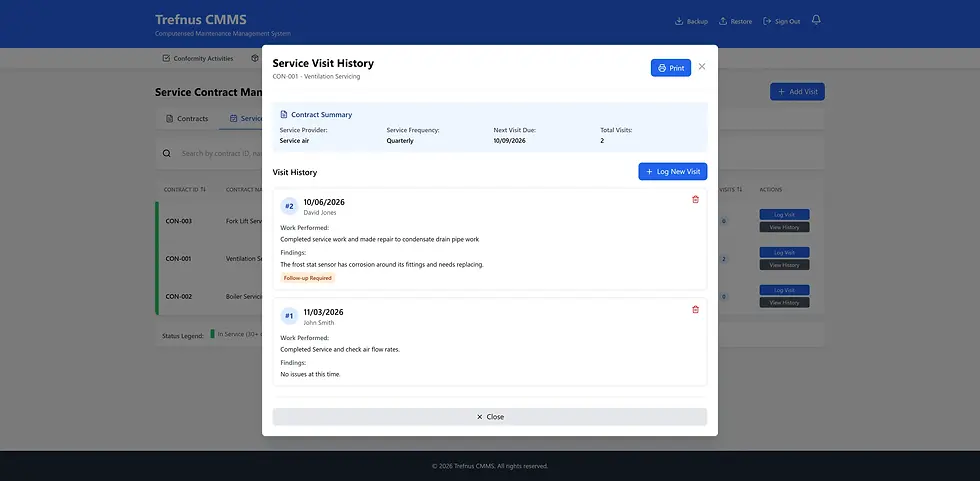
Managing Maintenance SLAs with Trefnus CMMS If your business relies on contractors or internal maintenance teams, keeping track of SLA commitments can quickly become a challenge. Trefnus CMMS is a maintenance management application designed to help businesses log and track maintenance activities, monitor asset conditions, and manage service contracts with renewal alerts. With a dedicated contract management module that tracks service visit schedules, upcoming renewals, and completion records, Trefnus CMMS gives you the visibility you need to hold suppliers accountable and stay on top of your SLA obligations. Explore Trefnus CMMS at: |

Why Small and Medium Businesses Need Service Level Agreements
It is a common misconception that SLAs are only necessary for large organisations. In reality, small and medium businesses arguably need them more, because they often have less capacity to absorb the impact of poor service and fewer resources to pursue disputes after the fact.
Protecting Your Business from Service Failures
Without a written SLA, you have little recourse if a supplier consistently underperforms. You may have no agreed standard to point to, no agreed remedy, and no formal process for escalation. A clear SLA gives you leverage and ensures your supplier takes their obligations seriously from the outset.
Setting Clear Expectations
Disputes often arise not because one party acted in bad faith, but because each side had a different understanding of what was agreed. A written SLA removes this ambiguity by documenting expectations in plain terms. It also protects the service provider, who can point to the agreement if a customer makes unreasonable demands outside the agreed scope.
Improving Service Quality Over Time
When performance is measured and reported regularly, both parties are motivated to maintain standards. Suppliers who know their performance is being tracked tend to be more responsive. Customers who review reports regularly are better placed to identify patterns and address issues before they escalate.
Common Mistakes to Avoid When Writing an SLA
Even businesses that use SLAs sometimes fall into avoidable traps. Here are the most common mistakes to watch out for.
Using Vague Language
Terms like 'reasonable timeframe' or 'as soon as possible' are almost useless in an SLA because they cannot be measured. Every performance target should have a specific, numerical value attached to it.
Focusing Only on Penalties
While consequences for failure are important, an SLA that is entirely punitive can damage the working relationship. The best SLAs are collaborative documents that encourage both parties to succeed, with fair remedies as a backstop rather than the primary focus.
Failing to Review Regularly
Business needs change. An SLA written three years ago may no longer reflect the current scope of the service, the volume of work, or the technology involved. Build in a regular review cycle, at least annually, to ensure the agreement remains fit for purpose.
Neglecting Internal SLAs
SLAs are not only for third-party contracts. Internal SLAs between departments, such as IT responding to helpdesk requests or HR processing payroll queries, can be just as valuable. They promote accountability, reduce friction, and help teams prioritise their workload effectively.
How to Manage Service Level Agreements Effectively
Signing an SLA is only the beginning. The real value comes from actively managing the agreement throughout its lifetime.
Track performance data consistently, using software or spreadsheets to log response times, completion rates, and any incidents
Hold regular review meetings with your supplier or service provider to discuss performance and address any concerns before they escalate
Document any breaches formally and in writing, noting the date, the nature of the failure, and the agreed remedy
Keep records of all communications related to the SLA, including change requests, escalations, and approvals
Review the agreement before each renewal period to ensure it still reflects the current service requirements
For businesses managing multiple contracts or maintenance schedules, dedicated software can make SLA tracking far more manageable. A system that logs contract dates, service visits, and completion records reduces the risk of renewals being missed or obligations going untracked.
Service Level Agreement vs Contract: What Is the Difference?
A common point of confusion is the distinction between an SLA and a broader commercial contract. The two are related but not the same.
A commercial contract sets out the legal terms of a business relationship, including payment, liability, intellectual property, and dispute resolution. An SLA sits within or alongside this contract and deals specifically with the performance standards for the service being delivered.
In practice, many businesses incorporate their SLA into the body of the main contract, while others maintain them as separate documents referenced by the contract. Either approach can work, provided both documents are consistent with each other and clearly signed off by both parties.
Conclusion
A well-constructed service level agreement is one of the simplest and most effective ways to protect your business, whether you are the provider or the recipient of a service. By defining expectations clearly, establishing measurable targets, and putting a monitoring process in place, you give yourself the best possible chance of maintaining a productive, dispute-free working relationship.
For businesses that rely on maintenance contractors or manage their own internal maintenance teams, keeping on top of service contracts and SLA commitments can become complex quickly. A structured approach, supported by the right tools, makes all the difference.
If you manage maintenance operations, explore Trefnus CMMS, an offline-first maintenance management application with built-in contract tracking, asset management, and activity scheduling to help you stay in control of your service obligations.
Disclaimer
The information in this article is intended for general guidance only and does not constitute professional legal, financial, or regulatory advice. Always consult a qualified professional for advice specific to your circumstances.


