How to Calculate Holiday Entitlement for Part-Time Employees


Published: 15 August 2026 | Last reviewed: 15 August 2026
Working out holiday entitlement for part-time employees is one of the most common sources of payroll error in UK small businesses. The principle sounds simple enough. Part-time staff are entitled to the same statutory 5.6 weeks of holiday as full-time staff, with that entitlement expressed in proportion to their working pattern. In practice, the arithmetic trips people up, particularly when bank holidays, shift patterns or mid-year changes to hours are involved.
Get it wrong and you risk an underpayment claim, a claim that a part-time worker has been treated less favourably than a comparable full-time colleague, or simply a demoralised employee who feels short-changed. This guide sets out the legal basis, the main calculation approaches for common working patterns, worked examples you can copy, and the mistakes that appear most often in real payrolls.
Quick answer A part-time employee who works the same number of days every week is entitled to 5.6 times their days worked per week. Someone working three days a week gets 16.8 days of statutory holiday a year, and someone working four days a week gets 22.4 days. If their shifts differ in length, calculate in hours instead by multiplying weekly hours by 5.6. A bank holiday falling on a day the employee does not normally work cannot be deducted from their entitlement. |
What part-time employees are legally entitled to
Under the Working Time Regulations 1998, almost everyone classed as a worker in the UK is entitled to 5.6 weeks of paid annual leave each year. For someone working five days a week, that is 28 days. Part-time workers who work regular hours across the whole year are entitled to the same 5.6 weeks, but because their week is shorter, this amounts to fewer than 28 days.
The key point is that the statutory entitlement is 5.6 weeks, not a fixed number of days. For a regular part-time worker, a week means their normal working week. Someone who works three days a week therefore gets 5.6 x 3 = 16.8 days.
Two pieces of law sit behind this:
The Working Time Regulations 1998 set the 5.6 week statutory minimum and the way leave accrues.
The Part-time Workers (Prevention of Less Favourable Treatment) Regulations 2000 make it unlawful to treat a part-time worker less favourably than a comparable full-time worker without objective justification.
In practice, this means part-time workers should receive holiday and other contractual benefits on a pro rata basis where appropriate, and their statutory entitlement must not be reduced below the amount they are legally entitled to.
There is a cap. Statutory entitlement stops at 28 days, so an employee working six days a week is still only legally entitled to 28 days, not 33.6. This cap rarely affects part-time staff, but it matters if you employ people on compressed or six-day patterns.
Contractual entitlement above the statutory minimum
If you offer full-time staff more than the legal minimum, say 33 days including bank holidays, that enhanced allowance must be pro rated for part-time staff too. Offering full-timers 33 days while giving part-timers only the statutory 5.6 weeks would be less favourable treatment. Whatever your full-time figure is, that is the number you pro rate from.
How to calculate holiday entitlement for part-time employees
For part-time workers on regular hours across the whole year, the statutory entitlement is 5.6 weeks, and there are three practical ways to express it depending on the working pattern. These are calculation approaches, not three separate legal regimes. Irregular hours and part-year workers accrue leave differently, which is covered later in this article.
Approach 1: fixed days of equal length, calculate in days
This is the simplest and most common case. The employee works the same number of days every week, and each day is roughly the same length.
Days worked per week x 5.6 = annual entitlement in days
An employee working three days a week is entitled to 3 x 5.6 = 16.8 days. An employee working four days a week is entitled to 4 x 5.6 = 22.4 days.
When that employee takes a day off, you deduct one day from the balance. Because their working day is their unit of leave, no further adjustment is needed.
Approach 2: fixed weekly hours, calculate in hours
If the employee works a set number of hours each week but spreads them unevenly, or works partial days, hours are a cleaner unit than days.
Hours worked per week x 5.6 = annual entitlement in hours
An employee working 20 hours a week is entitled to 20 x 5.6 = 112 hours of paid holiday a year. When they book time off, you deduct the number of hours they would otherwise have worked on those days.
This method is particularly useful for retail, hospitality and care settings where a part-time week might be a four-hour shift on Monday, a nine-hour shift on Saturday and nothing in between. Deducting whole days in that situation either overcharges or undercharges the employee depending on which day they book.
Approach 3: fixed days of differing lengths, calculate in days then convert to hours
Some employees work a fixed number of days but with very different hours on each. This is not a separate legal method, it is a conversion step. There is no specific rule in the legislation dictating how to handle uneven daily hours, and government guidance suggests calculating the entitlement in days first, then converting to hours using the employee's average working day.
1. Multiply days worked per week by 5.6 to get entitlement in days.
2. Divide total weekly hours by days worked per week to get the average working day.
3. Multiply the two figures together to get entitlement in hours.
An employee working 30 hours across four days gets 4 x 5.6 = 22.4 days. Their average day is 30 divided by 4, which is 7.5 hours. Their entitlement is 22.4 x 7.5 = 168 hours. They then draw down against those hours according to the shifts they actually book off.
Worked examples
The table below shows how the same 5.6 week entitlement produces different figures depending on the working pattern. All examples assume the statutory minimum and a full leave year.
Working pattern | Calculation | Annual entitlement |
5 days, 37.5 hours per week | 5 x 5.6 | 28 days (210 hours) |
4 days, 30 hours per week | 4 x 5.6 | 22.4 days (168 hours) |
3 days, 22.5 hours per week | 3 x 5.6 | 16.8 days (126 hours) |
2 days, 15 hours per week | 2 x 5.6 | 11.2 days (84 hours) |
20 hours per week over varied days | 20 x 5.6 | 112 hours |
16 hours per week over varied days | 16 x 5.6 | 89.6 hours |
Notice that the hours figures are simply the day figures multiplied by the average length of the working day. The two approaches agree with each other, which is a useful sense check when you are setting up a new employee record.
Using the official part-time holiday calculator
If you would rather not do the arithmetic yourself, GOV.UK provides a free holiday entitlement calculator that handles full leave years, partial leave years for starters and leavers, and accrued leave for irregular hours and part-year workers. It is worth using as a cross-check when you set up a new employee or change someone's pattern, because it is based on the statutory rules rather than being a generic holiday calculator.
It will not, however, keep a running balance for you across the year. That is a record-keeping job, and as of April 2026 it is a legal one.
Bank holidays and part-time staff
Bank holidays cause more part-time holiday disputes than anything else, because the eight English and Welsh bank holidays are not distributed evenly across the week. Most fall on a Monday.
The rule that matters most
If a bank holiday falls on a day a part-time employee does not normally work, the employer cannot require them to use a day of their holiday entitlement for it. Acas states this position directly. An employee who never works Mondays does not lose leave every time a Monday bank holiday comes round, whatever the rest of the business is doing that day.
The mirror image is also worth stating. Where a bank holiday does fall on a day the employee usually works and the workplace closes, the employer can require it to be taken as part of the holiday entitlement, provided this is either set out in the employment contract or the employee is given notice.
No standalone right, but the 5.6 weeks still stands
There is no statutory right to paid leave on a bank holiday for any worker, part-time or full-time. Employers may include bank holidays within the 5.6 weeks or grant them on top, and this is the same for full-time and part-time staff.
The distinction to hold onto is this. There is no separate statutory entitlement to paid bank holidays, but bank holidays cannot be used to reduce a worker's total statutory entitlement below 5.6 weeks. An employer cannot quietly remove a day of statutory leave because a bank holiday happened to land on a non-working day.
Why identical part-time contracts produce different outcomes
Consider two employees, both working three days a week. One works Monday, Tuesday and Wednesday. The other works Wednesday, Thursday and Friday. The direction of the unfairness depends entirely on how your contract treats bank holidays.
Where bank holidays are included within the allowance, the Monday worker has less flexibility over when they use their leave. Both employees have 16.8 days inclusive of bank holidays. If the business closes on bank holidays, the Monday worker spends a large share of their 16.8 days on days the business was shut anyway, while their colleague keeps almost all of theirs for time off of their own choosing. This is the scenario Acas uses in its own worked example.
Where bank holidays sit on top of the allowance, the position reverses. The Monday worker receives up to eight extra paid days off while their colleague receives almost none, on identical contracted hours.
Either way, two people on the same contracted hours end up with materially different benefits. This can amount to less favourable treatment of a part-time worker and should be avoided.
Giving a pro rata bank holiday allowance
A common way to remove the distortion is to pro rate the eight bank holidays by working pattern and credit the result as an allowance, regardless of which days of the week the employee works.
Employee | Pattern | Bank holiday allowance (pro rata method) |
Full-time | 5 days per week | 8 days |
Part-time | 4 days per week | 6.4 days (8 x 4/5) |
Part-time | 3 days per week | 4.8 days (8 x 3/5) |
Part-time | 2 days per week | 3.2 days (8 x 2/5) |
The alternative is to fold bank holidays into a single pro rata total and let staff book any day they like, which is administratively simpler. Either approach can work, provided the contractual terms and the worker's statutory entitlement are respected. What should be avoided is leaving the position undocumented and handling each case differently as it arises.
Worked example: a three-day employee who does not work Mondays
Jo works Wednesday, Thursday and Friday. Bank holidays are included within her contractual entitlement.
Annual statutory entitlement: 3 x 5.6 = 16.8 days.
Bank holidays falling on a Monday: nothing is deducted. Jo does not normally work Mondays, so her employer cannot require her to use leave for them.
Bank holidays falling on a Wednesday, Thursday or Friday, such as Good Friday or Boxing Day in some years: these can be deducted from her 16.8 days if the business closes and the contract says so or notice is given.
If instead the employer operates a pro rata bank holiday pot, Jo receives 4.8 days of bank holiday allowance and draws down from it for the bank holidays that do fall on her working days.
Note that Scotland and Northern Ireland have different bank holiday calendars, so a business operating across the UK should set its allowance against the relevant nation's list or standardise on a fixed number of days for everyone. For leave years running from 1 April to 31 March, the number of bank holidays falling inside the year can also vary depending on when Easter falls.
Starters, leavers and mid-year changes
Employees who start part way through the leave year
An employee joining mid-year accrues holiday in proportion to the part of the leave year they work. During the first year of employment, an employer can use a monthly accrual system under which the worker receives one twelfth of their annual entitlement at the start of each month. There is also an alternative pro rata calculation for someone starting part way through a month. Where that first-year accrual system is used, fractions of a day are rounded up to the nearest half day.
Outside that first-year accrual rule, there is no general requirement to round a worker's annual entitlement up to the nearest half day, despite the claim appearing widely online. Whatever rounding or administrative method an employer uses after the first year, it must not reduce the worker's statutory entitlement. You may round up as a matter of policy, and many employers do because 16.8 days can be awkward to administer, but you must not round down.
Employees who leave part way through the leave year
On termination, the employee is entitled to payment for statutory leave accrued but not taken. Work out the proportion of the leave year worked, apply it to the annual entitlement, and subtract days already taken. If they have taken more than they accrued, you can only recover the excess if the contract contains an express clause allowing the deduction.
Employees who change their hours mid-year
This is where most spreadsheets break down. If someone moves from three days a week to four in July, you cannot simply recalculate the whole year at the new rate, because that would retrospectively inflate leave they had already earned at the lower rate.
A straightforward way to handle this is to treat the leave year as two separate periods. It is not the only permissible method, and an employer with an established approach set out in its policy may apply that instead, provided the result is not less than the statutory entitlement.
Calculate entitlement for the period worked at the old pattern, pro rated by the weeks actually falling within that period.
Calculate entitlement for the remaining period at the new pattern, pro rated on the same basis.
Add the two together, then subtract leave already taken.
If leave was taken before the change and the employee's day length has now altered, it is cleaner to convert everything to hours before doing the arithmetic. Managing this in days almost always produces a small discrepancy that someone will eventually query.
Where part-time holiday calculations go wrong
These are the errors that turn up repeatedly in small business payrolls.
Rounding down. Reducing 16.8 days to 16 days is an underpayment of statutory entitlement. Round up or keep the fraction, but never round down.
Forgetting to pro rate the enhanced allowance. If full-time staff get 33 days, part-time staff must be pro rated from 33, not from 28.
Treating bank holidays inconsistently. Giving paid bank holidays only when they land on a working day advantages Monday to Wednesday staff and disadvantages everyone else.
Confusing part-time with irregular hours. A part-time employee on a fixed pattern is not an irregular hours worker, and the accrual rules for the two groups are different. More on this below.
Deducting whole days from an hours-based allowance. If someone has 112 hours of leave and takes a four-hour Monday off, deduct four hours, not a day.
Calculating holiday pay on basic hours only. Statutory leave splits into 4 weeks that must be paid at the worker's normal rate of pay, including elements such as regular overtime and commission, and a further 1.6 weeks that may be paid at basic pay.
For irregular hours and part-year workers whose leave year began on or after 1 April 2024, all statutory leave is paid at the normal rate. Holiday pay is a substantial topic in its own right and worth treating separately.
• Not writing the policy down. Two managers using two different mental models across the same team is how inconsistencies become claims.
Part-time is not the same as irregular hours or part-year
This distinction became more important for leave years beginning on or after 1 April 2024, when a separate accrual method was introduced for two specific groups.
Irregular hours workers, where the number of hours worked in a pay period often or always changes.
Part-year workers, where there are periods of at least a week in the leave year for which they are not paid and during which they are not expected to work.
Term-time workers are a common example. Whether a particular individual meets the definition depends on the contract and the actual working arrangement, not on the label used in conversation.
For those two groups, holiday accrues at 12.07 per cent of the hours actually worked in each pay period, rather than as a fixed annual allowance. The figure comes from 5.6 weeks divided by the 46.4 working weeks in a year. Rolled-up holiday pay, paid as an uplift on each payslip, is also permitted for these groups.
The 12.07 per cent method does not apply to a part-time employee on fixed, regular hours across the whole year. Someone contracted to 20 hours a week, every week, is a regular-hours part-time worker and receives 5.6 weeks pro rata in the normal way.
Applying 12.07 per cent to them is a common and costly misclassification.
The table below summarises the position for leave years beginning on or after 1 April 2024.
Worker type | How entitlement is worked out (leave years beginning on or after 1 April 2024) | Rolled-up holiday pay |
Full-time, regular hours | 5.6 weeks, usually 28 days | Not permitted |
Part-time, regular hours all year | 5.6 weeks pro rata by days or hours | Not permitted |
Irregular hours | 12.07% of hours worked each pay period | Permitted |
Part-year, which may include term-time workers | 12.07% of hours worked each pay period | Permitted |
If you are unsure which category someone falls into, look at the contract and the reality of the pattern rather than the job title. A fixed 16 hours a week that never varies is regular.
A contract that guarantees no minimum and offers shifts week to week is irregular. Someone described as term-time only may or may not meet the statutory definition of a part-year worker, so check whether there are genuinely periods of at least a week in which they are neither required to work nor paid.
Record-keeping duties from April 2026
This is no longer just good housekeeping. From 6 April 2026, employers must keep records of annual leave and holiday pay. The records must cover holiday taken, holiday carried over from previous years, holiday pay, and any payments made in lieu of holiday, such as pay for unused leave when someone leaves. For holiday pay, employers must give details of what is included, for example bonuses or commission.
Records must be kept for at least six years from the date they were made. There is no prescribed format. An online leave management system, a payroll system or a spreadsheet are all acceptable, provided whatever you use captures everything the law requires. If you already record holiday in your payroll system, check that it captures carry-over and payments in lieu, not just days booked.
The Fair Work Agency has enforcement powers in relation to these requirements. Acas notes that an employer who cannot prove they hold the required holiday records could be committing a criminal offence, with maximum penalties likely to be unlimited fines, alongside demands for underpayments of holiday pay and further financial penalties.
Records must also be kept in line with UK GDPR, which matters if you are moving from paper leave cards to a digital system, or storing employee data with a third party.
Keeping accurate records across mixed part-time patterns
The calculations set out above are not difficult in isolation. The difficulty is doing them consistently across a mixed team and being able to show your working years later. With a six-year retention duty behind it, reconstructing how you arrived at 16.8 days for a given employee in a given year is now a compliance question rather than an administrative preference.
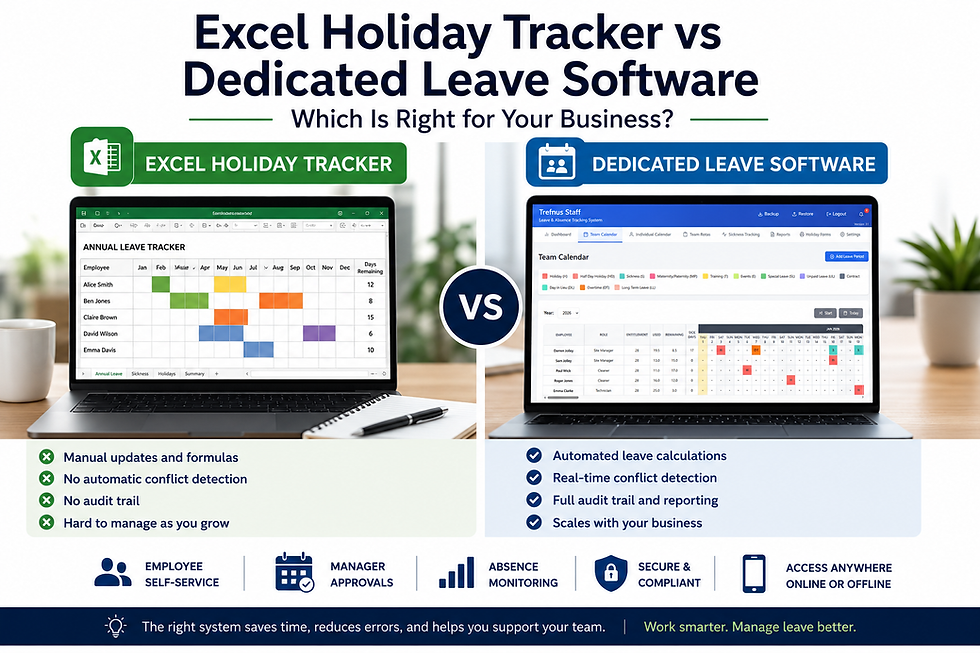
Spreadsheets cope with this until roughly the point where you have more than one working pattern, a mid-year hours change, and a leave year that does not start in January. After that, the formulas quietly drift out of step with reality and nobody notices until a leaver's final payment is disputed. For businesses running several working patterns, a dedicated staff leave management app makes these calculations and records easier to maintain than a shared spreadsheet.
Whatever system you use, it should be able to do the following:
Store an individual entitlement per employee in days or hours, not a single figure applied to everyone.
Run against a leave year start date that matches your business, whether that is January, April or September.
Record holiday taken, carry-over and any payments in lieu, so the statutory record is complete.
Show remaining balance and leave taken at a glance, so employees can check their own position without asking.
Flag clashes before they are approved, particularly where part-time staff share cover for the same days.
Produce a printable or exportable record you can retain for the six-year period and hand to an employee on request.

Tracking part-time leave and meeting the record-keeping duty If your team runs several different part-time patterns, keeping entitlement accurate by hand becomes a weekly chore rather than an annual one. Trefnus Staff is an offline-capable leave and absence tracker built for small and medium UK businesses, with individual leave entitlements per employee, custom leave year start dates, a team calendar for spotting cover gaps, printable leave request cards and Bradford Factor reporting for sickness. It is a one-time purchase with no per-employee licences, and employee data stays under your control. Find out more at: |

Frequently asked questions
How many holidays is a part-time worker entitled to in the UK?
Part-time workers are entitled to 5.6 weeks of paid holiday a year, the same as full-time workers, but calculated in proportion to the days or hours they work. Multiply the number of days worked per week by 5.6 to get the entitlement in days. Someone working three days a week is entitled to 16.8 days, and someone working four days a week is entitled to 22.4 days. If hours vary across the days worked, multiply weekly hours by 5.6 to get the entitlement in hours instead.
Do part-time employees get bank holidays off in the UK?
There is no legal right to paid time off on a bank holiday for any worker, part-time or full-time, and whether bank holidays are paid depends on the employment contract. However, if a bank holiday falls on a day a part-time employee does not normally work, the employer cannot require them to use a day of their holiday entitlement for it. Where a bank holiday does fall on a working day and the business closes, it can be taken as part of the entitlement if the contract says so or notice is given. Many employers give a pro rata bank holiday allowance instead, so an employee working three days a week receives 4.8 days regardless of which weekdays they work.
Can holiday entitlement be rounded down for part-time staff?
No. Statutory entitlement cannot be reduced below the pro rata figure, so 16.8 days cannot become 16 days. Employers may round up as a matter of policy, and many do so for simplicity, but rounding down is an unlawful reduction of statutory leave. Separately, in an employee's first year of employment, leave accrues monthly and fractions of a day are rounded up to the nearest half day under the Working Time Regulations.
How do you calculate holiday for someone who changes from full-time to part-time?
Split the leave year at the date the change takes effect. Work out entitlement for the full-time period as a proportion of the year, then work out entitlement for the part-time period as a proportion of the year at the new rate, and add the two figures together. Subtract any leave already taken. Where the length of the working day has changed, converting all figures to hours before doing the arithmetic avoids discrepancies caused by days of different lengths.
Does the 12.07 per cent method apply to part-time employees?
Only if they are also irregular hours or part-year workers. For leave years beginning on or after 1 April 2024, those two groups accrue holiday at 12.07 per cent of the hours they actually work in each pay period. A part-time employee on fixed, regular hours throughout the year is not in either group and should receive 5.6 weeks pro rata in the usual way. Term-time workers are a common example of part-time staff who may fall under the 12.07 per cent rules, provided they meet the statutory definition of a part-year worker.
What holiday records must employers keep from April 2026?
From 6 April 2026, employers must record holiday taken, holiday carried over from previous leave years, holiday pay including details of what it comprises such as bonuses or commission, and any payments made in lieu of holiday. These records must be kept for at least six years from the date they were made, in any reasonable format including a spreadsheet, payroll system or leave management app, and in line with UK GDPR. Enforcement sits with the Fair Work Agency, and an employer unable to prove they hold the required records could be committing a criminal offence.
What happens to holiday entitlement when a part-time employee leaves?
The employee must be paid for any statutory holiday they have accrued but not taken. Calculate the proportion of the leave year they worked, apply that to their annual pro rata entitlement, and deduct the leave already taken. If they have taken more leave than they accrued, the overpayment can only be recovered from final pay if the employment contract includes an express written clause permitting that deduction.
Conclusion
Calculating holiday entitlement for part-time employees comes down to one principle applied consistently. Everyone gets 5.6 weeks, and a week means whatever a week normally looks like for that person. Multiply days per week by 5.6 for straightforward patterns, use hours for anything uneven, and pro rate bank holidays rather than letting the calendar decide who benefits.
The errors that cause real problems are rarely mathematical. They come from rounding down, forgetting that enhanced allowances must also be pro rated, treating bank holidays inconsistently across the team, or applying the 12.07 per cent accrual method to staff who work regular hours. Document your approach, apply it to everyone, and keep the record current as patterns change.
The April 2026 record-keeping duty raises the cost of getting this wrong, since holiday records must now be retained for six years and are enforceable by the Fair Work Agency. If your leave records have outgrown a spreadsheet, it may be worth looking at a dedicated staff leave management app that holds individual entitlements, custom leave years, carry-over and absence reporting in one place, so the calculations stay right without weekly maintenance.
Further reading and official guidance
Holiday entitlement: GOV.UK, the government overview of statutory leave, including the position for part-time, irregular hours and part-year workers.
Calculate holiday entitlement: GOV.UK calculator, the official tool for checking entitlement across different working patterns.
Checking holiday entitlement: Acas, practical guidance on entitlement, accrual and bank holidays, with worked examples.
Holiday pay and entitlement reforms from 1 January 2024: GOV.UK, detail on the accrual method and rolled-up holiday pay for irregular hours and part-year workers.
Bank holidays and Christmas: Acas, the position on bank holidays falling on non-working days, with worked examples for part-time staff.
Keeping holiday records: Acas, what employers must record from 6 April 2026 and for how long.
The Working Time Regulations 1998: legislation.gov.uk, the underlying legislation setting the 5.6 week entitlement.
Part-time workers' rights: GOV.UK, the less favourable treatment rules that govern pro rata benefits.
Disclaimer
The information in this article is intended for general guidance only and does not constitute professional legal, financial, or regulatory advice. Always consult a qualified professional for advice specific to your circumstances.