How to Manage Repeated Short-Term Absence: UK Employer Guide


Published: June 2026 | Last reviewed: June 2026
Repeated short-term absence is one of the most disruptive and costly challenges facing UK employers today. Unlike a single period of long-term illness, repeated short spells of absence are harder to predict, more difficult to manage fairly, and far easier to overlook until the pattern becomes a serious operational problem.
Whether it is three days off one month and two days the next, or a consistent trend of Monday and Friday absences, managing repeated short-term absence requires a structured, consistent approach grounded in your organisation's policy, accurate records, and genuine employee engagement.
This guide sets out the key principles, legal considerations, and practical steps UK employers can use to address repeated short-term absence effectively and with confidence.
What Is Repeated Short-Term Absence?
Repeated short-term absence refers to a pattern of frequent, brief periods of sickness or other unplanned absence, typically lasting one to five days at a time. Unlike a single long-term illness, each individual absence may seem minor. However, when viewed collectively, the impact on productivity, team morale, and resourcing can be significant.
Common characteristics of repeated short-term absence include:
Multiple distinct absences within a rolling 12-month period
Absences clustered around weekends, bank holidays, or particular working days
A variety of unrelated reasons given for each absence
No single underlying medical condition identified by a GP
It is important to distinguish repeated short-term absence from long-term sickness absence, which typically involves a continuous period away from work due to a diagnosed medical condition. The two situations require different management responses.
Why Managing Repeated Short-Term Absence Matters
Unmanaged absence patterns carry real costs for small and medium-sized businesses. Research consistently shows that absenteeism has direct and indirect costs, including lost productivity, increased pressure on remaining team members, cover costs, and disruption to customer service.
Beyond the financial impact, allowing patterns of absence to go unaddressed can affect team fairness. If some employees perceive that a colleague's absences are never questioned, it can breed resentment and reduce overall morale.
For employers, the risks of failing to act include:
Continued disruption to operations and service delivery
A perception among staff that absence is not taken seriously
Difficulties later justifying formal action if no early intervention was taken
Potential legal exposure if the absence later turns out to be linked to a disability or protected characteristic
Acting early and following a fair, documented process is the most effective protection against both continued disruption and legal risk.
The Legal Framework for Absence Management in the UK
Before taking any formal steps to manage repeated short-term absence, employers must understand the relevant legal framework. The key pieces of legislation include:
Employment Rights Act 1996
Employees have statutory protection against unfair dismissal after two years of continuous employment. Dismissing someone for repeated absence can be fair, but only if the employer has followed a proper procedure, which includes warnings, evidence gathering, and consideration of medical evidence.
Equality Act 2010
If an employee's absences are linked to a disability, as defined under the Equality Act 2010, the employer has a duty to make reasonable adjustments. Frequent short-term absences may be a symptom of a condition the employer is not yet aware of. This is why return-to-work interviews and open dialogue are so important.
Statutory Sick Pay (SSP)
Employees who meet the qualifying conditions are entitled to Statutory Sick Pay for absences of four or more consecutive days. For shorter absences, SSP does not apply, though your contractual sick pay policy may differ. Ensure your policy is clearly documented and consistently applied.
ACAS Code of Practice
The ACAS Code of Practice on disciplinary and grievance procedures is not legally binding, but employment tribunals take it into account when assessing whether an employer acted reasonably. Failing to follow the Code can result in an uplift of up to 25 per cent on any tribunal award.
For detailed guidance, refer to the ACAS advice on managing absence and the GOV.UK guidance on Statutory Sick Pay.
The Foundation: A Clear Absence Management Policy
The single most important tool for managing repeated short-term absence is a clear, written absence management policy. Without it, any action you take risks being seen as inconsistent or unfair.
Your absence management policy should cover:
How and when employees must report absence (for example, calling a manager directly by a set time on the first day)
What documentation is required, and when a fit note from a GP becomes necessary
Whether the company operates trigger points for absence review, such as the Bradford Factor
The return-to-work interview process
The stages of informal and formal management action
How medical evidence will be requested and considered
How disability-related absence will be treated differently
Employees should receive the policy on joining and it should be easily accessible. If managers apply it selectively, you will struggle to defend any formal action taken later.
Return-to-Work Interviews: Your Most Effective Tool
The return-to-work interview is widely recognised as the single most effective method for reducing short-term absence. Yet many small businesses either skip it entirely or treat it as a box-ticking exercise.
A well-conducted return-to-work interview serves several purposes:
It signals to the employee that their absence has been noticed and recorded
It gives the employee an opportunity to raise any underlying issues, including work-related stress, personal problems, or health concerns
It helps the employer identify whether any disability-related adjustment may be needed
It provides a documented record of the conversation
Return-to-work interviews should take place on the first day back from every absence, regardless of how short the absence was. They should be conducted by the employee's direct line manager, in a private setting, and should not feel punitive.
What to Cover in a Return-to-Work Interview
A return-to-work interview does not need to be long. A structured 10 to 15 minute
conversation covering the following is usually sufficient:
A welcome back and acknowledgement of the absence
The reason for the absence, recorded in writing
Whether the employee is now fit to return to full duties
Any adjustments that might help the employee stay at work
An update on any work missed during the absence
A brief note on the employee's absence record, shared with the employee
Example opening questions for a return-to-work interview: "Welcome back. How are you feeling now?" "Is there anything we should be aware of or that we can support you with going forward?" "Are you fit to return to your full duties today, or would any temporary adjustments be helpful?" |
Keep a written record of every return-to-work interview, signed off by both parties where possible.
Using the Bradford Factor to Identify Patterns
The Bradford Factor is a formula used to measure the impact of frequent short-term absences on an organisation. It gives greater weight to frequency than to duration, reflecting the disproportionate disruption that repeated brief absences cause.
Bradford Factor Score = S² x D
(S = number of separate spells of absence in the period; D = total number of days absent)
For example, an employee who has had five separate absences totalling ten days would have a Bradford Factor score of 250 (5 x 5 x 10). An employee who had a single absence of ten days would score just 10 (1 x 1 x 10).
Many organisations use trigger thresholds to flag employees for management review. Common thresholds are:
Bradford Factor Score | Suggested Action |
0 to 49 | No action required; monitor as normal |
50 to 99 | Informal discussion with line manager |
100 to 199 | Formal review meeting, documented warning |
200 to 399 | Final written warning and attendance improvement plan |
400 and above | Potential grounds for dismissal; seek HR/legal advice |
The Bradford Factor is a useful indicator, but it should never be applied mechanically. It does not account for disability-related absence or other protected circumstances, and should always be used alongside qualitative judgement rather than as an automatic trigger for formal action.
Trigger Points and the Absence Review Process
Trigger points give managers a consistent, objective basis for initiating an absence review conversation. Without them, managers may act on instinct or personal preference, which creates fairness risks and inconsistency.
Trigger points can be based on:
The Bradford Factor score reaching a defined threshold
A specific number of absences within a rolling 12-month period (for example, three or more separate occasions)
A total number of days absent within a defined period
A pattern of absences on specific days or around particular events
When a trigger point is reached, the following process is recommended:
Stage 1: Informal Discussion
The line manager meets with the employee to discuss the absence record. The purpose is supportive, not disciplinary.
The manager should:
Explain the concern and share the absence record
Give the employee the opportunity to explain the absences
Explore whether any underlying factors, including health conditions or personal circumstances, are contributing
Agree on a monitoring period and any support that will be offered
Document the discussion and give the employee a copy
If the absence continues or the trigger point is reached again within the monitoring period, move to a more formal stage.
Stage 2: Formal Absence Review Meeting
This meeting is more structured and should follow the principles of the ACAS Code of Practice. The employee should be informed in writing, given the right to be accompanied by a colleague or trade union representative, and the outcome should be documented formally.
At this stage, the employer may:
Issue a first formal warning
Refer the employee for an occupational health assessment
Set clear targets for improvement with a defined review period
Agree a support plan if appropriate
Stage 3: Final Review and Escalation
If improvement targets are not met, the employer may issue a final written warning or, in cases where all reasonable steps have been exhausted and the attendance is unsustainable for the business, may consider dismissal. This step must always be taken with appropriate legal advice. The ACAS Code of Practice applies throughout, and the employee must have had a genuine opportunity to improve.
When to Refer to Occupational Health
Occupational health referrals are not just for long-term illness. If an employee has repeated short-term absences and you are unsure whether there is an underlying medical condition driving the pattern, an occupational health assessment can be very useful.
An occupational health practitioner can:
Assess whether the absences are likely to continue
Advise whether the employee has a disability under the Equality Act 2010
Suggest reasonable adjustments that might reduce future absence
Provide an opinion on fitness to continue in the role
An occupational health report does not bind the employer, but it does provide a medical basis for decision-making and demonstrates that you have acted reasonably. Always obtain the employee's consent before making a referral.
Disability, Mental Health, and Protected Characteristics
Before taking formal action for repeated short-term absence, always consider whether the absences may be linked to a disability or other protected characteristic under the Equality Act 2010.
Conditions that qualify as disabilities are not always obvious and can include:
Mental health conditions such as anxiety, depression, or bipolar disorder
Chronic conditions such as Crohn's disease, fibromyalgia, or migraines
Neurodivergent conditions including ADHD and autism
Progressive conditions even in early stages
If an employee's repeated short-term absences are linked to a disability, the employer has a duty to make reasonable adjustments. These might include flexible start times, adjusted duties, or phased attendance plans.
Failing to consider this before taking formal action could constitute disability discrimination. Where mental health is a contributing factor, a compassionate and supportive approach is more likely to lead to sustained improvement than a purely procedural one.
Keeping Accurate Absence Records
Accurate, up-to-date absence records are not optional when managing repeated short-term absence. They are fundamental. Without them, you cannot identify patterns, calculate Bradford Factor scores, or demonstrate that you have followed a fair process.
Your absence records should capture:
The dates and duration of every absence
The reason given by the employee
Whether a fit note or other documentation was provided
Return-to-work interview notes
Any management action taken and the date
Occupational health referrals and outcomes
Records should be stored securely in line with your obligations under the UK GDPR. Access should be limited to those with a legitimate management need. Absence data relating to health conditions is special category data and must be handled accordingly.
Maintaining records manually across spreadsheets or paper files increases the risk of gaps and inconsistencies. Dedicated absence management tools make it far easier to keep records complete and accessible.

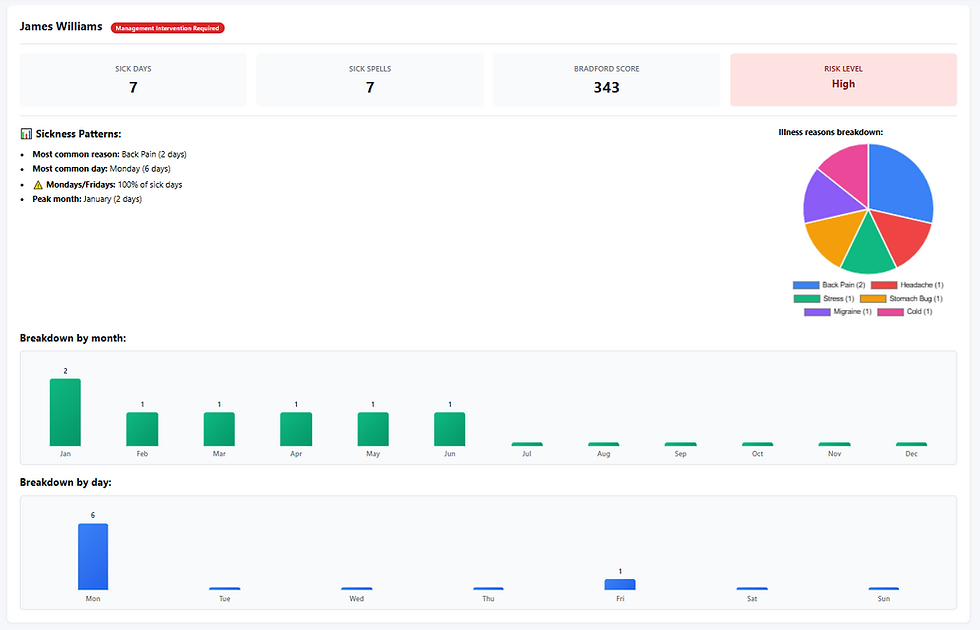
Trefnus Staff: Centralised Absence Records for Your Whole Team Trefnus Staff gives you a single, secure place to record every absence, log return-to-work notes, and track sickness trends across your team. With 36 sickness categories, customisable absence types, and built-in Bradford Factor scoring, it supports consistent absence record-keeping without the need for spreadsheets. Designed for UK SMEs, Trefnus Staff works offline and does not require a cloud subscription, making it a straightforward, cost-effective tool for managers who want to maintain accurate attendance records without complex HR software. Find out more: |

Communicating with Employees About Absence
One of the most common mistakes employers make when managing repeated short-term absence is avoiding the conversation for too long. Early, open, and non-judgmental dialogue is far more effective than waiting until formal action is unavoidable.
When speaking to an employee about their absence record:
Be factual and refer to the documented record rather than impressions
Listen carefully and avoid making assumptions about the cause
Acknowledge that personal circumstances and health issues can be complex
Focus on the impact of the absence on the team and the business, not on blame
Agree on a clear path forward, including any support the employer can offer
Many cases of repeated short-term absence resolve when employees feel their concerns have been heard and when practical adjustments are put in place. Formal action should be a last resort, not a first response.
Frequently Asked Questions
What counts as repeated short-term absence in the UK?
There is no statutory definition of repeated short-term absence in UK employment law. In practice, most HR professionals and employment tribunals consider a pattern of three or more separate absences within a 12-month rolling period to be significant enough to warrant review. The key is frequency rather than duration.
An employee who has had five one-day absences in six months is likely to attract more concern than one who has had a single two-week absence, because the repeated disruption is harder to plan around and the pattern suggests something broader may be happening. Your absence management policy should set out the trigger points your organisation uses, whatever they are, and apply them consistently across all employees.
Can I dismiss an employee for repeated short-term absence?
Yes, dismissal for repeated short-term absence can be a fair dismissal in UK employment law, provided the employer has followed a proper and documented process.
The key requirements are:
The employee has been made aware of their absence record and the concern it raises
They have been given a genuine opportunity to improve, with clear targets and a monitoring period
They have been warned that continued absence may lead to dismissal
Medical evidence has been sought and considered
Any disability-related absence has been properly considered under the Equality Act 2010
Skipping any of these steps significantly increases the risk of an unfair dismissal claim at an employment tribunal. Employers should seek advice from an HR professional or employment solicitor before proceeding to dismissal on absence grounds, particularly where the employee has two or more years of continuous service.
Do I have to pay employees during short-term absence?
Statutory Sick Pay (SSP) is only payable for absences of four or more consecutive days, including non-working days. For absences shorter than four days, SSP does not apply. However, your own contractual sick pay policy may provide for payment during shorter absences, and if so, it must be applied consistently.
Some employers use waiting days, under which no pay is made for the first one, two, or three days of absence, as a deterrent to unnecessary short-term absence. If you introduce or change a waiting days policy, this constitutes a change to terms and conditions of employment and should be handled carefully, with appropriate notice and employee consultation. Always refer to your employment contracts and sick pay policy, and take advice if you are considering a change.
What is the Bradford Factor and should I use it?
The Bradford Factor is a numerical formula used to measure the impact of an employee's short-term absence pattern. It is calculated by squaring the number of separate absence spells (S) and multiplying the result by the total number of days absent (D), giving a score of S squared multiplied by D. Because it squares the number of spells, it gives significantly greater weight to frequency than to duration. An employee with ten separate one-day absences will score far higher than one who was off for ten days in a single spell.
The Bradford Factor is a useful and widely used tool for identifying patterns that merit management attention, but it must be used with judgement. It should never be applied mechanically to trigger formal action without taking into account the reasons for absence, any disability-related considerations, or the wider context. Many organisations use it as a flag for a conversation, not as an automatic gateway to disciplinary action.
How should I record and store absence information?
Every absence should be recorded as it occurs, not retrospectively. Your records should capture the dates, duration, reason given, whether medical evidence was provided, and the outcome of any return-to-work interview.
Under UK GDPR, absence data is personal data, and where it relates to health it is special category data requiring a higher level of protection. It should be stored securely, accessed only by those with a legitimate management need, and retained for no longer than is necessary. Many employers retain absence records for the duration of employment plus up to six years to cover potential tribunal claims, though you should take advice on what is appropriate for your organisation.
Paper records and shared spreadsheets carry greater risk of error and unauthorised access. A dedicated absence management system offers more reliable and auditable record-keeping.
What should a return-to-work interview include?
A return-to-work interview is a brief, structured conversation between a line manager and an employee on the first day back after any absence, however short. It should cover: a welcome back; confirmation of the reason for the absence, recorded in writing; whether the employee is now fit to carry out their full duties; whether any adjustments or support would be helpful; an update on work missed; and a note on the employee's current absence record, shared with them.
The interview should take place in private, feel supportive rather than punitive, and be documented. Both parties should sign the record where possible. Return-to-work interviews are consistently cited as the most effective single intervention for reducing short-term absence, because they signal that absence is noticed and taken seriously, while giving employees an opportunity to raise any underlying issues before they escalate.
Further Reading and Official Guidance
The following sources provide authoritative guidance on absence management in the UK:
ACAS: Managing Absence, https://www.acas.org.uk/managing-absence
GOV.UK: Statutory Sick Pay (SSP), https://www.gov.uk/statutory-sick-pay
GOV.UK: Handling an employee's long-term sickness, https://www.gov.uk/handling-employee-sickness
Equality and Human Rights Commission: Guidance on disability and the Equality Act 2010, https://www.equalityhumanrights.com/en/advice-and-guidance/guidance-employers
ICO: Employment Practices and Data Protection, https://ico.org.uk/for-organisations/uk-gdpr-guidance-and-resources/employment/
Conclusion
Managing repeated short-term absence effectively requires a combination of clear policy, consistent process, accurate records, and genuine employee engagement. There is no single magic solution, but employers who act early, communicate openly, and follow a fair and documented process are far better placed to reduce absence levels and avoid legal risk.
The most important steps are straightforward: have a written absence management policy, conduct return-to-work interviews consistently, keep accurate records of every absence, use trigger points such as the Bradford Factor to identify patterns objectively, and take medical and legal considerations seriously before escalating to formal action.
For small and medium-sized businesses, the administrative burden of absence management can feel significant. Tools such as Trefnus Staff can help by automating Bradford Factor calculations, maintaining absence records, and keeping your team's attendance data in one accessible place, so that managing absence is less about paperwork and more about supporting your people.
Disclaimer
The information in this article is intended for general guidance only and does not constitute professional legal, financial, or regulatory advice. Always consult a qualified professional for advice specific to your circumstances.