Return to Work Interviews Explained: A Manager's Guide

Updated: Jun 19

Published: 15 June 2026 | Last reviewed: 15 June 2026
When an employee returns to work after a period of absence, whether that is a single sick day, a long-term illness, or maternity leave, the first conversation they have with their manager matters. A return to work interview, sometimes called a return to work meeting, is a short, structured discussion held when an employee comes back, designed to welcome them, confirm they are fit to resume their duties, and identify any support they might need. It is one part of a wider absence management process.
For small and medium businesses, return to work interviews are one of the simplest tools for managing sickness absence fairly and consistently. They are not a legal requirement in the UK, but Acas recommends them as good practice in absence management. This guide explains what a return to work interview is, when to hold one, what to ask, and how to record it properly.
What is a return to work interview?
A return to work interview is a brief meeting between an employee and their line manager, held as soon as possible after the employee returns from a period of absence. It is sometimes called a return to work meeting or back to work interview, and the terms are used interchangeably.
The purpose is straightforward. Managers use the conversation to:
Welcome the employee back and check they feel ready to return
Confirm the dates and reason for the absence, for accurate record-keeping
Identify whether any reasonable adjustments or support are needed
Update the employee on anything they missed while away
Spot patterns of absence early, so they can be addressed supportively
It is important that this meeting is not treated as, or confused with, a disciplinary process. The tone should be supportive and informal. If a pattern of absence does need to be addressed formally, that should happen as a separate conversation, following the organisation's normal disciplinary or capability procedure.
Are return to work interviews a legal requirement?
There is no specific UK law that requires employers to hold a return to work interview. It is best understood as risk mitigation and good practice rather than a legal obligation, but for SMEs this distinction matters: skipping it is not unlawful in itself, yet doing so consistently can leave gaps in records and make it harder to demonstrate a fair, consistent approach to absence if a dispute arises later.
Several legal considerations sit around the process and should shape how it is run:
Under the Equality Act 2010, employers must make reasonable adjustments for employees considered to be disabled. A return to work conversation is a useful mechanism for surfacing and agreeing these adjustments, though the legal duty itself arises from the Act, not from the interview
Employees have a statutory right to take sick leave, and the interview should never feel like a deterrent to taking genuine sick days
Applying return to work interviews only to certain staff, or only after certain types of absence, can create a perception of unfair or discriminatory treatment
Acas recommends return to work conversations as good practice in absence management, applied consistently across the organisation.
When should a return to work interview be held?
Timing depends on the type and length of absence. The table below sets out a practical approach for common scenarios.
Type of absence | Recommended approach | Typical duration |
Single day or short illness | Brief, informal welcome-back chat on the first day | 5 to 10 minutes |
Recurring short-term absences | Structured conversation, reviewing the pattern factually | 15 to 20 minutes |
Long-term sickness absence | Planned meeting, often with occupational health input | 30 minutes or more |
Maternity, paternity or shared parental leave | Supportive discussion covering KIT days, handover and any changes | 20 to 30 minutes |
Compassionate or bereavement leave | Sensitive, employee-led conversation focused on support needs | Varies by case |
As a general principle, hold the conversation on the employee's first day back, or as soon as practical afterwards, while the details are still fresh and before the employee has been thrown back into a full workload.
How to conduct a return to work interview
A return to work interview does not need to be complicated, but a little structure helps ensure consistency and creates a useful record. The following steps work well for most short-term absences.
Find a private space. The conversation should take place somewhere quiet, away from colleagues, so the employee feels comfortable being open
Set the tone early. Remind the employee this is a routine welcome-back conversation, as outlined above
Confirm the details. Check the dates of absence and the reason given, and record these accurately
Ask how they are feeling. Give the employee space to mention anything relevant, including ongoing symptoms, without pressing for unnecessary medical detail
Discuss any support needed. This might include a phased return, temporary changes to duties, or referral to occupational health
Update them on work. Briefly cover anything important that happened while they were away, so they do not feel out of the loop
Note any patterns. If this is part of a recurring pattern, mention it factually and refer to the absence policy if appropriate
Record and sign off. Both manager and employee should agree the record reflects the conversation, and the employee should receive a copy
Sample return to work interview questions
The exact questions will vary depending on the type of absence, but the following examples cover the most common ground for a short-term sickness absence.
How are you feeling, and do you feel ready to be back at work?
Can you confirm the dates you were off and the reason for your absence?
Is there anything we need to put in place to support you, such as adjusted duties or hours?
Is there anything about your role or the workplace that contributed to this absence?
Is there anything you'd like to raise or ask before we finish?
For longer absences, particularly those related to ongoing health conditions, questions should focus more on practical support, any medical guidance received, and a plan for a phased return where appropriate.
Return to work interviews and the Bradford Factor
Many UK employers use the Bradford Factor as part of their absence management approach. It is a formula that gives more weight to frequent, short, unplanned absences than to a single longer absence, on the basis that frequent short absences tend to be more disruptive to a team.
Return to work interviews are a natural point at which to record the data that feeds into Bradford Factor scoring, including the number and length of absence episodes. Recording this information consistently makes it easier to spot patterns and to have evidence-based conversations later if attendance becomes a concern.
While widely used, the Bradford Factor should be treated as a screening tool rather than a standalone decision-making system. It does not account for underlying health conditions, disabilities, or other protected characteristics, so a high score should prompt a closer look and a conversation, not an automatic outcome. Managerial judgement, and where relevant occupational health or HR input, should always sit alongside the score.
Manually tracking absence dates, reasons, and Bradford Factor scores across a growing team can quickly become time-consuming, particularly when records are spread across spreadsheets, paper forms, and emails.

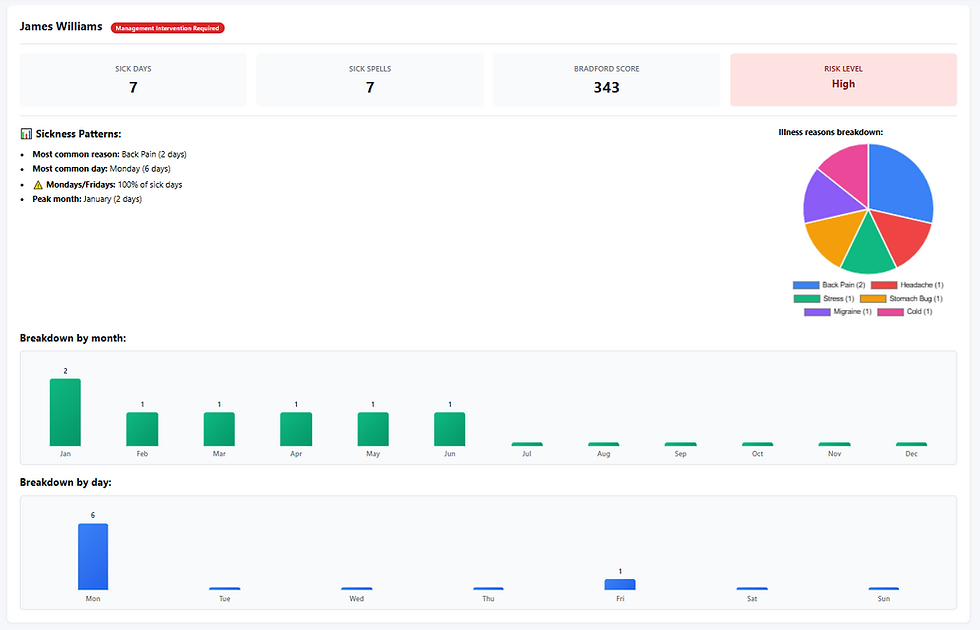
Tool example: Trefnus Staff Trefnus Staff is a leave and absence management tool designed for small and medium organisations. It tracks holidays, sickness absence, and Bradford Factor scores, giving managers a clearer picture of an employee's absence history ahead of a return to work conversation. It is built as an offline-first app, with data stored locally on the device rather than requiring a constant internet connection. Find out more about Trefnus Staff: |

Recording the return to work interview
A short written record of the conversation should be kept, even for brief absences. This protects both the employer and the employee, and creates a consistent, factual log over time.
A good record typically includes:
The employee's name and the date of the meeting
The dates and length of the absence
The reason given for the absence
Any support, adjustments, or follow-up actions agreed
Signatures, or a digital confirmation, from both the employee and the manager
The employee should be given a copy of the record, or access to it, so there is no ambiguity later about what was discussed and agreed.
Common mistakes to avoid
Treating the meeting as a disciplinary discussion, which can damage trust and discourage employees from taking genuine sick leave
Only holding interviews after long absences, or only for certain employees, which can appear inconsistent or unfair
Asking for excessive medical detail beyond what is needed to support the employee and update records
Failing to follow up on agreed adjustments or support, which undermines the purpose of the conversation
Not keeping any written record, which makes it difficult to identify patterns or demonstrate a consistent process later
Frequently Asked Questions
Is a return to work interview a legal requirement in the UK?
No, there is no UK law that requires employers to hold a return to work interview. However, it is widely recommended as best practice by Acas, and it supports compliance with other obligations, such as making reasonable adjustments under the Equality Act 2010 for employees with a disability.
How long should a return to work interview last?
For a single day or short illness, a brief informal chat of around five to ten minutes is usually sufficient. Longer or more complex absences, such as long-term sickness or a return from maternity leave, may need a more structured meeting of twenty to thirty minutes or longer, ideally planned in advance.
Should every absence trigger a return to work interview?
Best practice, in line with Acas guidance, is to hold some form of return to work conversation after every absence, regardless of length, so that employees know absence is consistently noticed. The depth of the conversation should be adjusted to suit the type and length of absence, but consistency helps avoid any perception of unfair treatment.
Can a return to work interview be used as evidence in a disciplinary process?
The factual record from a return to work interview, such as dates, reasons, and any patterns discussed, can form part of the evidence base if a separate disciplinary or capability process is later started due to attendance concerns. However, the return to work interview itself should not be conducted as, or presented as, a disciplinary meeting.
What should happen if an employee discloses a health condition during the interview?
If an employee discloses a health condition that may amount to a disability under the Equality Act 2010, the employer should consider whether reasonable adjustments are needed to support the employee's return, and may wish to seek advice from occupational health. Any information shared should be handled sensitively and in line with the organisation's data protection obligations.
Do return to work interviews actually reduce absence levels?
Many HR organisations report that consistent return to work interviews are associated with reductions in short-term absence, often attributed to employees knowing that absence is noticed and discussed. The effect tends to be strongest when interviews are conducted consistently, supportively, and as part of a wider absence management approach rather than as an isolated tactic.
Final thoughts
Return to work interviews are a small investment of time that can make a meaningful difference to how absence is managed across a business. Done well, they reassure employees that they are valued, surface support needs early, and give managers the consistent records they need to spot patterns fairly.
The key is consistency: the same approach, applied to every employee, every time, with a tone that is supportive rather than punitive. Keeping clear, organised records of absences and return to work conversations makes this far easier, particularly as a team grows.
If your organisation is still tracking leave and absence manually, it may be worth exploring tools that bring this information together in one place, making return to work conversations more productive and absence patterns easier to spot.
Further Reading and Official Guidance
Disclaimer: The information in this article is intended for general guidance only and does not constitute professional legal, financial, or regulatory advice. Always consult a qualified professional for advice specific to your circumstances.