The Bradford Factor Score: A Practical Guide to Managing Staff Absence
- Trefnus Editorial Team

- May 10
- 6 min read

Introduction
Managing staff absence is one of the most persistent challenges for small and medium-sized businesses. A single employee who takes frequent short, unplanned days off can disrupt operations far more than a colleague who takes one extended period of sick leave. Yet many businesses lack a consistent, objective way to identify and address this pattern.
The Bradford Factor score is a widely used HR tool that provides exactly that: a simple, numerical method for measuring and monitoring short-term, unplanned absenteeism. This guide explains what it is, how to calculate it, and how to use it fairly and effectively within your business.
What Is the Bradford Factor Score?
The Bradford Factor is a formula developed at the University of Bradford in the 1980s. It was designed to highlight the disruptive effect of frequent short-term absences compared to longer, single periods of leave. The underlying principle is straightforward: repeated, unpredictable absences cause greater disruption to a business than one longer, planned absence, even if the total number of days lost is the same.
For example, an employee who takes ten separate one-day absences over a rolling period has a far higher Bradford score than a colleague who takes one ten-day absence. The formula reflects the operational impact, not just the raw number of days lost.
The Bradford Factor Formula
Bradford Score = S x S x D
Where:
S = the number of separate absence occasions in the rolling period
D = the total number of days absent in the same rolling period
Most organisations apply the formula over a rolling 52-week period, though some use 26 weeks. The key is consistency: whatever period you choose should be applied equally across all employees.
A Quick Example
Employee A takes 5 separate absences totalling 10 days: Bradford score = 5 x 5 x 10 = 250
Employee B takes 1 absence of 10 days: Bradford score = 1 x 1 x 10 = 10
Both employees have been absent for ten days in total. But Employee A has a score 25 times higher, reflecting the repeated disruption their pattern creates.
Bradford Factor Score Thresholds: A Reference Guide
Most organisations use threshold bands to trigger different levels of management action. While there is no legal requirement to use specific thresholds, the following bands are commonly applied in UK workplaces:
Bradford Score Range | Risk Category | Recommended Action |
0 to 49 | Low | No action required; monitor as normal |
50 to 99 | Low to Medium | Informal conversation; check for any underlying issues |
100 to 199 | Medium | Formal review meeting; document discussion outcomes |
200 to 399 | High | Written warning; set attendance improvement targets |
400 and above | Very High | Final warning or disciplinary process; consider occupational health referral |
These thresholds should be outlined clearly in your absence management policy and communicated to all employees. They are intended as triggers for conversation, not automatic disciplinary action.
Why Use the Bradford Factor? The Case for Objective Measurement
Without a structured method, absence management often relies on a manager's subjective impression. This can lead to inconsistency, unconscious bias, and, in some cases, employment tribunal claims. The Bradford Factor offers several important advantages for small and medium-sized businesses.
Consistency Across the Workforce
Because the formula applies the same calculation to every employee, it removes the risk of different managers applying different standards. An employee in one department is assessed on the same basis as one in another, which supports a fair and defensible process.
Early Identification of Problematic Patterns
The Bradford Factor is particularly effective at catching absence patterns that might otherwise go unnoticed. A series of Monday absences, or frequent single days around bank holidays, will generate a high score quickly, prompting a timely management conversation before the pattern becomes entrenched.
A Documented Basis for Action
If absence management ever needs to be escalated, a clear numerical record provides a documented basis for any action taken. This is particularly important in the event of an employment dispute.

Trefnus Staff: Automated Bradford Factor Tracking Trefnus Staff calculates Bradford Factor scores automatically for every employee, so you never have to run the formula manually. With real-time dashboards, absence trend tracking, and configurable alerts, it gives managers the visibility they need to address issues early and fairly. Explore Trefnus Staff at: |

How the Bradford Factor Compares to Other Absence Monitoring Methods
The Bradford Factor is one of several tools available to managers. Understanding how it sits alongside other approaches helps you choose the right combination for your business.
Method | What It Measures | Objective? | Handles Frequency? |
Bradford Factor | Pattern of short-term absences | Yes | Yes |
Total Days Lost | Volume of absence | Yes | No |
Manager Observation | General attendance and attitude | No | Depends on manager |
Return-to-Work Interviews | Context and wellbeing | Partially | No |
Most effective absence management strategies combine the Bradford Factor with return-to-work interviews. The score flags patterns; the interview provides context. Together, they give a fuller picture than either approach alone.
How to Implement the Bradford Factor in Your Business
Introducing the Bradford Factor effectively requires more than just applying a formula. Without proper communication and a clear policy, employees may perceive it as punitive rather than supportive. The following steps will help you roll it out fairly.
Step 1: Write or Update Your Absence Management Policy
Your policy should set out how the Bradford Factor is calculated, which rolling period applies, what the threshold bands are, and what action each band triggers. The policy should be shared with all employees and accessible at any time.
Step 2: Communicate Clearly Before You Begin
Employees should understand the system before it is applied. Explain that the Bradford Factor is a tool for identifying patterns and starting conversations, not an automatic route to disciplinary action. Transparency builds trust and reduces anxiety.
Step 3: Carry Out Return-to-Work Interviews
Each absence occasion should be followed by a brief return-to-work interview. This is not a formal disciplinary meeting, but a supportive conversation to understand the reason for absence and check on the employee's wellbeing. It also ensures the absence is recorded accurately, which feeds directly into the Bradford calculation.
Step 4: Review Scores Regularly
Bradford scores should be reviewed at regular intervals, typically monthly or quarterly, rather than only when a threshold is crossed. Regular review allows you to spot trends early and act proportionately.
Step 5: Train Your Managers
Managers need to understand how the score works, what the thresholds mean, and how to conduct absence review conversations sensitively. A well-trained manager will use the Bradford Factor as a tool for support, not as a stick to beat employees with.
Limitations of the Bradford Factor: What to Watch Out For
Used well, the Bradford Factor is a genuinely useful management tool. However, it has limitations that every employer should be aware of.
It Does Not Account for the Reason for Absence
The formula treats every absence the same, regardless of whether it relates to a serious medical condition, a disability, or a casual attitude to attendance. Employers must apply their absence policy with sensitivity. Where absences are related to a disability, taking disciplinary action based solely on a Bradford score could constitute disability discrimination under the Equality Act 2010.
It Can Penalise Employees with Chronic Conditions
An employee managing a long-term condition may accumulate a high Bradford score over time, even if their absences are entirely legitimate and unavoidable. In such cases, the score should prompt a supportive conversation and, where appropriate, an occupational health referral, not an automatic escalation.
It Should Not Stand Alone
The Bradford Factor is most effective as part of a broader absence management framework that includes return-to-work interviews, clear policies, and consistent management. Relying on the score alone, without context or conversation, is both unfair and legally risky.
Common Mistakes to Avoid When Using the Bradford Factor
Failing to communicate the system to employees before applying it
Using different rolling periods for different employees or departments
Applying automatic sanctions based on the score alone, without a management conversation
Ignoring the underlying reasons for absence, including disability, caring responsibilities, or genuine illness
Not updating or reviewing the policy as employment law and best practice evolve
The Bradford Factor and Leave Tracking Software
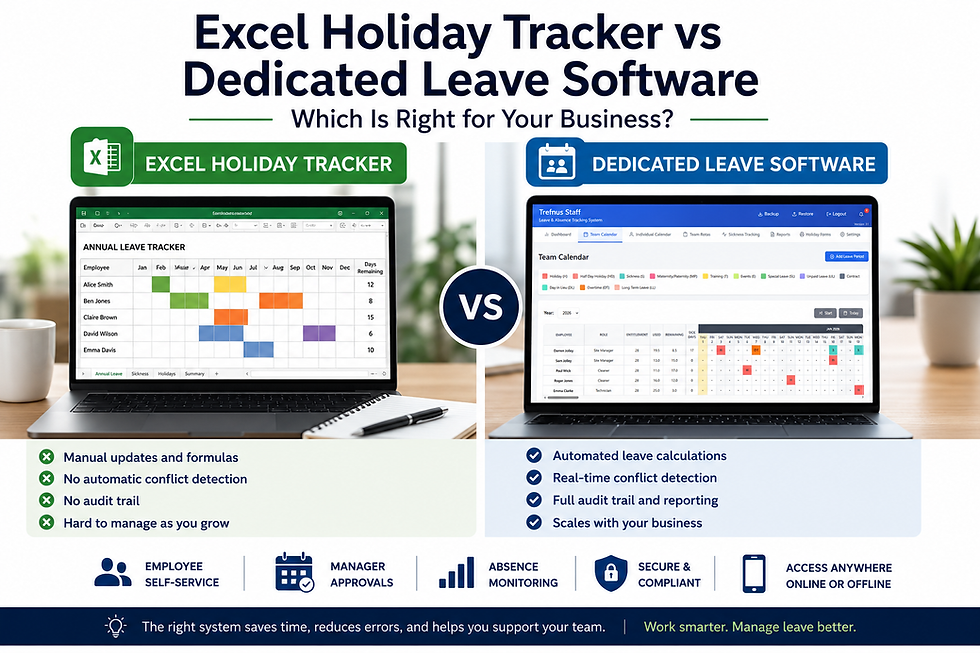
Calculating Bradford scores manually is time-consuming and error-prone, particularly as your team grows. A single miscounted absence occasion or missed rolling period can distort the score significantly. Dedicated absence management software removes this burden by automating the calculation and keeping a reliable, auditable record for every employee.
Trefnus Staff is a purpose-built absence management application for small and medium-sized businesses. It tracks every type of absence, calculates Bradford Factor scores automatically, and provides managers with clear, up-to-date dashboards showing which employees require attention. The system also handles holiday entitlement, shift rotas, and sickness tracking, making it a comprehensive tool for day-to-day workforce management. You can explore Trefnus Staff at trefnus.com/staff.
Conclusion
The Bradford Factor score is a straightforward, objective, and widely respected tool for managing short-term staff absence. By assigning a numerical value to absence patterns, it helps managers identify problems early, act consistently, and maintain a clear record of their decisions. Used alongside return-to-work interviews, a clear absence policy, and genuine support for employees, it can significantly reduce the disruption that unplanned absences cause.
For small and medium-sized businesses, where every absence has a direct impact on operations, having a reliable system in place is not a luxury. It is a practical necessity. If you are not yet tracking Bradford scores, now is a good time to start.
Disclaimer The information in this article is intended for general guidance only and does not constitute professional legal, financial, or regulatory advice. Always consult a qualified professional for advice specific to your circumstances.